Silicon emulsion textiles chemicals industries manufacture silicone emulsions used for fabric finishing and performance enhancement. These emulsions improve textile properties like smoothness, wrinkle resistance, and hydrophobic behavior. With demand rising across apparel, home furnishing, and industrial textiles, these industries form a crucial link between textile processing and advanced chemical innovation. What defines their growing importance in today’s textile value chain?
Key Takeaways
- Silicon emulsions are essential for textile finishing and softening.
- They impart superior pliability and a soft, luxurious touch to fabrics.
- India plays a major role in global silicon emulsion production.
- Manufacturing involves precise emulsification and quality control.
- Sustainable and innovative emulsions define the industry’s future.
What Are Silicon Emulsion Textiles Chemicals Industries and Their Core Functions?
Silicon emulsion textiles chemicals industries focus on developing silicone-based formulations that improve fabric quality and process efficiency. Their primary functions include:
- Enhancing fabric hand feel, softness, and drape
- Reducing friction during sewing and processing
- Increasing fabric durability and abrasion resistance
- Providing water repellency and crease resistance
Amino silicone emulsions, in particular, are valued for delivering permanent softness and elasticity without compromising fabric strength.
How Are Silicon Emulsions Classified in Textile Chemical Applications?
Within textile finishing applications, silicon emulsions are grouped by their molecular composition and intended functional use:
| Type | Description | Application |
| Amino Silicone Emulsion | Contains reactive amino groups | Premium softness, stretch fabrics |
| Non-Ionic Silicone Emulsion | Stable and compatible with other agents | Blended fabric finishing |
| Micro Silicone Emulsion | Ultra-fine particles for uniform coating | High-sheen and smooth surfaces |
| Macro Silicone Emulsion | Larger droplets for bulk softness | Towels, denims, and upholstery |
These emulsions differ in molecular weight and emulsion particle size, directly influencing softness and surface smoothness.
What Are the Key Industrial Applications of Silicon Emulsion Textile Chemicals?
Silicon emulsion textile chemicals industries serve diverse textile segments, including:
- Garments: Enhancing comfort, flexibility, and feel
- Home Textiles: Used in curtains, upholstery, and towels for silky finishes
- Technical Textiles: Providing heat and chemical resistance in protective clothing
- Denim Finishing: Offering smoothness and abrasion protection
They are often discussed alongside textile auxiliaries, dyeing agents, and coating chemicals used in finishing operations.
How Do Silicon Emulsion Textile Chemicals Industries in India Contribute to Global Supply Chains?
India is a major hub for silicon emulsion textile chemicals due to its robust textile manufacturing ecosystem. Key factors driving its growth include:
- Competitive manufacturing from regions like Gujarat and Maharashtra
- Conformance with worldwide safety and quality standards, including REACH and OEKO-TEX®.
- Presence of leading manufacturers like Fineotex, Adarsha, LN Chemicals, and Om Tex
- Export partnerships supporting garment clusters across Asia, Europe, and Africa
Indian producers integrate R&D and sustainable chemistry to meet global textile finishing demands.
What Are the Advantages of Using Amino Silicone Emulsion in the Textile Industry?
Amino silicone emulsions offer superior surface properties and long-lasting softness. Advantages include:
- Enhanced hand feel and bounce
- Resistance to yellowing during heat treatment
- Compatibility with non-ionic and cationic systems
- Low foaming and easy dilution
These emulsions are widely used by textile chemical manufacturers in India to improve high-end apparel and technical fabrics.
How Does the Silicone Softener Manufacturing Process Work?
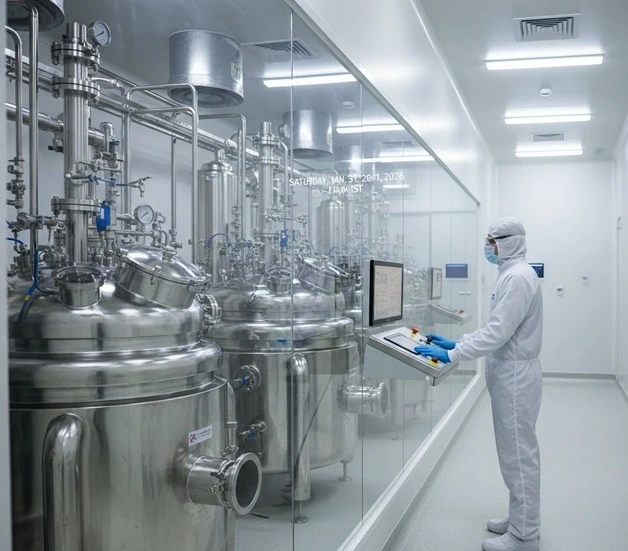
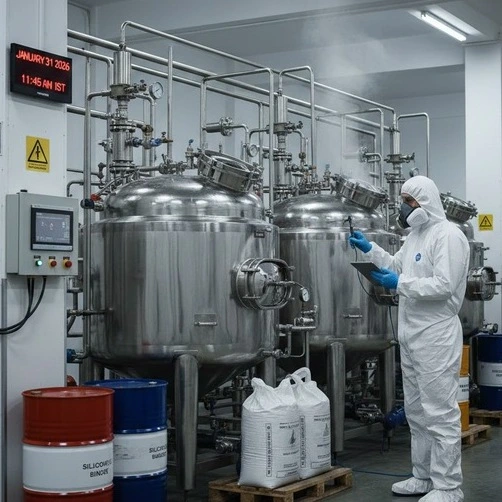
The silicone softener manufacturing process involves controlled emulsification of silicone oil using surfactants and stabilizers:
- Base Preparation: Mixing silicone oil with emulsifiers under agitation.
- Emulsification: High-shear blending creates stable particle dispersion.
- pH Adjustment: Maintaining neutral to slightly acidic conditions.
- Filtration and Packaging: Ensures purity and uniformity for textile finishing applications.
Manufacturers like Mr. Silicone and LN Chemical Industries ensure consistency through quality testing at every stage.
Which Silicon Emulsion Textile Chemicals Products Are Most Commonly Used?
Common silicon emulsion products in textile chemicals industries include:
- Amino Silicone Softener
- Hydrophilic Silicone Emulsion
- Non-yellowing Silicone Softener
- Cationic Silicone Emulsion
- Micro Silicone Emulsion
These are essential components across textile finishing lines, enabling both performance and sustainability in final fabrics.
Conclusion
Silicon emulsion textiles chemicals industries continue to advance fabric finishing through innovation, sustainability, and global-standard manufacturing. Their classification—from amino to hydrophilic emulsions—illustrates the chemical diversity driving modern textile excellence. To complement this, sustainable practices are also gaining importance in every natural textiles chemical company, ensuring responsible textile processing for the future.
FAQ
What is the primary use of silicon emulsion in textiles?
It is used to enhance softness, smoothness, and water repellency in fabric
What are the main types of silicone emulsions?
Amino, non-ionic, cationic, and micro silicone emulsions are commonly used in textile finishing.
Are silicon emulsions safe for all fabrics?
Yes, when applied under recommended concentrations and conditions, they are suitable for most textile substrates.
Which countries lead in silicon emulsion textile chemical manufacturing?
Owing to robust chemical and textile infrastructures, India, China, and Germany remain top manufacturing hubs.
What is the advantage of amino silicone emulsions over regular softeners?
They provide durable softness and elasticity without affecting fabric color or texture.
Sources
https://fineotex.com/textile-chemicals/finishing-process/silicone-emulsions/#:~:text=There%20are%20several%20manufacturers%20of,to%20fabric%20manufacturers%20and%20processors.
https://dir.indiamart.com/impcat/amino-silicone-emulsion.html
https://fineotex.com/helpie_faq/silicone-emulsion-manufactures-for-textile-and-what-are-the-functions-of-silicone-emulsion-in-textile/
https://www.lnchemicals.com/silicone-emulsions.html
https://adarsha.co/products/silicone-emulsion-manufacturers-in-india
https://www.omtexchem.com/silicone-emulsions.html
https://www.mrsilicone.in/silicone-emulsion.html
https://www.lnchemicalindustries.com/textile-softeners.html