
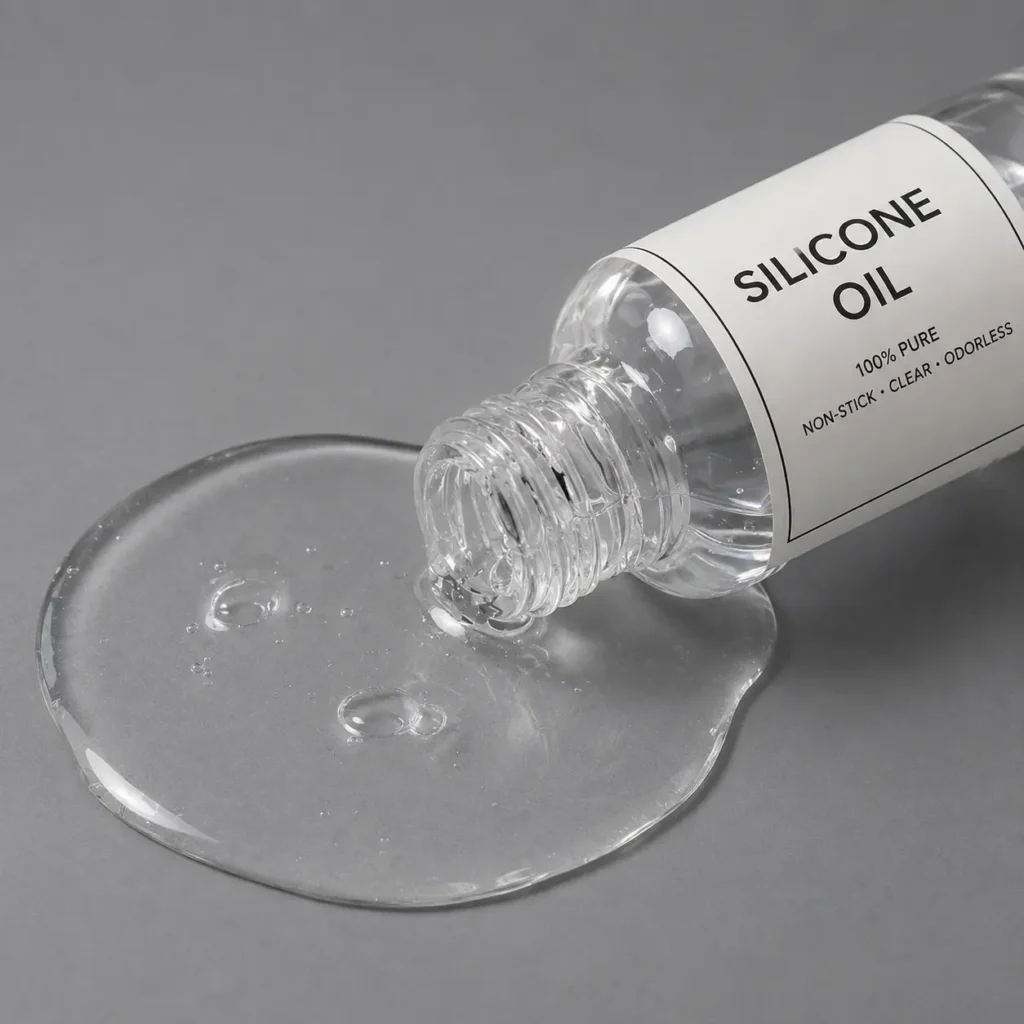
Silicone oil is a family of synthetic siloxane fluids used in applications ranging from lubrication and cosmetics to electronics and specialized eye surgery. Polydimethylsiloxane (PDMS) is one of the most widely used silicone fluids. Its adjustable viscosity, low surface tension, chemical stability, and water-repellent behavior explain much of its versatility. However, silicone oil is not one universal product: grade, purity, formulation, and intended use matter.
Key Takeaways
- Silicone oil is a family of silicone-based fluids, with PDMS being one of the most common examples.
- Its adjustable viscosity, low surface tension, chemical stability, and water-repellent behavior make it useful across many industries.
- Common applications include lubrication, damping, mold release, antifoaming, cosmetics, electronics, and selected medical procedures.
- A higher-viscosity silicone oil is not automatically better; the appropriate viscosity depends on the application.
- Ophthalmic silicone oil is a specially manufactured medical material used as a retinal tamponade in selected complex retinal cases.
- Some complications of intraocular use are well recognized, while the causes of certain forms of visual loss remain under investigation.
What Is Silicone Oil?
Silicone oil is a liquid silicone polymer made from repeating siloxane units, with organic groups attached to the silicon atoms. One of the most important examples is polydimethylsiloxane, commonly abbreviated as PDMS.
Unlike petroleum-derived mineral oils, PDMS has a backbone containing alternating silicon and oxygen atoms. This structure contributes to useful properties such as low surface tension, water repellency, flexible flow behavior, and resistance to many forms of chemical and thermal stress.
The term silicone oil therefore describes a category rather than one single specification. Different molecular structures, chain lengths, side groups, and purification levels can produce fluids with very different behavior.
That is why viscosity, purity, formulation, and intended use should always be checked before selecting a product.
How Does Silicone Oil Work and Why Is It So Versatile?
Silicone oils are commonly sold in standard viscosity grades measured in centistokes (cSt), such as 100, 350, 1000, 5000, and 10000+ cSt. Lower grades flow easily and spread quickly, while higher grades are thicker and resist movement more strongly. Viscosity is chosen to match the application: lower grades suit thin films and easy spreading, medium grades are common for general lubrication and mold release, and higher grades are typically selected for damping, where controlled resistance to motion is needed. Operating temperature, the surfaces involved, and the required film thickness also influence the choice.
Several physical properties explain why silicone oil appears in so many unrelated fields.
Viscosity describes how strongly a liquid resists flowing. A low-viscosity silicone fluid moves readily, while a high-viscosity grade flows much more slowly. Changes in molecular chain length and molecular weight can substantially change viscosity.
Silicone fluids generally have low surface tension, allowing them to spread efficiently across many surfaces and form thin films. This helps explain their use in cosmetics, lubricants, release agents, coatings, and specialized surface technologies.
The siloxane structure also contributes to useful chemical and thermal stability. However, stability should not be interpreted as universal compatibility: performance depends on the exact formulation, temperature, surrounding materials, additives, and duration of exposure.
Many silicone fluids are strongly hydrophobic and have very low water solubility. That property is useful when a formulation needs water resistance, surface protection, or a low-affinity film.
What Are the Main Uses of Silicone Oil?
Silicone oil is used in a wide range of applications because different industries take advantage of different properties.
Lubrication
Silicone fluids can reduce friction between compatible surfaces and are used in selected mechanical, plastic, rubber, textile, and specialty applications. They are not a universal replacement for mineral or synthetic hydrocarbon lubricants, especially where a system requires particular load-bearing or extreme-pressure performance.
Damping
Higher-viscosity silicone fluids can resist movement in a controlled way. This makes them useful in damping systems, gauges, instruments, shock-control devices, and mechanisms where unwanted vibration or rapid movement needs to be reduced.
Mold Release
A thin silicone film can reduce adhesion between a material and a mold. This is useful in manufacturing plastics, rubber products, and other molded components. The same low-adhesion property can become a problem if silicone contamination later interferes with painting, bonding, or coating.
Antifoaming
Silicone-based materials are widely used to control unwanted foam. Their low surface tension allows them to interact efficiently with foam films. The exact formulation matters because an antifoam is normally an engineered product rather than simply unmodified silicone fluid.
Electronics and Electrical Applications
Certain silicone fluids provide useful dielectric and thermal characteristics and are used in specialized electrical and electronic applications. The exact electrical performance depends on the formulation and operating conditions.
How Is Silicone Oil Used in Cosmetics and Personal Care?
Silicone-derived ingredients are common in cosmetics and personal-care products because they can improve spreadability, lubrication, shine, softness, and the sensory feel of a formulation.
Dimethicone is one familiar example. Silicone ingredients used in personal care can provide a smooth feel and help form water-resistant films on skin or hair.
That does not mean every technical silicone oil is suitable for direct skin application. Cosmetic ingredients have specifications appropriate to their intended formulations, while industrial fluids may have different additives, impurities, or manufacturing requirements.
The practical rule is simple: use a silicone product for its labeled purpose rather than assuming that all silicone fluids are interchangeable.
Why Is Silicone Oil Used in Eye Surgery?
One of the most specialized uses of silicone oil is as an intraocular tamponade during vitreoretinal surgery.
In selected complex retinal detachments, a surgeon may use specially manufactured ophthalmic silicone oil to help support the retina after surgery. It has been used particularly in difficult cases involving conditions such as proliferative vitreoretinopathy, giant retinal tears, trauma, and selected tractional retinal detachments.
Its physical properties are important here. Silicone oil is transparent, has suitable interfacial behavior, and can remain in the eye until it is surgically removed.
Unlike an intraocular gas bubble, silicone oil is not absorbed on the same timetable and does not behave the same way with changes in atmospheric pressure. This can make it useful in selected patients who need a longer-lasting internal tamponade or who cannot follow some postoperative restrictions.
This is a highly specialized medical application. Ophthalmic silicone oil should not be confused with ordinary industrial silicone fluid.
What Are the Risks of Silicone Oil in the Eye?
Silicone oil can be an effective retinal tamponade, but intraocular use can be associated with complications.
Reported complications include elevated intraocular pressure, glaucoma, cataract, corneal changes, emulsification, residual oil droplets, and other ocular abnormalities.
Some mechanisms are well understood, while others remain under investigation.
For example, emulsified oil droplets can migrate within the eye and may interfere with aqueous outflow or interact with ocular tissues. Emulsification is influenced by multiple factors, including time, inflammation, surfactants, impurities, and mechanical forces.
What Does Silicone Oil Emulsification Mean?
Emulsification occurs when a larger oil phase breaks into smaller droplets.
Inside the eye, these droplets can become clinically important because they may move into areas where the original oil bubble would not normally be present. Mechanical forces and substances that alter the oil-water interface can influence this process.
Longer exposure can increase the opportunity for emulsification, although duration is not the only factor. The type and viscosity of the oil, surgical conditions, inflammation, and other factors can also matter.
Is Higher-Viscosity Silicone Oil Better?
Not necessarily. Higher-viscosity silicone oil can be more resistant to emulsification in some settings, but it is also more difficult to inject and remove.
Clinical studies comparing 1,000-cSt and 5,000-cSt silicone oils have not established one viscosity as the universal choice for every retinal case. Outcomes can be broadly similar while individual trade-offs differ.
The important point is that viscosity is one part of a larger clinical decision. A thicker oil is not automatically safer or more effective in every situation.
What Does Current Research Say About Silicone Oil and Vision Loss?
Unexplained visual loss after silicone-oil use or removal is an area where scientific caution is especially important.
Recent reviews describe associations between silicone-oil-related visual loss and structural or functional retinal abnormalities reported in some studies. However, there is not yet a single accepted explanation for every case, and differences among surgical techniques, patient populations, and testing methods make the evidence difficult to interpret.
A 2026 systematic review and meta-analysis examined unexplained visual loss after silicone-oil removal and found reported events across several retrospective cohorts. The authors emphasized important limitations, including study selection and low-to-moderate certainty of evidence. These findings show an observed association in the available cohorts; they do not establish that silicone oil independently causes every case of postoperative visual loss.

Is Silicone Oil Safe?
There is no single safety answer for every silicone oil.
Safety depends on the exact chemical formulation, purity, viscosity, additives or impurities, route and duration of exposure, intended application, and manufacturing specifications.
A medical-grade ophthalmic product, cosmetic ingredient, food-use material, and industrial fluid can have very different requirements even when all are described using the word silicone.
For workplace or industrial use, the manufacturer’s technical documentation and safety data should be followed. For medical use, decisions about silicone-oil treatment and removal should be made by the treating specialist.
Silicone Oil vs. Mineral Oil: What Is the Difference?
Although both are called oils, their chemistry is fundamentally different.
Mineral oil is primarily composed of hydrocarbon molecules, whereas silicone oils such as PDMS contain a silicon-oxygen backbone with organic groups attached to the silicon atoms.
That structural difference affects viscosity behavior, surface tension, water interaction, thermal performance, and other physical characteristics.
Neither material is automatically better. The correct choice depends on what the fluid is expected to do.
Silicone Oil vs. Silicone Grease: Are They the Same?
Silicone oil is a fluid; silicone grease is a thickened semisolid formulation.
A grease is generally designed to remain where it is applied more effectively, while an oil can flow and spread. They may share silicone chemistry, but they are not interchangeable products.
A mechanism or seal specified for silicone oil should not automatically be treated with silicone grease unless the manufacturer specifically permits it.
Faqs
Is 1,000-cSt or 5,000-cSt silicone oil better?
Neither is universally better. Higher-viscosity oil can be more resistant to emulsification in some settings but is harder to inject and remove. Clinical studies have not established one viscosity as the universal choice for every retinal case.
How long can silicone oil stay in the eye?
There is no single duration that applies to every patient. Silicone oil may be retained for an extended period when clinically necessary, but prolonged retention can increase opportunities for complications. Removal timing is individualized by the retinal surgeon.
Can silicone oil damage the eye?
It can be associated with complications including elevated intraocular pressure, glaucoma, cataract, corneal changes, emulsification, and other ocular abnormalities. Risks vary with the clinical situation, duration of tamponade, surgical factors, and patient-specific variables.
Why is silicone oil put in the eye?
Specially manufactured ophthalmic silicone oil can act as a long-term internal tamponade after selected retinal surgeries. It helps support the retina while the surgical repair stabilizes. Its use is generally reserved for particular clinical situations rather than routine retinal surgery.
Is silicone oil safe for skin?
Some silicone-derived ingredients, including dimethicone, are intentionally formulated for cosmetic and dermatological use. That does not mean every industrial or technical silicone oil is appropriate for skin. Use only products formulated and labeled for the intended application.
Is silicone oil the same as dimethicone?
Dimethicone is a specific silicone-based material commonly used in cosmetics and personal-care products. The terms can overlap in some contexts, but they should not be treated as perfect synonyms for every silicone fluid.
Is silicone oil the same as PDMS?
Not exactly. PDMS, or polydimethylsiloxane, is one of the most common types of silicone fluid and is often what people mean when they use the term silicone oil. However, silicone oils can encompass a broader range of silicone-based materials.
What is silicone oil mainly used for?
Silicone oil is used for lubrication, damping, mold release, antifoaming, cosmetics, electrical applications, and selected medical procedures. The appropriate use depends on the particular grade and formulation.
Conclusion
Silicone oil is not one universal substance with one universal use. It is a broad family of engineered siloxane fluids whose properties can be adjusted for applications ranging from lubrication and damping to cosmetics, electronics, and specialized medical procedures.
The science is clearest on its basic chemistry and physical behavior: PDMS and related silicone fluids can offer low surface tension, adjustable viscosity, water repellency, and useful chemical and thermal stability. Those properties explain much of their versatility.
In retinal surgery, ophthalmic silicone oil has an established role in selected complex cases, but its benefits must be weighed against recognized complications. Current research also shows that some questions, particularly the mechanisms behind certain forms of visual loss, remain unresolved.
The most useful way to evaluate silicone oil is therefore not by the name alone. The grade, viscosity, purity, formulation, intended application, and supporting evidence all matter.
Editorial note: This article is educational and is not a substitute for medical advice. Ophthalmic silicone-oil decisions should be made with a qualified retinal specialist.