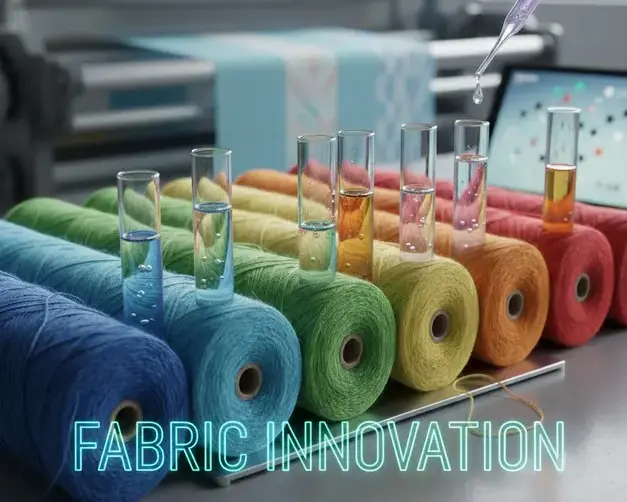
Conductive chemicals for textile industry are formulations designed to provide electrical conductivity to fabrics through coating, impregnation, or fiber integration. These chemicals transform ordinary textiles into functional materials used for sensing, heating, and data transmission. As wearable technology and smart clothing become mainstream, the use of conductive agents in fabric engineering continues to expand across industrial and consumer applications.
Key Takeaways
- Conductive chemicals impart electrical conductivity to textiles through coatings or fiber integration.
- Silver, carbon, and conductive polymers are primary agents.
- Used in wearables, defense, and medical textiles.
- Testing standards include ISO 21196 and ASTM D257.
- Innovation focuses on eco-friendly, nano-based conductive materials.
What are conductive chemicals for textile industry and how do they work?
Conductive chemicals for textile industry enable fabrics to transmit electricity or signals by integrating conductive particles or polymers.
Common mechanisms include:
- Surface coating: Applying silver, copper, or carbon-based compounds on fibers.
- Chemical grafting: Binding conductive polymers like polypyrrole or polyaniline.
- Fiber embedding: Integrating conductive nanoparticles during spinning.
These processes maintain textile flexibility while adding electrical properties essential for wearable electronics.
Which types of conductive chemicals are used in textile processing?
Major types include:
| Type | Base Material | Key Properties | Applications |
| Metallic Compounds | Silver nitrate, copper oxide | High conductivity | Sensors, heating fabrics |
| Carbon-Based | Carbon black, graphene oxide | Lightweight, flexible | EMI shielding, sportswear |
| Conductive Polymers | Polyaniline, PEDOT:PSS | Wash-resistant, tunable | Medical textiles, circuits |
These chemicals often appear as textile coating agents, printing pastes, or dispersions.
What are the main applications of conductive chemicals in textiles?
Conductive Chemicals for Textile Industry, finishes support a wide range of smart functionalities, including:
- Health monitoring: ECG or temperature-sensing fabrics.
- Defense and aerospace: Antistatic and electromagnetic shielding garments.
- Heating textiles: Battery-powered jackets and gloves.
- Fashion and wearables: Interactive clothing and illuminated fabrics.
A textile chemical liquid is often discussed alongside antistatic agents, conductive coatings, and finishing auxiliaries used in smart apparel and industrial fabrics.
How are conductive textiles tested and standardized?
Testing ensures consistent performance and durability under use.
Common standards include:
- ISO 21196: Measurement of surface resistivity.
- ASTM D257: Electrical resistance evaluation.
- AATCC 76: Conductive and antistatic textile assessment.
These tests verify the stability of conductivity after washing, stretching, and environmental exposure.

What challenges exist in using conductive chemicals for textiles?
While technologically advanced, these materials face limitations such as:
- High production costs for metallic or graphene-based finishes.
- Durability issues after repeated washing cycles.
- Environmental concerns from metallic nanoparticles.
- Compatibility challenges with traditional dyeing and printing processes.
Continuous research focuses on eco-friendly, biodegradable conductive alternatives.
What are the future trends for conductive chemicals in textile industry?
Emerging trends highlight:
- Nano-engineered coatings for improved conductivity and wash resistance.
- Integration with IoT for real-time data transmission.
- Sustainable conductive agents replacing heavy metals with carbon-based solutions.
These developments are aligning with circular textile manufacturing and next-generation wearable electronics.
Conclusion
Conductive chemicals for textile industry have redefined fabric functionality by merging electrical performance with comfort and design flexibility. Their use spans from healthcare sensors to energy-harvesting clothing, illustrating the future of smart materials. To understand their broader classification within the chemical ecosystem, explore how they relate to commodity chemicals in textiles, which form the foundation for large-scale textile processing.
FAQ
Which chemical is used in the textile industry?
Common textile chemicals include surfactants, dyes, softeners, and finishing agents such as silicone emulsions and binders.
What are conductive textiles?
Conductive textiles are fabrics engineered to conduct electricity through embedded conductive fibers, coatings, or polymers.
What is an example of a conductive fabric?
Examples include silver-coated nylon, graphene-coated cotton, and carbon fiber fabrics used in wearable sensors.
What are commodity chemicals in textile industry?
Commodity chemicals are basic industrial compounds like acids, alkalis, and salts used in large volumes for pre-treatment, dyeing, and finishing.
Sources
https://www.sciencedirect.com/topics/engineering/conductive-textile
https://www.mdpi.com/2624-6120/4/1/1
https://www.bekaert.com/en/products/basic-materials/textile/e-textiles-/conductive-fibers-and-yarns-for-smart-textiles
https://en.wikipedia.org/wiki/Conductive_textile
https://www.datamintelligence.com/research-report/conductive-textile-market
https://www.aimspress.com/article/10.3934/matersci.2018.3.551
https://www.fiberjournal.com/conductive-textiles/
https://aces.onlinelibrary.wiley.com/doi/10.1002/asia.201402230
https://tuball.com/articles/revolutionizing-the-textile-industry