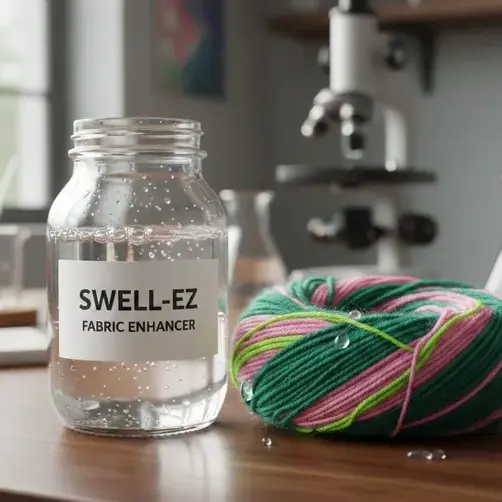
A swelling agent chemical in textile is a compound that increases the internal volume of fibers by loosening molecular bonds, enabling better dye and chemical penetration. These agents are indispensable in processes such as scouring, bleaching, and dyeing where uniformity and fiber receptivity are essential for high-quality output.
Key Takeaways
- Swelling agents enhance fiber porosity and chemical accessibility.
- They are essential for uniform dyeing and smooth finishing.
- Environmental compliance is critical in modern formulations.
- Integration depends on fiber type, process temperature, and concentration.
What Is the Role of a Swelling Agent Chemical in Textile Processing?
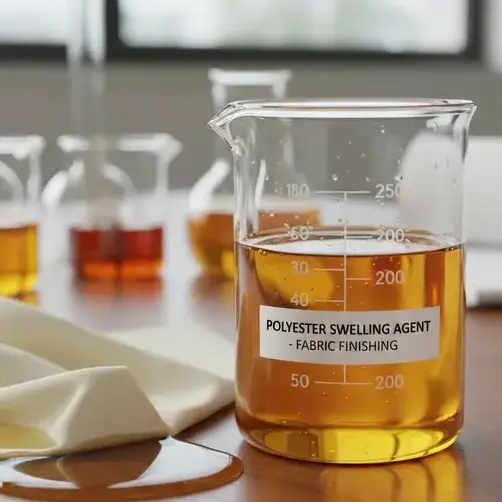
Swelling Agent Chemical in Textile function by penetrating the fiber matrix and partially disrupting hydrogen or van der Waals bonds to allow greater accessibility.
Key roles include:
- Enhancing dye diffusion within hydrophobic fibers
- Improving fiber reactivity for finishing treatments
- Facilitating even shade development and color depth
- Increasing water absorption and wet processing efficiency
Typical applications include pretreatment of polyester-cotton blends, wool finishing, and reactive dyeing processes.
How Do Swelling Agents Work at the Molecular Level?
Swelling Agent Chemical in Textile modify the polymer system of fibers such as cellulose or polyester.
Mechanism of action:
- The substance moves through the amorphous portions of the fiber, enhancing accessibility.
- It breaks weak intermolecular interactions.
- Fiber volume expands, improving accessibility to reactive sites.
For example, phenol-based compounds, formic acid, and dimethyl sulfoxide (DMSO) are used to induce controlled swelling in polyester and nylon fibers.
What Are the Main Types of Swelling Agent Chemicals Used in Textiles?
Swelling agents vary based on fiber compatibility and chemical reactivity.
| Fiber Type | Common Swelling Agent | Function |
| Cotton & Cellulose | Sodium hydroxide, Urea | Opens cellulose structure for absorbency |
| Polyester | Phenol, Benzyl alcohol | Enhances dye penetration |
| Wool | Organic acids | Loosens cuticle scales for softness |
| Nylon | Formic acid | Improves dye uptake |
Textile auxiliaries in liquid form are often linked to swelling, levelling, and dispersing agents that ensure consistent color and quality finishing.
What Are the Industrial Benefits of Using Swelling Agents?
Swelling agents offer multiple operational and quality advantages:
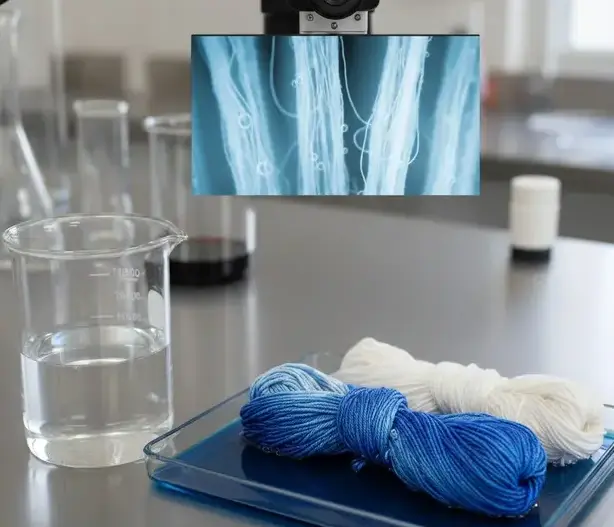
- Improved dye uniformity in hydrophobic fibers
- Enhanced wetting and reactivity during pretreatment
- Reduced processing time and temperature requirements
- Better color reproducibility and shade accuracy
These benefits make them vital in continuous dyeing, knit finishing, and advanced pretreatment lines.
Are There Environmental or Safety Considerations?
Yes. Many traditional swelling agents such as phenolic compounds pose toxicity and effluent load concerns. Modern alternatives focus on biodegradable, low-VOC, and non-toxic formulations that comply with REACH and OEKO‑TEX standards.
- Manufacturers must maintain Material Safety Data Sheets (MSDS).
- Effluent treatment is mandatory for wastewater containing organic solvents.
How Are Swelling Agents Integrated in Textile Pretreatment Lines?
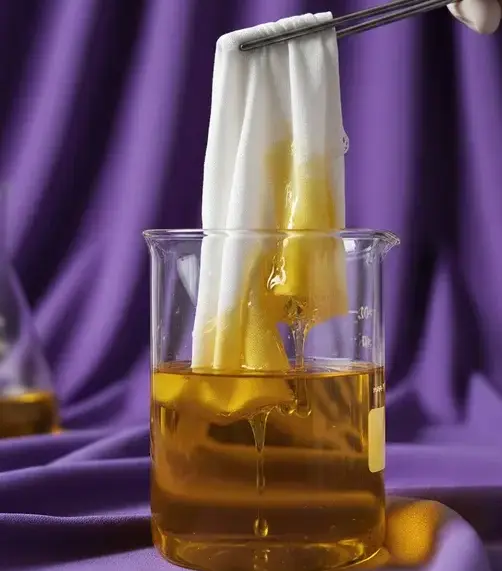
Swelling agents are added during scouring or alkaline treatment stages at controlled temperatures and pH levels.
Standard integration steps:
- Mix swelling agent with wetting and dispersing agents.
- Apply at 60–90°C for 20–40 minutes.
- Rinse thoroughly to remove residues.
This integration improves subsequent dyeing and finishing processes, ensuring deeper penetration and smooth fabric surfaces.
Conclusion
Swelling agent chemicals in textiles form a crucial bridge between fiber chemistry and high-performance finishing outcomes. As sustainability standards tighten, industries increasingly adopt safer, eco-friendly alternatives. For comprehensive chemical management, refer to related regulatory classifications such as red listed chemicals in textiles to ensure compliance and environmental responsibility.
FAQ
What is an example of a swelling agent?
Phenol, formic acid, and dimethyl sulfoxide (DMSO) are common swelling agents used in textile processing.
What is a levelling agent in textiles?
A levelling agent ensures uniform dye distribution by controlling dye migration during the dyeing process.
What is swelling in textiles?
Swelling is the expansion of fibers when treated with chemicals, improving dye and finish penetration.
Which chemical is used in the textile industry?
Common chemicals include detergents, softeners, swelling agents, leveling agents, and fixing agents.
Sources
http://www.nicholas.co.in/swelling-agent.html
https://dir.indiamart.com/impcat/swelling-agent.html
https://patents.google.com/patent/US3537809A/en
https://www.sciencedirect.com/topics/chemistry/swelling-agent
https://www.slideshare.net/slideshow/ran-chemicals-textile-pretreatment-scouring-cum-swelling-agent-for-polyester-ransc1094p/33083922
https://www.researchgate.net/publication/286734804_The_role_of_swelling_and_enzymatic_finishing_in_developing_new_shades_on_polyestercotton_blends