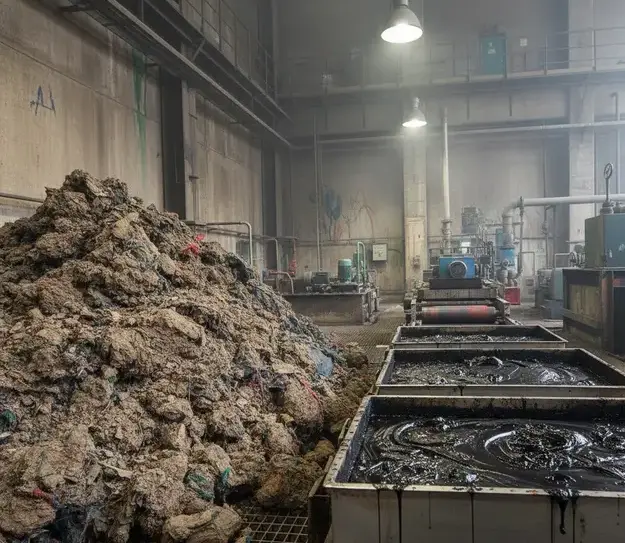
Textile mill sludge chemicals are residual chemical compounds present in the solid waste generated during wastewater treatment in textile industries. These substances often include dyes, surfactants, heavy metals, and coagulants accumulated from effluent treatment plants (ETPs). Managing them effectively ensures regulatory compliance, prevents soil and groundwater contamination, and supports sustainable waste reuse. How are these chemicals characterized, and what control measures are essential?
Key Takeaways
- Textile mill sludge chemicals result from ETP processes handling dyeing and finishing effluents.
- Heavy metals, dyes, and coagulants make the sludge potentially hazardous.
- Proper treatment ensures compliance with CPCB and SPCB norms.
- Reuse options include construction materials and energy recovery.
- Emerging trends emphasize circular economy and ZLD integration.
What are textile mill sludge chemicals and how are they formed?
Textile mill sludge chemicals originate from wastewater generated during textile dyeing, washing, bleaching, and finishing processes.
Composition commonly includes:
- Reactive and azo dyes
- Surfactants and detergents
- Heavy metallic substances for example chromium, zinc, and copper.
- Coagulants (alum, ferric chloride) and flocculants
- Residual organic compounds and microfibers
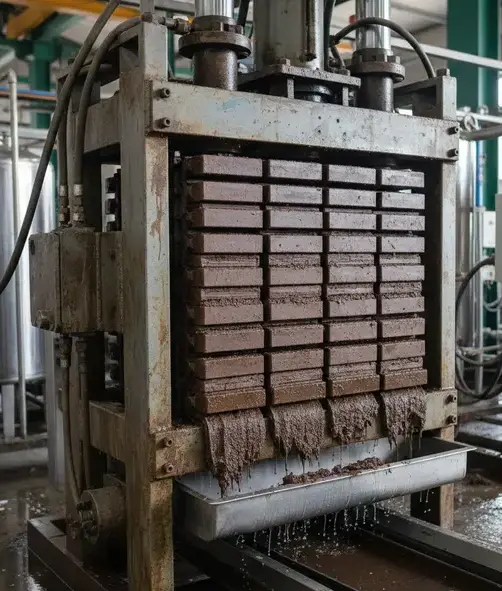
The sludge forms after physical, chemical, and biological treatment in ETP units where solid particles settle out of the wastewater stream.
Why are textile mill sludge chemicals considered hazardous?
- Toxic metal accumulation causing soil and water contamination
- Increased COD and BOD values reflecting high organic load
- Refractory organic substances that remain undegraded in nature
When improperly disposed, sludge can release carcinogenic or mutagenic compounds into the environment.
How are textile mill sludge chemicals treated for safe disposal?
Treatment technologies depend on sludge characteristics and regulatory thresholds.
Common methods include:
| Treatment Method | Description | Application |
| Incineration | Thermal oxidation reduces volume and destroys organics | Hazardous sludge |
| Composting | Stabilizes biodegradable content | Mixed with organic matter |
| Landfilling (Secured) | Disposal in lined, monitored facilities | Non-recyclable sludge |
| Thermal Drying | Reduces moisture and transportation load | Pre-treatment step |
A textile chemical liquid is often discussed alongside coagulants, flocculants, and finishing auxiliaries used in pre-treatment and wastewater management.
Can textile mill sludge chemicals be reused or recycled?
Yes. Advanced R&D initiatives explore:
- Brick and cement manufacturing: Sludge ash as filler or binding material
- Pigment recovery: Extraction of residual colorants
- Energy recovery: Through pyrolysis or co-incineration in cement kilns
However, feasibility depends on heavy metal concentration and calorific value.
What are the environmental regulations for textile sludge management?
Governments mandate compliance with:
- CPCB directives regulating hazardous waste treatment and disposal practices
- Observance of the Environmental Protection Act, 1986, and the Water (Prevention and Control of Pollution) Act, 1974, for maintaining pollution control standards.
- ETP operation certification under State Pollution Control Boards (SPCBs)
Periodic sludge testing and manifest maintenance are mandatory for transport and disposal.
How does sludge composition differ between textile processes?
| Process | Dominant Chemical Residue | Typical pH | Potential Use |
| Dyeing | Azo dyes, NaOH, salts | 9–11 | Fuel blending |
| Printing | Pigments, binders | 7–9 | Construction material |
| Finishing | Surfactants, softeners | 6–8 | Compost mix |
| Washing | Detergents, suspended solids | 6–7 | Non-hazardous |
This variation affects both treatment methods and recycling potential.
What future trends are shaping textile sludge chemical management?
- Adoption of zero liquid discharge (ZLD) systems
- Development of bio-based coagulants
- Integration of nanomaterials for pollutant adsorption
- Digital monitoring of ETP efficiency through smart sensors
Such innovations align with global sustainability frameworks and cleaner production goals.
Conclusion
Textile mill sludge chemicals pose complex environmental challenges that require scientific management, regulatory adherence, and innovative reuse strategies. A structured approach linking process chemistry and waste handling ensures both compliance and sustainability. For related insight, explore how chemicals used in textile finishing influence downstream sludge characteristics and treatment outcomes.
FAQ
What is textile mill sludge?
It is the semi-solid residue generated after treating wastewater in textile effluent treatment plants.
What are the toxic chemicals in the textile industry?
Common toxicants include azo dyes, formaldehyde, surfactants, chromium, copper, and bleaching agents.
What is the use of ETP sludge?
ETP sludge can be repurposed in brick manufacturing, co-processing in cement kilns, or composting after stabilization.
What are the two types of sludge?
Sludge is categorized as primary, obtained via sedimentation, and secondary, resulting from biological treatment.
Sources
https://theasengineers.com/textile-sludge-a-comprehensive-guide/
https://www.sciencedirect.com/science/article/pii/S0969806X17300567
https://watermanaustralia.com/etp-pants-characteristics-of-textile-sludge-and-its-treatment/
https://pollution.sustainability-directory.com/area/textile-sludge-pollution/
https://www.researchgate.net/publication/275536515_Textile_Sludge_Management_by_Incineration_Technique
https://link.springer.com/rwe/10.1007/978-981-16-4230-2_58
https://pmc.ncbi.nlm.nih.gov/articles/PMC7969488/