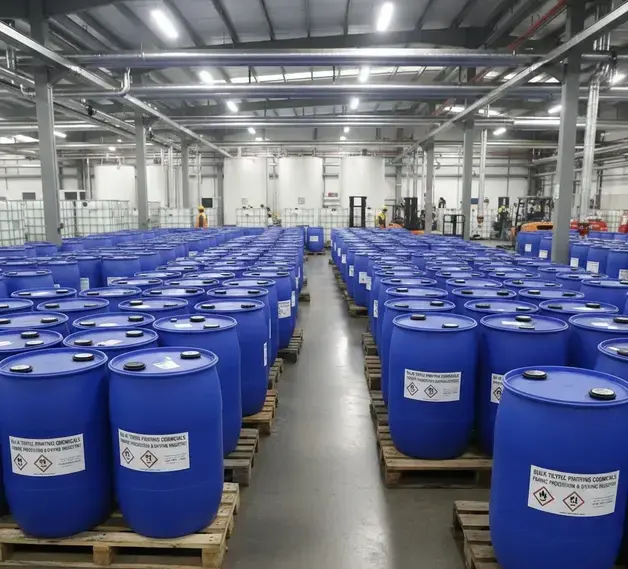
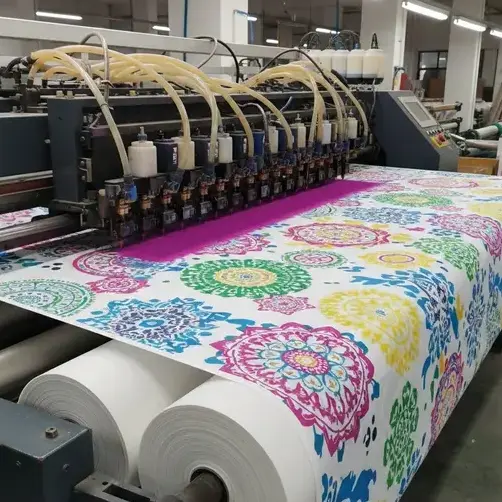
Textile printing chemicals are compounds used to apply color patterns onto fabrics through various printing techniques such as screen, rotary, or digital printing. These chemicals determine the sharpness, brightness, and fastness of prints, directly influencing the fabric’s final quality and market value.
Key Takeaways
- Textile printing chemicals define the quality and durability of printed fabrics.
- Binders and thickeners are central to pigment printing performance.
- Fixing agents improve color retention and wash fastness.
- Emulsifiers and dispersants maintain color consistency.
- Eco-compliant formulations are growing in industrial demand.
What are the main types of textile printing chemicals?
The main types of textile printing chemicals are binders, thickeners, emulsifiers, softeners, and fixing agents. Each serves a specific purpose in achieving uniform and durable prints.
| Type | Primary Function | Common Use |
| Binder | Fixes pigment to fabric | Pigment printing |
| Thickener | Controls viscosity | Screen and rotary printing |
| Emulsifier | Ensures uniform dispersion | Oil-based pigment systems |
| Softener | Enhances hand feel | Post-print finishing |
| Fixing Agent | Improves color fastness | Reactive and vat dyes |
How do binders influence the performance of textile printing chemicals?
Binders form a film around pigment particles, adhering them to the fabric surface after curing. High-quality acrylic or polyurethane-based binders ensure superior wash durability and elasticity. The right binder selection depends on the fabric type, curing temperature, and color depth desired.
Why are thickeners critical in textile printing processes?
Thickeners regulate the flow of printing paste, preventing color bleeding and uneven prints.
- Natural thickeners: Guar gum, sodium alginate (eco-friendly, widely used in reactive printing)
- Synthetic thickeners: Polyacrylates, carboxymethyl cellulose (ideal for pigment and disperse printing)
Proper rheology control ensures crisp design edges and optimal screen performance.
What role do emulsifiers and dispersing agents play in textile printing?
Emulsifiers stabilize oil-water mixtures in pigment formulations, ensuring uniform color dispersion. Dispersing agents prevent pigment aggregation, leading to consistent shades. Nonionic surfactants are commonly used for stable emulsions in digital and rotary pigment systems.
How do fixing agents improve durability in printed textiles?
Fixing agents chemically bond dyes or pigments to fibers, enhancing fastness to washing, rubbing, and light. For reactive dye systems, cationic fixers improve ionic attraction between dye and fiber. In pigment printing, thermal crosslinking fixers enhance adhesion during curing.
What are auxiliary textile printing chemicals used for?
Auxiliaries include softeners, defoamers, wetting agents, and retarders that refine process efficiency and surface quality.
- Softeners: Enhance tactile feel post-printing
- Defoamers: Prevent air bubble formation in print paste
- Wetting agents: Improve penetration of print onto fibers
A textile chemical liquid is often discussed alongside pigment binders, textile auxiliaries, and color fixation agents used in pre- and post-printing treatments.
How are textile printing chemicals used in India’s textile industry?
India’s textile printing sector uses a blend of traditional and modern formulations—natural thickeners for cotton fabrics and synthetic emulsions for polyester prints. Leading suppliers like Sarex, Balaji Marketing, and Esteem Chemicals manufacture water-based and eco-compliant solutions aligned with GOTS and REACH standards.
Conclusion
Textile printing chemicals enable vibrant, precise, and durable prints essential to modern fabric design. Their correct combination ensures both aesthetic and functional performance across fibers. For related surface protection and finishing applications, see waterproof chemical for textile, which enhances fabric resistance without compromising print quality.
FAQs
Which chemical is used in printing?
Binders and thickeners are the most common chemicals, used to fix and control the print paste on fabrics.
What is a thickener used in printing?
A thickener adjusts the viscosity of the print paste, preventing spreading and ensuring sharp design outlines.
Which chemical is used in the textile industry?
Textile industries use dyes, binders, wetting agents, and finishing auxiliaries for coloration and surface treatment.
What materials are used in textile printing?
Cotton, polyester, silk, and blended fabrics are printed using pigment, reactive, or disperse dye systems.
Sources
https://dir.indiamart.com/impcat/textile-printing-chemicals.html
https://www.esteem-india.com/Printing-chemical.php
https://acmemills.com/industry-news-blog/list-of-chemicals-used-in-textile-dyeing-industry/
https://www.kamsons.com/products.html
https://www.sarex.com/textile/printing-auxiliaries/digital-printing
https://www.tradeindia.com/products/textile-printing-chemical-3136528.html
https://balajimarketing.asia/textile-printing-chemicals.php