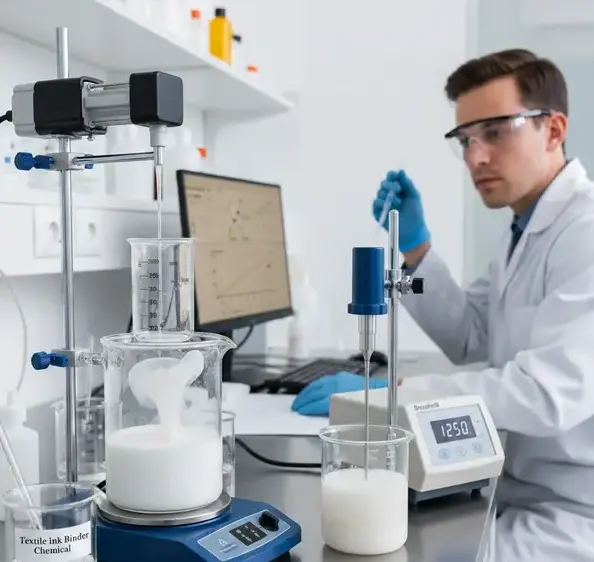
A water based textile ink binder chemical is a polymer emulsion that binds pigments to textile fibers, ensuring adhesion, flexibility, and wash durability in water-based printing inks. These binders replace solvent-based systems, supporting low-VOC and eco-friendly production. How do such chemical formulations influence print performance and compliance in the evolving textile industry?
Key Takeaways
- Water based binders enable eco-safe, durable textile printing.
- PU and acrylic emulsions dominate industrial applications.
- Compliance with REACH, ZDHC, and OEKO-TEX® ensures global acceptance.
- Innovations include bio-based and self-crosslinking polymers.
- Crucial for sustainable textile ink and coating development.
What is a Water Based Textile Ink Binder Chemical Made Of?
A water based textile ink binder chemical typically comprises:
- Polymer Emulsion Base: Polyurethane (PU), acrylic, or hybrid copolymers
- Crosslinkers: Improve mechanical strength and water resistance
- Plasticizers: Enhance film flexibility
- Additives: Stabilizers, thickeners, and defoamers for print consistency
These ingredients collectively determine film-forming ability, pigment retention, and hand feel.
How Does a Water Based Textile Ink Binder Chemical Function in Printing?
The binder chemically and physically anchors pigment particles to textile fibers through a film formation process:
- Deposition: Pigment and binder mixture applied to the fabric
- Coalescence: Water evaporates, binder particles fuse
- Curing: Heat or chemical crosslinking creates a durable polymer film
This process ensures excellent color fastness, elasticity, and abrasion resistance essential for garments and home textiles.
What Are the Major Types of Water Based Textile Ink Binder Chemicals?
The main classifications include:
| Type | Polymer Base | Key Properties | Common Use |
| Acrylic Binder | Styrene-acrylic copolymer | Bright color, low cost | Cotton and blends |
| Polyurethane Binder (PU) | Waterborne PU dispersion | High elasticity, soft feel | Sportswear and stretch fabrics |
| Hybrid Binder | PU + Acrylic | Balance of cost and performance | Digital printing inks |
For comparison, people often explore related materials like pigment emulsions, textile printing auxiliaries, and crosslinking agents used in coating and finishing.
Why Are Water Based Textile Ink Binder Chemicals Preferred Over Solvent-Based Types?
Key advantages include:
- Low VOC emissions: Environmentally safer production
- Worker safety: Non-toxic and odor-free environment
- Regulatory compliance: Meets REACH and ZDHC guidelines
- Energy efficiency: Lower curing temperatures than solvent systems
This makes them compatible with global sustainability programs and digital textile printing technologies.
How Are These Binder Chemicals Evaluated for Performance?
Performance testing ensures reliability across applications:
- Wash and Rub Fastness: Determines print durability
- Tensile and Elongation Tests: Measures film flexibility
- Viscosity and pH Control: Maintains ink stability
- Adhesion Tests: Confirms binder-pigment-fiber interaction
Manufacturers like Covestro and SinograceChem follow ISO 9001 and ZDHC MRSL standards to ensure quality.
What Are Current Innovations in Water Based Textile Ink Binder Formulations?
Recent advancements focus on:
- Bio-based polymers derived from renewable feedstocks
- Self-crosslinking emulsions reducing curing energy
- Nanocomposite binders for higher abrasion resistance
- Digital printing compatibility for fine-resolution prints
These developments align with textile sustainability goals and next-generation pigment ink technologies.
What Are Common Industrial Applications of Water Based Textile Ink Binder Chemicals?
Applications span multiple textile sectors:
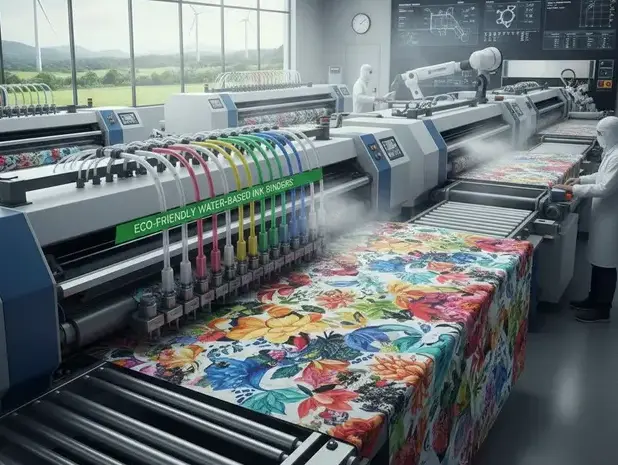
- Screen and digital pigment printing
- Garment printing for cotton, polyester blends, and rayon
- Technical textiles requiring stretch or moisture management
They are widely used in eco-certified apparel manufacturing under OEKO-TEX® and Global Organic Textile Standard.
Conclusion
Water based textile ink binder chemicals represent the core of sustainable textile printing—balancing adhesion, flexibility, and eco-performance. Their evolution toward bio-based and self-crosslinking systems marks the future of responsible ink chemistry. For advanced textile coating insights, explore related materials such as polypyrrole and polyaniline chemicals for textile industry, which expand the horizon of conductive and functional fabrics
FAQ
What is the purpose of a water based textile ink binder chemical?
It secures pigment particles onto fabric fibers, ensuring print durability and wash fastness.
Can these binders be used on synthetic fabrics?
Yes, polyurethane and hybrid systems work effectively on polyester, nylon, and blended textiles.
Are water based binders environmentally safe?
They emit minimal VOCs and comply with REACH and ZDHC environmental standards.
How is binder performance tested?
Through fastness tests, adhesion checks, and mechanical strength evaluation.
What makes PU binders superior in textile inks?
Their elasticity and soft handle make them ideal for high-performance stretch fabrics.
Sources
https://www.indiamart.com/proddetail/water-based-ink-binder-4000-electron-2854673580830.html
https://www.sinogracechem.com/blog/the-main-components-and-classification-of-water-based-ink_b466
https://solutions.covestro.com/ko/highlights/articles/stories/2021/insqin-waterborne-pu-for-digital-textile-ink-binders
https://www.dyestuffscn.com/info/the-basic-knowledge-of-water-based-ink-91071005.html
https://www.tradeindia.com/products/binders-for-water-based-printing-inks-640024.html
https://patents.google.com/patent/WO1999027023A1/en
https://ahderun.en.made-in-china.com/product/HnxreXpKgRks/China-Excellent-Composite-Strength-PU-Ink-Binder-for-Water-Based-Printing-Ink.html