ISO textile perspiration chemicals are specialized testing solutions defined under the ISO 105-E04 standard to simulate human sweat conditions on fabrics. These chemicals help assess colorfastness, ensuring that textile dyes remain stable during wear. Why are these solutions critical for textile testing and certification?
Key Takeaways
- ISO textile perspiration chemicals simulate sweat to test colorfastness.
- Two main solutions are used: acidic and alkaline.
- ISO 105-E04 is the governing standard for perspiration testing.
- Grading is done using ISO 105-A02 and A03 grey scales.
- Consistent solution quality ensures accurate test results.
What Are ISO Textile Perspiration Chemicals?
ISO textile perspiration chemicals are standardized acidic and alkaline solutions used to test colorfastness to perspiration in textiles.
- Defined under International Organization for Standardization (ISO) 105-E04, they replicate the effect of acidic and basic sweat.
- Key components include sodium chloride, histidine monohydrochloride, and sodium phosphate.
- Two main formulations exist:
- Acidic solution (pH 5.5 ± 0.2)
- Alkaline solution (pH 8.0 ± 0.2)
These chemical solutions mimic real perspiration to test how fabric dyes perform under different pH conditions.
How Are ISO Textile Perspiration Chemicals Used in Testing?
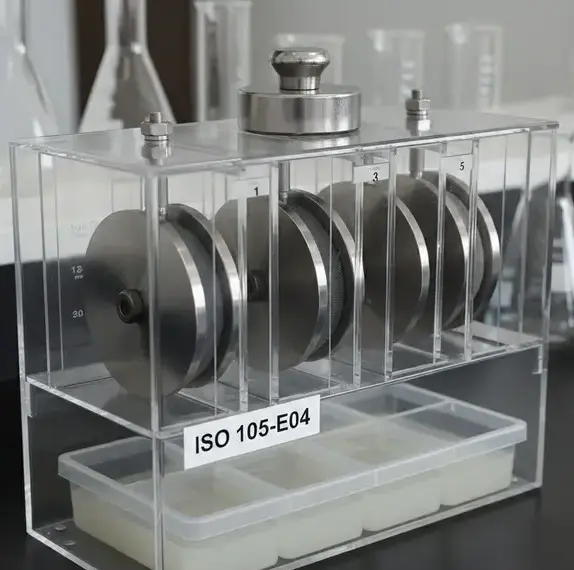
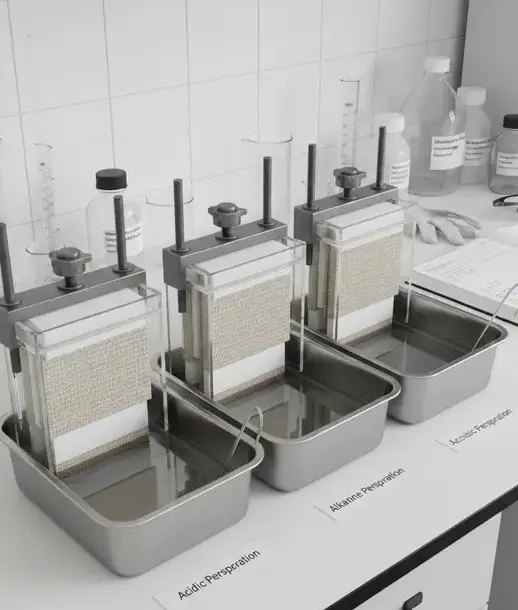
Textile specimens are immersed in ISO perspiration solutions and pressed between filter papers under controlled temperature and pressure.
Standard test steps include:
- Preparing test solutions (acidic and alkaline).
- Soaking fabric samples in the solution for 30 minutes.
- Placing samples between glass plates and compressing under load.
- Incubating at 37 ± 2°C for 4 hours.
- Drying and evaluating color change using ISO 105-A02/A03 grey scales.
Why Are ISO Textile Perspiration Tests Important?
These tests verify that fabrics retain color and performance during use.
- Quality control: Ensures color stability in garments exposed to body sweat.
- Regulatory compliance: Required for export to many countries following ISO or equivalent standards.
- Consumer safety: Prevents dye bleeding that may cause skin irritation.
In industrial practice, a textile chemical liquid is often discussed alongside finishing auxiliaries and post-treatment agents used for durability and comfort.
Which Chemicals Are Commonly Included in ISO Perspiration Tests?
Below is a standard list of chemicals used in ISO textile perspiration testing:
| Chemical Name | Purpose | Typical Concentration |
| Sodium chloride (NaCl) | Replicates salt in sweat | 10 g/L |
| Histidine monohydrochloride | Represents amino acid in sweat | 0.25 g/L |
| Sodium dihydrogen phosphate | Buffers pH for acidic solution | 0.25 g/L |
| Disodium hydrogen phosphate | Buffers pH for alkaline solution | 0.25 g/L |
| Deionized water | Solvent medium | Balance |
How Do ISO Standards Classify Colorfastness to Perspiration?
Colorfastness to perspiration is evaluated using ISO 105-E04 and graded according to ISO 105-A02 (color change) and ISO 105-A03 (staining).
Grading scale:
- 5: No change
- 4: Slight change
- 3: Noticeable change
- 2: Significant change
- 1: Severe change
This ensures uniform evaluation of textile performance across laboratories worldwide.
What Are Related Standards for ISO Textile Perspiration Chemicals?
Several interconnected ISO and national standards complement the perspiration test:
- ISO 105-A01: General principles of colorfastness testing.
- ISO 105-B07: Artificial perspiration solutions (acidic and alkaline).
- ISO 11641: Colorfastness to perspiration for leather.
- IS 971:1983 (India): Equivalent Bureau of Indian Standards (BIS) adaptation.
These standards establish harmonized testing across textile, apparel, and leather industries.
How Do Manufacturers Ensure Compliance and Reliability?
Manufacturers use certified ISO textile perspiration chemicals from approved suppliers, ensuring solution stability and accurate pH balance. Regular calibration of testing instruments and adherence to ISO 105 guidelines guarantee repeatable results.
Best practices include:
- Verifying chemical pH before every test.
- Storing solutions in airtight, non-reactive containers.
- Performing comparative tests with reference materials.
Conclusion
ISO textile perspiration chemicals form the foundation of reliable colorfastness testing and international textile compliance. By ensuring consistency in testing conditions, these solutions help maintain quality and safety across global supply chains. For comprehensive performance assurance, related tests such as fire retardant chemicals for textiles evaluation are also integral to product certification.
FAQ
What ISO is Colorfastness to perspiration?
Colorfastness to perspiration is tested under ISO 105-E04, which evaluates dye resistance to acidic and alkaline sweat.
What is the ISO standard for the textile industry?
The primary ISO standards include ISO 105 for colorfastness and ISO 3758 for care labeling of textiles.
What does ISO 105 A02 test in fabric materials?
ISO 105-A02 measures color change in textiles using a grey scale to quantify fastness performance.
Is ISO 105-E04?
Yes, ISO 105-E04 specifies the procedure for determining colorfastness to perspiration using defined acidic and alkaline test solutions.
Sources
https://sdlatlas.com/test-materials/other/perspiration-test-set-of-chemicals-ISO
https://www.iso.org/standard/1868.html
https://www.nanochemazone.org/artificial-perspiration-iso-105-b07-acidic-solution-not-stabilized-bz151–7215559.html
https://www.iso.org/obp/ui/#iso:std:iso:105:-A01:ed-6:v1:en
https://www.gester-instruments.com/blog/how-to-know-the-iso-11641-colour-fastness-to-perspiration-for-your-projects_b91
https://textilelearner.net/color-fastness-to-perspiration/
https://www.tradeindia.com/products/artificial-perspiration-iso-105-b07-acidic-solution-ph-5-5-stabilized-bz154-c7215560.html
https://archive.org/details/gov.in.is.971.1983