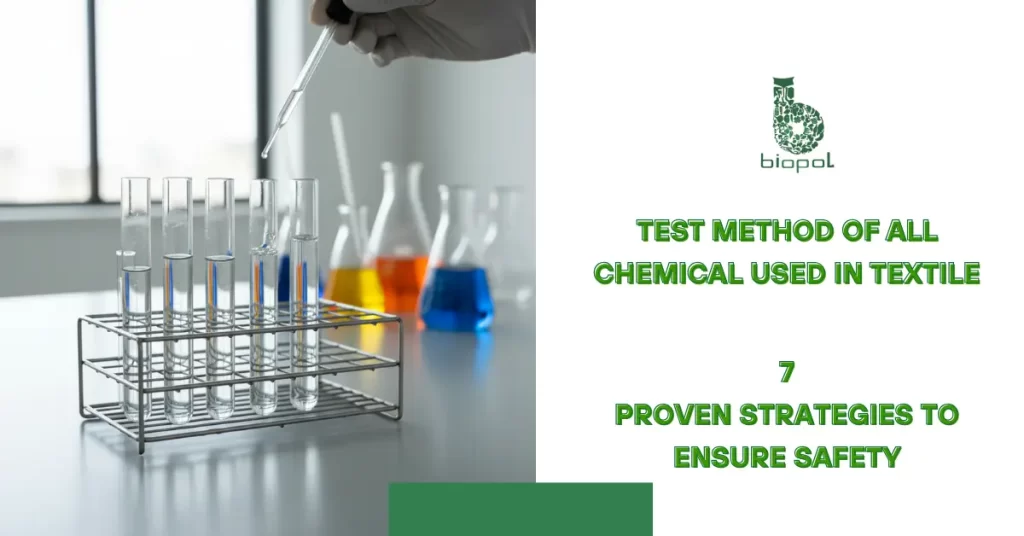
The test method of all chemical used in textile ensures every fabric meets safety, compliance, and quality standards. From hidden dyes to residual metals, testing transforms invisible risks into actionable insights, protecting consumers, brands, and supply chains while building trust in responsible textile manufacturing.
Why Textile Chemical Testing Is a Game Changer
The test method of all chemical used in textile defines more than compliance—it defines credibility. How can a fabric truly be considered safe without knowing what lies in its fibers? Testing isn’t an afterthought; it’s the foundation of responsible manufacturing.
Every textile product, from a baby’s blanket to a luxury label, carries hidden risks. Residual dyes, formaldehyde traces, and heavy metals can silently compromise safety and brand reputation. By applying the test method of all chemical used in textile, I protect my supply chain from threats that could snowball into costly recalls or lost consumer trust.
Regulators demand it, consumers expect it, and smart businesses act on it. Each test result is a story—one of safety, precision, and accountability. Isn’t that the story every textile brand wants to tell?
Core Hazards & Substances That Demand Screening
The test method of all chemical used in textile becomes essential the moment we examine the hidden side of fabric chemistry. Beneath the bright colors, compounds may exist that pose serious risks.
Azo dyes, for example, can break down into aromatic amines linked to health concerns. Disperse dyes may trigger allergies if improperly fixed. Formaldehyde, used in wrinkle-resistant finishes, can irritate skin and lungs. Heavy metals—lead, cadmium, chromium—may linger from dyes or catalysts. Even surfactants like nonylphenol ethoxylates (NPEs) degrade into environmentally harmful compounds.
| Chemical Group | Risk Factor | Reason for Testing |
| Azo & Disperse Dyes | Toxic amines, allergies | Detect restricted or unstable compounds |
| Formaldehyde | Volatile emissions | Confirm safe exposure limits |
| Heavy Metals | Bioaccumulation, toxicity | Identify residual metals |
| Surfactants (NPEs) | Aquatic toxicity | Ensure environmental safety |
Screening protects people and the planet, one tested fabric at a time.
Regulatory Maps
The test method of all chemical used in textile isn’t just science—it’s compliance. Global regulations set the stage. REACH restricts hazardous substances in Europe, ZDHC limits harmful production discharge, OEKO-TEX certifies fabrics for chemical safety, and CPSIA governs children’s products.
Local norms are equally vital, dictating permissible limits for dyes, finishing agents, or residues. Embedding the test method of all chemical used in textile into daily practice ensures alignment with domestic and international standards. Following regulations is strategic; each test builds trust with clients, consumers, and authorities alike.
Lab Techniques Overview
The test method of all chemical used in textile begins in the lab, where precision meets practicality. Chromatography separates complex mixtures, exposing hazardous compounds. Spectroscopy examines chemical structures using UV-Vis, IR, or atomic absorption. Titration measures pH and residual chemicals. Mass spectrometry identifies trace substances with unmatched accuracy.
| Technique | Purpose | Application |
| Chromatography (HPLC, GC) | Separation & quantification | Dyes, solvents, additives |
| Spectroscopy (UV-Vis, IR, AAS) | Structural analysis | Pigments, metals, finishes |
| Titration | Concentration measurement | pH, acids/bases |
| Mass Spectrometry | Trace detection | Heavy metals, banned substances |
Combining these methods makes the test method of all chemical used in textile comprehensive and actionable.
Processing Tests
The test method of all chemical used in textile is crucial at every step—dyeing, bleaching, finishing. During dyeing, residual dye, pH, and salts are key. Bleaching requires monitoring oxidizing agents and by-products. Finishing demands checks for surfactants, resins, and formaldehyde residues.
| Stage | Parameters to Test | Reason |
| Dyeing | Residual dye, pH, salts | Prevent bleeding & irritation |
| Bleaching | Peroxides, by-products | Ensure safety & uniformity |
| Finishing | Surfactants, resins, formaldehyde | Guarantee comfort & compliance |
These checks ensure products leaving the factory are both safe and high-quality.
These stages not only require testing but also relate closely to surface chemical modification of textile fibres, which enhances dye uptake, finishing performance, and fabric durability.

Lab Setup & Workflow Best Practices
The test method of all chemical used in textile starts with the lab itself. Proper sampling, quality control, and instrument calibration are essential. Chain of custody ensures traceability and accountability.
| Focus | Action |
| Sampling | Proper labeling, representative samples |
| QC | Use standards, blanks, replicates |
| Instruments | Select correct tools, maintain regularly |
| Calibration | Routine to maintain accuracy |
| Chain of Custody | Track every sample movement |
A thoughtful setup makes testing reliable and defensible.
Reading Results & Certifying Compliance
The test method of all chemical used in textile delivers real value when I interpret results accurately. Are residual dyes and formaldehyde within safe limits? Are heavy metals below thresholds? Well-structured reports translate data into actionable insights, while compliance certificates confirm product safety.
| Parameter | Measured Value | Limit | Status |
| Residual Dye | 12 ppm | ≤15 ppm | Pass |
| Formaldehyde | 20 mg/kg | ≤75 mg/kg | Pass |
| Heavy Metals | ND | ≤5 ppm | Pass |
| Surfactants | 0.02% | ≤0.05% | Pass |
Accurate interpretation builds trust with clients, regulators, and end-users.
Common Pitfalls & Smart Fixes
The test method of all chemical used in textile can face challenges: contamination, matrix interference, and repeatability issues. Cleaning equipment, using validated methods, and maintaining strict calibration prevent errors.
| Pitfall | Solution |
| Contamination | Clean tools, separate samples |
| Matrix Interference | Use sample pretreatment |
| Poor Repeatability | Calibrate instruments, replicate tests |
Proactive measures turn potential setbacks into manageable outcomes.
How to Select Accredited Testing Partners (and Why It Pays Off)
The test method of all chemical used in textile is only as strong as the lab executing it. Accreditation, chemical scope, reporting clarity, and turnaround time all matter. Cost is important, but value outweighs price—accurate, reliable results prevent far costlier mistakes.
| Criterion | Check |
| Accreditation | ISO 17025 or equivalent |
| Scope | All relevant chemicals |
| Reporting | Clear & actionable |
| Turnaround | Meets production needs |
| Cost vs Value | Balanced for accuracy & reliability |
The right lab ensures credible, actionable testing results.
Take Action
The test method of all chemical used in textile isn’t optional—it’s a commitment. Start with audits, partner with accredited labs, and implement routine checks. Review results, issue certificates, and refine processes continuously.
- Audit & Identify Risks
- Partner with Labs
- Implement Routine Checks
- Review & Certify
- Refine Continuously
Integrating testing into everyday operations safeguards products, people, and brand reputation. It’s the decisive step toward responsible, trusted textile production.
FAQs
What are the methods of textile testing?
Textile testing methods include physical, chemical, and performance tests. Physical tests assess strength, thickness, and durability. Chemical tests check for dyes, finishing agents, and harmful substances. Performance tests evaluate colorfastness, shrinkage, and wear resistance. Together, these methods ensure quality, safety, and compliance.
What is a chemical test in textiles?
A chemical test in textiles analyzes the composition and presence of chemicals in fibers, fabrics, or finished garments. It identifies dyes, bleaching agents, formaldehyde, heavy metals, and other additives to verify safety, regulatory compliance, and product performance.
How many types of chemical tests are there?
Chemical tests are broadly categorized into:
- Qualitative tests – Determine the presence or absence of a chemical.
- Quantitative tests – Measure the exact amount of a chemical.
- Specific tests – Target specific substances like azo dyes, heavy metals, or flame retardants.
How to test for chemicals in clothing?
Testing for chemicals in clothing involves:
- Sampling the fabric and preparing it for analysis.
- Using techniques such as spectroscopy (UV, FTIR), chromatography (HPLC, GC), or wet chemical analysis.
- Sending samples to accredited textile laboratories to ensure accurate, standardized results.