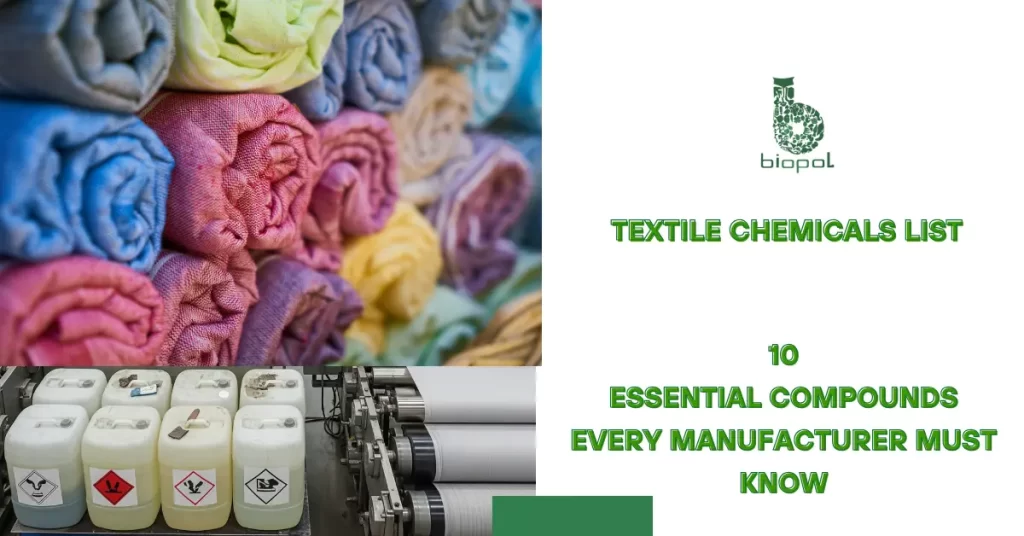
Textile Chemicals List forms the backbone of modern fabric processing, covering essential agents from pre-treatment to finishing. This guide outlines key chemical types, sustainable alternatives, and practical sourcing tips to help manufacturers achieve desired fabric qualities efficiently while meeting performance, safety, and environmental standards.
Table of Contents
Textile Chemicals List
The textile chemicals list serves as the foundation for understanding how raw fabric transforms into the finished textiles used daily. Without these chemical allies, cotton would stay coarse, colors would fade after a single wash, and jackets would fail to keep out rain.
Manufacturers work with a wide range of categories, each serving a distinct role. Some prepare fabrics for subsequent processes, some bring vibrant color, and others add qualities that extend a textile’s life and performance.
| Chemical Category | Primary Purpose |
| Pre-treatment agents | Clean and prepare fabrics for dyeing or finishing |
| Dyeing auxiliaries | Help dyes penetrate fibers and remain vibrant |
| Finishing agents | Add softness, durability, and special performance traits |
| Coatings and repellents | Protect against water, fire, or stains |
| Sustainable alternatives | Reduce environmental impact while maintaining quality |
Viewed in full, the textile chemicals list reflects a balance of functionality and innovation. Each category shapes textiles to meet strict industry standards while satisfying consumer expectations. Without these elements, fabric production would be far less effective—both in quality and appearance.
Pre-Treatment Essentials
The textile chemicals list always begins with pre-treatment essentials, as without them, every later step loses effectiveness. Preparing fabric before dyeing or finishing is comparable to painting on a clean, smooth surface rather than a dusty wall.
Scouring agents remove natural waxes, oils, and dirt, giving a fresh surface for subsequent treatments. Desizing agents break down weaving starches, allowing fibers to absorb chemicals more effectively. Bleaching agents brighten and even the fabric’s base tone, readying it for bold, uniform colors.
| Pre-Treatment Step | Chemical Example | Main Function |
| Scouring | Caustic soda, detergents | Remove oils, waxes, dirt |
| Desizing | Amylase enzymes | Break down starch residues |
| Bleaching | Hydrogen peroxide | Whiten and brighten fibers |
The textile chemicals list demonstrates that preparation may not be glamorous, yet it is critical. Skipping it results in uneven dyeing, reduced durability, and wasted resources. In textile production, good finishing begins with thorough cleaning.
For a complete breakdown of compound types and applications, refer to our detailed article on textile chemicals name.
Dyes & Fixatives
The textile chemicals list is incomplete without dyes and fixatives—the pairing that gives fabric its identity and keeps that identity intact. Color communicates brand, style, and quality, but without the right chemistry, it fades quickly.
Each dye class has its strengths:
| Dye Type | Common Use | Key Advantage |
| Azo dyes | Cotton, polyester | Bright, versatile colors |
| Reactive dyes | Cotton, rayon | Strong bond, high wash-fastness |
| Acid dyes | Wool, silk, nylon | Rich, deep shades, excellent softness |
Fixatives quietly secure dye molecules to fibers, protecting them from fading due to washing, sunlight, or friction. Within the textile chemicals list, dyes provide the visual impact while fixatives preserve it, making the combination essential for lasting results.
Finishing Agents
The textile chemicals list reaches its final enhancement stage with finishing agents, where fabrics gain comfort, resilience, and special properties. Without these, even perfectly dyed cloth can feel harsh, wrinkle easily, or degrade quickly.
Softeners improve fabric hand feel and drape. Wrinkle-resistant treatments keep garments presentable for longer wear. Protective finishes guard against water, stains, fire, or microbial growth.
| Finish Type | Common Chemicals | Benefit |
| Softeners | Silicone emulsions, fatty acids | Enhanced softness and flexibility |
| Wrinkle-resistant | DMDHEU, resin finishes | Reduced creasing, improved shape |
| Protective | Fluorocarbons, phosphorus compounds, silver salts | Water repellency, flame retardancy, antimicrobial protection |
In the textile chemicals list, finishing agents are the handshake between manufacturer and customer, defining how the fabric performs in daily life and how long it retains that performance.
Coatings & Repellents
The textile chemicals list also covers coatings and repellents—functional treatments that protect fabrics in challenging environments. Though less visible than dyes or finishes, they are vital to performance and safety.
Water-repellent treatments create an invisible barrier, causing liquids to roll off rather than soak in. Flame-retardant coatings slow ignition, adding critical safety in hazardous conditions. Specialty coatings deliver targeted benefits such as UV protection, anti-static properties, or resistance to surface damage.
| Treatment Type | Common Chemicals | Primary Benefit |
| Water-repellent | Fluorocarbons, silicones | Blocks moisture penetration |
| Flame-retardant | Phosphorus, nitrogen compounds | Reduces flammability |
| Specialty coatings | Titanium dioxide, conductive polymers | UV protection, static control |
In the textile chemicals list, coatings and repellents quietly ensure performance, only becoming noticeable when absent—and failure becomes costly.
Sustainable Options
The textile chemicals list now incorporates sustainable options, proving that effective textile performance can align with environmental responsibility.
Plant-based softeners replace petroleum-derived alternatives without compromising softness. Enzyme-based pre-treatments reduce water and energy use, operating effectively at lower temperatures. Natural dyes from plant and mineral sources bring rich shades while cutting chemical waste.
| Sustainable Solution | Source | Key Advantage |
| Plant-based softeners | Soy, coconut | Renewable, biodegradable |
| Enzyme pre-treatments | Microbial cultures | Lower resource consumption |
| Natural dyes | Plants, minerals | Reduced synthetic waste |
Within the textile chemicals list, these options are increasingly adopted as industry standards shift toward responsible manufacturing practices.
Selection & Sourcing Tips
The textile chemicals list becomes valuable only when the right choices are made. Poor selection risks inferior quality, wasted production, and compliance issues.
First, match the chemical to the fabric’s composition and process. Cotton, polyester, and wool each require specific chemical interactions. Next, verify certifications such as Oeko-Tex, Bluesign, or GOTS to confirm safety and environmental compliance.
When sourcing, prioritize suppliers offering consistent quality, full technical documentation, and reliable delivery. The cheapest option often proves costly if it compromises production results.
| Step | Key Consideration |
| Match to fabric | Understand fiber chemistry |
| Verify certification | Confirm compliance with recognized standards |
| Evaluate supplier | Assess quality, service, and reliability |
In the textile chemicals list, informed selection and dependable sourcing distinguish ordinary manufacturing from high-quality, commercially successful textile production.
FAQs
What chemicals are used in textiles?
Textiles use a range of chemicals such as sizing agents, bleaching agents, dyes, softeners, finishing agents, and functional coatings to improve durability, appearance, and performance.
Which chemicals are used in dyeing?
Dyeing typically involves reactive dyes, acid dyes, disperse dyes, vat dyes, and pigment-based colors, along with auxiliaries like salt, alkali, and fixing agents to ensure colorfastness.
What chemicals are in clothes?
Clothes may contain fabric softeners, wrinkle-resistant resins, flame retardants, antimicrobial treatments, and water-repellent finishes, depending on the garment’s intended use.
What are the chemical processes in the textile industry?
The textile industry follows processes like desizing, scouring, bleaching, mercerizing, dyeing, printing, and finishing to achieve the desired texture, color, and functionality in fabrics.