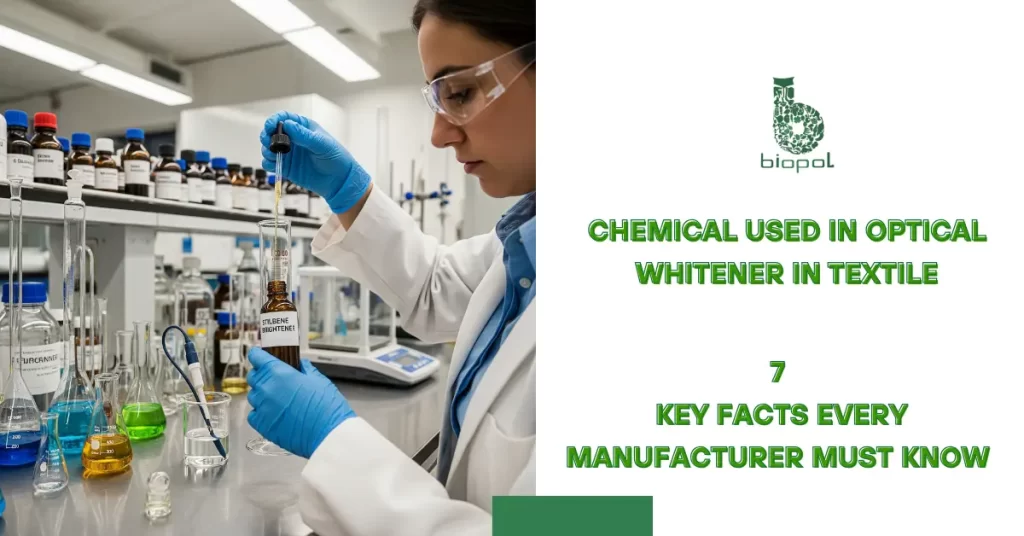
Chemical used in optical whitener in textile plays a vital role in enhancing fabric brightness and visual appeal. Understanding its chemical makeup, safety profile, and environmental impact helps manufacturers make informed decisions. This article explores everything from core ingredients to innovations shaping textile whitening.
Table of Contents
What to Know
The chemical used in optical whitener in textile is far from a background player—it’s a precision performer. But what exactly brings that cold, clean glow to your whites?
It starts with fluorescent whitening agents (FWAs). These compounds absorb invisible ultraviolet light and re-emit it as bluish light—making yellow-tinged fabrics appear brilliantly white. That optical trick isn’t accidental. It’s calculated.
The most common chemical used in optical whitener in textile is stilbene-based—specifically DASDA derivatives. These bind well with natural fibers and stay strong during processing.
| Common FWAs | Key Features |
| DASDA (stilbene) | High brightness, binds to cellulose |
| Benzoxazole | Ideal for synthetics, heat-resistant |
| Coumarin | Moderate effect, niche use |
So no—it’s not about bleaching harder. It’s light manipulation at its cleverest. Chemistry that flatters the fabric, and the eye.

How Optical Brighteners Work on Fabric
The chemical used in optical whitener in textile isn’t just brushed on—it’s engineered for impact. How does it do that?
Simple: it absorbs UV light and returns it as blue. That extra blue light offsets yellow, making white fabrics look brighter—without changing their actual color.
Here’s the process:
- UV Absorption – It captures invisible light.
- Blue Emission – It re-emits light in a visible spectrum.
- Visual Trickery – It creates the illusion of enhanced whiteness.
Cotton responds best to stilbene; polyester needs benzoxazole. Right match, right result. The chemical used in optical whitener in textile isn’t magic. It’s pure photonic cleverness.
Main Ingredients: Stilbene & Benzoxazole
Let’s call them what they are—the real MVPs. Stilbene and benzoxazole are the core chemical used in optical whitener in textile, and each has its place.
Stilbene-based FWAs (like DASDA):
- Strong fluorescence
- Water-soluble
- Affordable
- Best for cotton and viscose
Benzoxazole compounds:
- Heat-stable
- Bond with synthetics
- Hold up to washing
| Compound Type | Best For | Strength |
| Stilbene Derivatives | Cotton, viscose | Bright, affordable |
| Benzoxazole | Polyester, nylon | Durable, heat-resistant |
Choosing between them isn’t a guess—it’s chemistry meeting compatibility.
Bleaching vs Brightening in Textile Processing
Bleaching cleans. Brightening enhances. That’s the split.
Bleaching removes natural pigments using oxidizing agents like peroxide. It strips the fabric bare. But the chemical used in optical whitener in textile works differently. It adds fluorescence—without removing anything.
| Process | Purpose | Chemical Type |
| Bleaching | Strip color, clean fiber | Peroxide, hypochlorite |
| Brightening | Add visual whiteness | Stilbene, benzoxazole |
You bleach to prepare. You brighten to impress. And that final glow? It’s all thanks to the chemical used in optical whitener in textile.
Safety, Toxicity & Textile Standards
Not every chemical used in optical whitener in textile is created equal—or safe.
Used within guidelines, stilbene and benzoxazole are mostly non-toxic. But risks remain:
- Skin irritation (if not fully bonded)
- Water pollution
- Sensitivity reactions
That’s why global standards matter:
| Standard | Focus |
| Oeko-Tex 100 | Skin safety, residues |
| REACH (EU) | Environmental compliance |
| ZDHC MRSL | Chemical discharge limits |
Trust in bright fabrics starts with safe chemistry.
Eco Impact and Cleaner Alternatives
Let’s not sugarcoat it—the chemical used in optical whitener in textile can pollute. Stilbene and benzoxazole aren’t quick to degrade, and when untreated, they harm aquatic systems.
But better options are emerging:
- Bio-based brighteners
- Formaldehyde-free variants
- Closed-loop water systems
| Alternative | Advantage |
| Bio-derived FWAs | Lower toxicity |
| Formaldehyde-free compounds | Safer for workers, end-users |
| Closed-loop dyeing systems | Cuts wastewater load |
Cleaner choices don’t just help the planet—they define tomorrow’s textile standards. For a deeper look at how textile dyes are treated after processing, explore our detailed guide on the chemical used for textile dye removal from effluent—a crucial step in minimizing environmental harm.
Choosing the Right Optical Whitener for Use
Picking the right chemical used in optical whitener in textile isn’t guesswork—it’s precision.
Ask yourself:
- What’s the fabric?
- What’s the process temperature?
- What performance is needed?
| Fabric | Best Chemical | Why |
| Cotton/Viscose | Stilbene | Strong whiteness, good bond |
| Polyester/Nylon | Benzoxazole | Heat-stable, longer lasting |
| Blends | Mixed formulations | Balance performance and cost |
Don’t let price be the only factor. Cheap fades fast. Smart brightening lasts.
FAQs
What are the chemicals in optical brighteners?
Optical brighteners primarily contain stilbene, benzoxazole, coumarin, and naphthotriazole derivatives. These compounds absorb ultraviolet (UV) light and re-emit it as blue fluorescence, making fabrics appear whiter and brighter.
What chemicals are used in textiles?
Textile processing involves various chemicals such as surfactants, dyes, enzymes, softeners, optical brighteners, fixing agents, and antimicrobials—each chosen based on the desired functionality, fabric type, and end-use.
How to make an optical brightener?
Optical brighteners are synthesized through organic chemical reactions involving aromatic compounds like stilbene or benzoxazole. The process typically includes nitration, condensation, and sulfonation steps, followed by purification. Manufacturing requires controlled environments and compliance with chemical safety standards.