In the hospitality industry, maintaining flawless cleanliness and comfort is non-negotiable. Textile chemicals hospitality formulations help hotels deliver superior hygiene, vibrant textiles, and long-lasting linen quality. But how do these specialized chemicals transform everyday fabric care into high-performance hospitality solutions?
key takeaways
- Choose eco-friendly, concentrated formulations to save costs and water.
- Regularly calibrate laundry dosing systems for consistency.
- Train staff on chemical handling and safety measures.
- Prefer suppliers with certified Clax laundry chemical systems for quality assurance.
What are textile chemicals used in hospitality and why are they essential?
Textile chemicals hospitality products are specialized formulations used in hotels, resorts, and institutional laundries to maintain linen quality, hygiene, and appearance.
Key purposes include:
- Cleaning: Removing stains, oils, and residues from fabrics.
- Softening: Ensuring towels, sheets, and uniforms remain soft and fresh.
- Disinfecting: Killing bacteria and viruses for hygiene compliance.
- Finishing: Enhancing brightness, fragrance, and durability.
Examples: Bleaches, detergents, alkalis, softeners, emulsifiers, and optical brighteners.
How do textile chemicals in hospitality enhance hotel laundry operations?
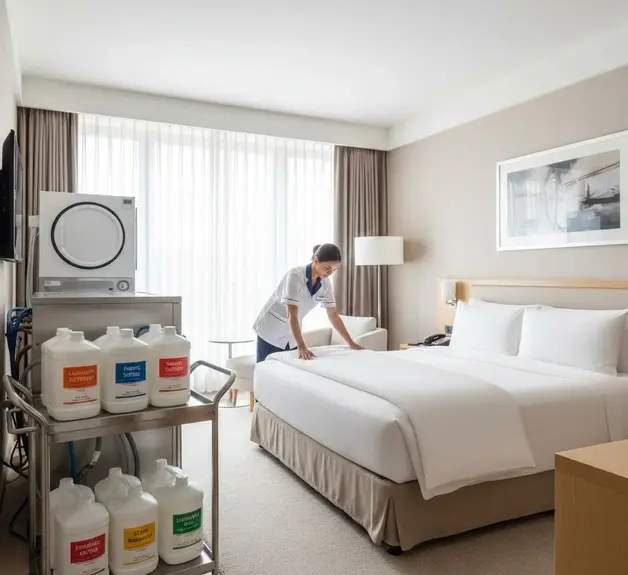
Hotel laundries rely on a precise combination of textile chemicals hospitality agents to process hundreds of kilograms of linen daily.
Typical process flow:
- Pre-wash: Enzyme-based cleaners remove organic matter.
- Main wash: Alkaline detergents and builders lift grease and stains.
- Bleaching: Hydrogen peroxide or chlorine bleach disinfects and brightens.
- Rinsing: Neutralizers balance pH and remove residues.
- Finishing: Fabric softeners add smoothness and scent.
Result: Consistent whiteness, freshness, and textile life extension by up to 30%.
What are the main types of laundry chemicals used in hotels?
Hotels use various textile chemicals hospitality products to meet fabric care standards.
| Category | Common Chemicals | Primary Function |
| Detergents | Synthetic surfactants | Soil and stain removal |
| Alkalis | Sodium carbonate, silicates | Boost cleaning power |
| Bleaches | Hydrogen peroxide, sodium hypochlorite | Disinfection, whitening |
| Softeners | Cationic surfactants | Fabric softness |
| Souring Agents | Acetic acid | pH balance |
| Optical Brighteners | Stilbene derivatives | Fabric brightness |
| Emulsifiers | Non-ionic surfactants | Grease removal |
The Clax laundry chemicals list by Diversey is a leading industry reference for hotel textile care formulations.
How are textile chemicals hospitality applications managed safely?
Proper handling of textile chemicals in hospitality ensures worker safety and guest well-being.
Safety practices include:
- Wearing PPE such as gloves and goggles during use.
- Storing chemicals in labeled, ventilated areas.
- Following MSDS (Material Safety Data Sheets) for each chemical.
- Implementing automatic dosing systems to prevent overuse.
- Training housekeeping and laundry staff regularly.
Unilever Professional and ORAPI Asia recommend standardized dosing for each fabric type to maintain both hygiene and fabric life.
How are textile chemicals in hospitality evolving towards sustainability?
Eco-friendly innovations are transforming textile chemicals hospitality into greener systems.
Recent trends:
- Biodegradable surfactants reducing aquatic toxicity.
- Low-temperature detergents lowering energy use.
- Water recycling systems minimizing wastewater discharge.
- Enzyme-based formulations replacing harsh oxidizers.
In India, sustainable textile chemical solutions are increasingly adopted in premium hospitality chains, aligning with global ESG commitments.
What are examples of textile chemicals used in hospitality?
Some common textile chemicals hospitality examples include:
- Hydrogen Peroxide: Disinfectant and bleaching agent.
- Sodium Carbonate: Laundry alkali booster.
- Nonionic Surfactants: Effective against oil-based stains.
- Cationic Softeners: Adds fragrance and smoothness.
- Optical Brighteners: Keeps linens visibly white under UV light.
These chemicals are crucial for both small and large-scale hotel laundries across India.
Conclusion
Textile chemicals hospitality products are integral to achieving hygiene, luxury, and sustainability standards across global hotels. As the industry advances toward eco-conscious operations, smart chemical management defines both guest satisfaction and environmental responsibility. For a deeper industry perspective, explore our related feature on textile chemicals fair to understand emerging innovations shaping textile care globally.
FAQ
What are the chemicals used in the textile industry?
They include dyes, detergents, softeners, finishing agents, and bleaching compounds used for cleaning and finishing fabrics.
What are the chemical hazards in the hospitality industry?
Exposure to acids, alkalis, and disinfectants may cause skin, eye, or respiratory irritation if not handled properly.
What chemicals are used in hotels?
Hotels use detergents, bleaches, air fresheners, disinfectants, and fabric softeners for cleaning and laundry.
What are the chemicals used in housekeeping?
Housekeeping uses surface cleaners, sanitizers, glass cleaners, and laundry detergents to maintain hygiene.
Sources
- https://www.textilesphere.com/2024/11/the-role-of-textile-chemicals-in-the-textile-industry.html?m=1
- https://unilever-professional.com/collections/chemicals-used-in-hotel-housekeeping
- https://hospitality.institute/bha205/top-laundry-agents-hotel-industry/
- https://rainchem.com/commercial-laundering-and-fabric-care
- https://www.intertek.com/textiles-apparel/chemical-testing/