
The chemistry of Textile chemicals and auxiliaries are essential components in contemporary textile production. From improving dye uptake to enhancing fabric durability, these chemicals are indispensable. How do they work, and why are they critical for both industrial efficiency and fabric quality? This article delves into the key aspects, mechanisms, and applications of textile auxiliaries, providing a structured overview for students, researchers, and industry professionals alike.
Key Takeaways:
- Textile auxiliaries optimize dyeing, finishing, and processing.
- Modern auxiliaries improve efficiency, sustainability, and fabric quality.
- Green and innovative chemicals are redefining efficiency and sustainability in textile manufacturing.
What is the chemistry of textile chemicals and auxiliaries?
The chemistry of textile chemicals and auxiliaries involves understanding chemical reactions and interactions that modify fabric properties. Key points include:
- Definition: Substances added to textiles to aid processing, dyeing, or finishing.
- Function: Improve wetting, penetration, fixation, and fabric softness.
- Types: Surfactants, binders, softeners, emulsifiers, and pH regulators.
- Example: Cationic auxiliaries enhance dye uptake in cotton fibers.
How do textile auxiliaries chemicals work in fabric processing?
Textile auxiliaries chemicals facilitate uniform processing and fabric quality:
- Scouring agents – Remove natural oils and impurities.
- Bleaching agents – Oxidize residual color to produce white fabrics.
- Dyeing auxiliaries – Improve dye solubility and penetration.
- Finishing agents – Impart softness, water repellency, or crease resistance.
- Mechanism: Most act through surfactant properties or chemical bonding with fibers.
What are the main types of textile auxiliary chemicals?
Textile auxiliaries chemicals are classified based on functionality:
| Type | Function | Example |
| Wetting agents | Improve fabric penetration | Non-ionic surfactants |
| Softening agents | Increase fabric hand feel | Quaternary ammonium salts |
| Antifoaming agents | Reduce foam during processing | Silicone-based agents |
| Dyeing auxiliaries | Enhance color fastness and uniformity | Levelling agents |
| Finishing agents | Impart specialty properties | Fluorochemicals |
How is the chemistry of textile chemicals applied in dyeing?
In dyeing, chemistry of textile chemicals and auxiliaries ensures:
- Uniform dye distribution: Surfactants reduce surface tension.
- Enhanced fixation: Mordants or reactive agents improve fastness.
- Modern chemical auxiliaries improve sustainability by reducing water and energy demands
- Example: Reactive dyes with cationic auxiliaries give vibrant cotton colors.
What are the safety and environmental considerations?
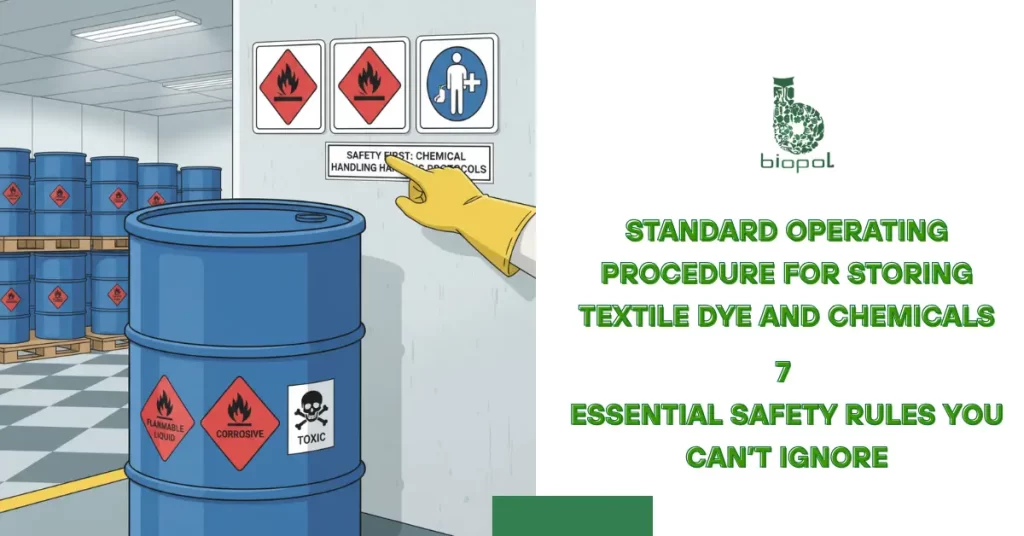
Textile chemicals require careful handling due to potential hazards:
- Wear the correct personal protective gear during chemical handling.
- Ensure proper PPE is used while managing textile chemicals.
- Follow proper disposal protocols to prevent water pollution and environmental harm.
- Maintain adherence to the environmental and textile regulations enforced by CPCB and the Ministry of Textiles..
How do textile auxiliaries improve industrial performance?
Textile auxiliaries contribute to improved manufacturing performance by:
- Reducing processing time and water usage.
- Enhancing fabric durability and softness.
- Enabling specialty finishes like anti-wrinkle, flame retardant, or water-repellent fabrics.
- Real-world example: Large-scale cotton mills in Tirupur achieve 20–30% efficiency gains using modern auxiliaries.
What are the emerging trends in textile chemical research?
- Producing environmentally safe auxiliaries with enzyme-based or biodegradable components.
- Smart textiles with functional coatings (UV protection, antibacterial finishes).
- AI-driven formulations for predictive processing outcomes.
- Integration with sustainable fashion initiatives globally.
Conclusion
The chemistry of textile chemicals and auxiliaries is essential for modern textile production, balancing efficiency, performance, and sustainability. Understanding their mechanisms allows manufacturers to optimize processes while reducing environmental impact. For further insights into the production side, explore our detailed article on construction and textile chemicals manufacturers to understand supplier innovations and applications.
FAQ
What are textile auxiliaries?
Textile auxiliaries are chemicals used to assist fabric processing, dyeing, and finishing.
What are auxiliaries in chemistry?
Auxiliaries in chemistry are substances that aid chemical reactions without being consumed.
What are auxiliary chemicals?
Auxiliary chemicals support primary chemicals in processes like wetting, bleaching, and dyeing.
What is textile chemistry?
Textile chemistry studies chemical processes applied to fibers, yarns, and fabrics to enhance properties.
Sources
https://www.bluelakechem.com/what-are-textile-auxiliaries/
https://ebooks.inflibnet.ac.in/hsp09/chapter/introduction-to-textile-auxiliaries/
https://www.textilesresources.com/articles/top-chemicals-used-in-the-textile-industry/
https://fineotex.com/textile-chemicals/