Silicone adhesive is a high-performance sealant valued across automotive, construction, and electronics industries for its exceptional flexibility and resistance to extreme temperatures, moisture, and chemical exposure. Adhesion challenges often call for materials that can withstand dynamic movement, extreme environmental stress, and chemical exposure without degrading. Ordinary glues and bonding materials have proven unreliable in scenarios of thermal expansion and constant exposure to moisture. Silicone adhesives are highly effective in such conditions.
Silicone adhesives are made up of an inorganic backbone of silicon-oxygen, making them the best option for bridging the two extremes of structural bonding and elastic sealing.
Table of Contents
What is a Silicone Adhesive and How Does It Function?
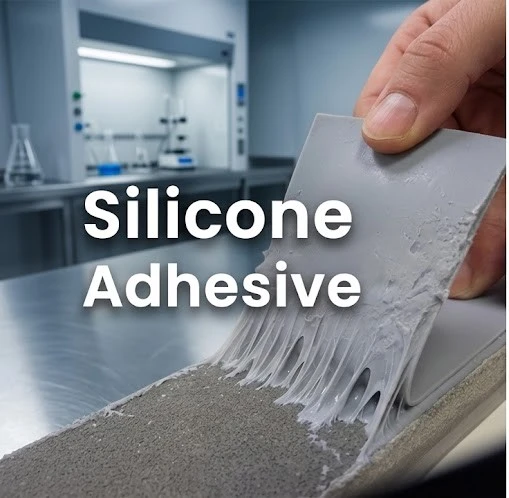
A adhesive for silicone is an elastic material used in bonding that is composed of silicone polymers, cross-linkers, fillers (for example, fumed silica), and catalysts. In contrast to solvent-volatile glues or non-elastic epoxies, silicone adhesives set via chemical reaction, which can be catalyzed by moisture in the air (RTV/Room Temperature Vulcanizing) or by heating.
Once set, the fluid/paste material sets into a durable and rubber-like substance. The material not only chemically reacts with surface oxides but physically locks onto the surfaces, enabling the bonded joint to withstand shock, vibrations, and temperature changes without breaking or releasing adhesion.
Performance Comparison
| Performance Characteristic | Silicone Adhesives | Organic/Epoxy Adhesives |
| Elasticity & Flexibility | Exceptional (Maintains high elongation) | Low to moderate (Often rigid) |
| Temperature Range | Broad (-60°C to +250°C+) | Limited (-20°C to +100°C) |
| Moisture & UV Resistance | Outstanding (Hydrophobic, zero UV breakdown) | Variable (Prone to yellowing & embrittlement) |
| Curing Mechanism | Moisture-cure (RTV), heat-cure, or 2-part mix | Solvent evaporation or chemical heat reaction |
| Substrate Stress Distribution | Distributes mechanical stress uniformly | Concentrates stress along rigid joint lines |
Key Performance Advantages
- Thermal and Environmental Stability: Maintains flexibility at sub-zero freeze temperatures as well as high-temperature operation.
- Hydrophobic Sealant: Totally water repellent; it is absolutely essential in applications where waterproofing, waterproof sealing, and exterior enclosures are required.
- Chemical & Electrical Insulation: Resistant to acids, bases, and environmental contaminants; it also works well as an electrical insulator.
Final Thoughts
adhesive for silicone presents an interesting combination of high elasticity, heat resistance, and environmental stability. Regardless of whether one uses it to seal architectural glass windows, to insulate sensitive electronic circuitry or to bond parts within stringent automotive assemblies, selecting the right formula of silicone is essential to the proper functioning of the joint.
Advance Your Bonding Solutions with Biopol Chemicals
For high-quality technical silicone polymers, sealants, or raw materials for the production of chemicals, Biopol Chemicals provides you with an extensive line of industrial-grade silicone products.
Frequently Asked Questions (FAQs)
1. What distinguishes silicone adhesive of one component (1K) from those of two components (2K)?
While 1K silicones react with the moisture in the air and are perfect for sealant tasks, 2K silicones combine a base and a curing agent to fasten in an instant without depending on the humidity or the depth of the joint.
2. Is it important to clean the surface prior to applying silicone adhesive?
Cleaning the surface is very important since any trace of oils, dust, or moisture hinders a good chemical reaction. Degreasing substrates with solvent ensures excellent adhesion strength.
3. What does the term ‘acetoxy-cure’ mean when it comes to adhesive for silicone ?
Acetoxy silicone adhesives contain acidic compounds that will eat away at some electronic parts or metal, while neutral ones emit non-corrosive alcohol.
4. Are there any special industrial silicone adhesive that may be custom-tailored to specific requirements?
Certainly, they can be tailored as per the industrial chemical supplier’s request regarding viscosity, curing rate, and thermal characteristics.