The silicones global market continues to expand as manufacturers seek materials capable of maintaining performance under demanding operating conditions. Silicone has evolved from a specialty polymer into an important material used across construction, automotive, electronics, healthcare, personal care, food-contact products and industrial manufacturing.
The attributes of thermal stability, flexibility, chemical resistance, durability, and weather resistance make silicones ideal for application areas where ordinary organic polymers might not suffice. The estimates of the market size are variable depending on the type of product and application area. The worldwide silicones market size was valued at USD 24.3 billion in 2025, and the forecasted size is USD 37.3 billion by 2033.
Key Takeaways
- Silicones serve diverse industries worldwide with versatile performance.
- Food-grade and medical-grade silicones require different compliance considerations.
- Specialty formulations create opportunities for silicone manufacturers worldwide.
Silicones Global Market at a Glance
| Market Factor | Current Industry Direction |
| Major product forms | Elastomers, fluids, resins and gels |
| Major industries | Construction, automotive, electronics, healthcare and industrial |
| Key properties | Thermal stability, flexibility and chemical resistance |
| Major regional demand | Asia-Pacific |
| Emerging opportunities | Medical devices, electronics, energy and specialty formulations |
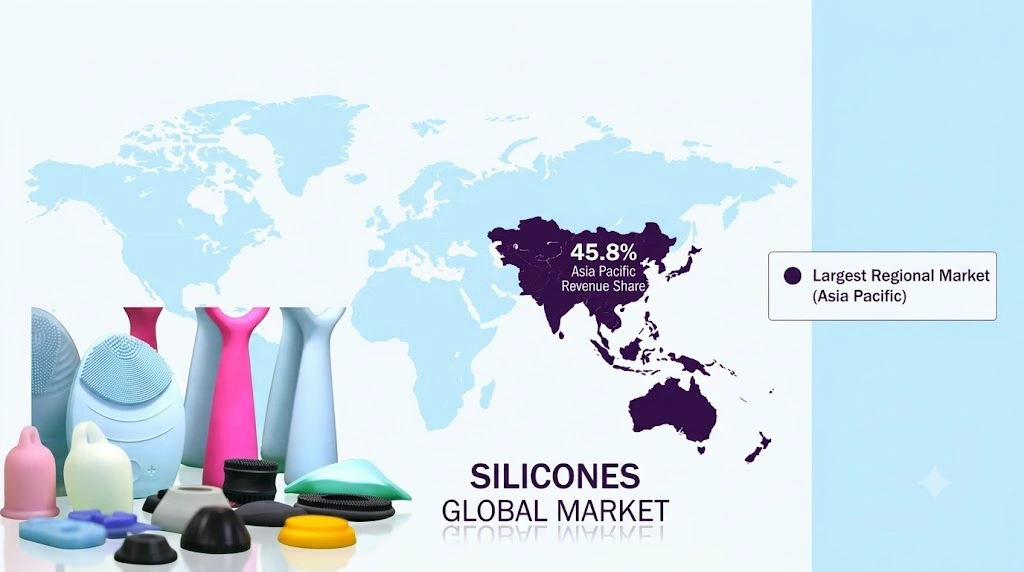
Asia-Pacific remains an important manufacturing and consumption region. According to earlier research, it accounted for 45.8% of global silicone market revenue in 2025.
What Is Driving the Silicones Global Market?
Several industries are increasing their use of silicone-based materials.
1. Automotive Manufacturing
Silicones are used in automotive seals, gaskets, hoses, adhesives, encapsulants and thermal-management applications. Their resistance to temperature variation and environmental exposure makes them useful in demanding vehicle environments.
The transition toward electric vehicles is also creating opportunities for silicone materials in battery systems, electrical insulation and thermal-management components.
2. Construction and Infrastructure
Silicone sealants and adhesives are widely used for glazing, weather sealing, façades, bathrooms and other construction applications. Their resistance to moisture, UV exposure and temperature fluctuations supports long service life.
3. Electronics
Electronic devices require materials that provide insulation, protection and thermal stability. Silicone encapsulants, coatings, adhesives and thermal-management materials can protect sensitive components from moisture, vibration and environmental exposure.
4. Healthcare
Healthcare represents another important area for specialty silicone. Medical-grade silicone is used in products such as tubing, seals, prosthetic components, medical devices and selected implantable applications. Market research indicates continuing growth in medical-grade silicone demand as healthcare manufacturers seek flexible and biocompatible materials.
Chemistry Behind Silicone Materials
Unlike many carbon-based polymers, silicone has an inorganic silicon-oxygen backbone. Its basic structure can be represented as:
–Si–O–Si–O–Si–
Organic groups, commonly methyl groups, are attached to the silicon atoms. This molecular arrangement contributes to silicone’s characteristic flexibility, thermal stability and resistance to environmental conditions.
| Chemical Property | Contribution |
| Si–O backbone | Supports thermal and chemical stability |
| Flexible siloxane bonds | Provides elasticity |
| Organic side groups | Allows formulation and property modification |
| Cross-linked network | Provides strength and shape retention |
| Hydrophobic character | Helps resist moisture |
The ability to modify silicone chemistry through molecular weight, fillers, cross-linking systems and additives allows manufacturers to produce materials for very different applications.
Chemistry of Food-Grade Silicone
Food-contact silicone is formulated for applications where the finished material may come into contact with food. Common examples include baking moulds, seals, tubing, kitchenware and food-processing components.
Many high-performance food-contact silicone products use platinum-catalyzed addition curing. In this process, silicone components cross-link without the same type of peroxide decomposition by-products associated with peroxide curing.
However, “food-grade” is not simply a chemical composition. The finished product and its intended use must meet the applicable regulatory requirements such as FDA certification.
Important Properties
- High and low temperature flexibility
- Low moisture absorption
- Chemical stability
- Good release properties
- Resistance to repeated heating and cooling
- Suitability for selected food-contact applications
Manufacturers should verify the specific formulation, curing process, additives and compliance documentation before describing a silicone product as food-contact compliant.

Silicone Chocolate Molds: Food Grade Silicone
Chemistry of Medical-Grade Silicone
Medical-grade silicone is designed for applications requiring controlled material properties and appropriate biological safety evaluation. It can be supplied as liquid silicone rubber (LSR), high-consistency rubber (HCR), gels, adhesives, coatings and other forms.
The chemistry still relies on the silicone polymer backbone, but the manufacturing and qualification requirements are more demanding for medical applications. Medical-grade silicone drives the silicones global market mainly in the healthcare domain.
| Property | Food-Grade Silicone | Medical-Grade Silicone |
| Primary consideration | Food-contact safety | Biological safety and intended medical use |
| Common forms | LSR, HCR, molded silicone | LSR, HCR, gels, adhesives, tubing |
| Key characteristic | Chemical stability | Biocompatibility and controlled performance |
| Testing | Applicable food-contact regulations | Application-specific biological evaluation |
| Typical uses | Moulds, seals, kitchenware | Tubing, devices, prosthetics and selected implants |
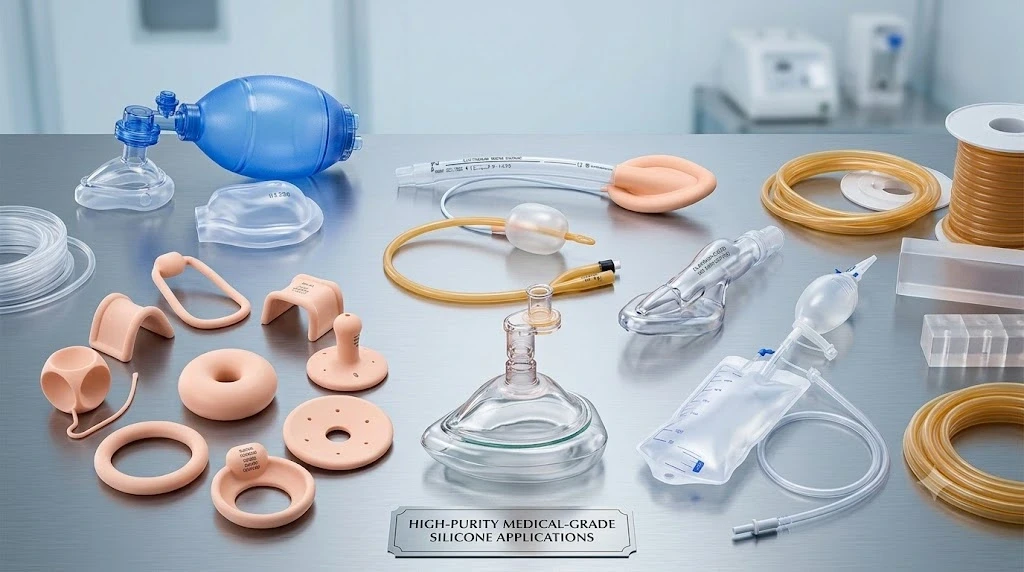
Medical Grade Silicone
Major Silicone Product Categories
The silicones global market is dominated by these material forms:
| Silicone Type | Common Applications |
| Silicone Elastomers | Seals, gaskets, tubing and molded components |
| Silicone Fluids | Personal care, lubricants and industrial formulations |
| Silicone Resins | Coatings, electrical and high-temperature applications |
| Silicone Gels | Healthcare, cushioning and specialty applications |
| Liquid Silicone Rubber | Precision molding and medical/consumer products |
| Silicone Adhesives & Sealants | Construction, electronics and industrial assembly |
Opportunities Ahead
Manufacturing companies face new market opportunities that go beyond providing standard silicone compounds. Customers have needs for customized hardness, curing system, color, thermal and chemical resistance, food contact approval or medical device approval.
In the medical sector, current needs are for elastomers, gels, adhesives, coatings, and LSR used for a variety of applications, including prosthetics, drug delivery systems, among others.
Quality control, batch tracking, consistent formulation, and proper testing are especially critical when providing materials for regulated applications.
Final Thoughts
The silicones global market reflects the expanding role of high-performance materials across modern manufacturing. From construction sealants and automotive components to electronics, food-contact products and medical devices, silicone’s distinctive chemistry enables manufacturers to address a wide range of performance requirements.
In silicone manufacturing, it is becoming more about the formulation for specific applications and its qualification, not just the commodity materials alone. The food-grade and medical-grade applications show why it is equally important to have proper formulation, process, testing, and documentation.
With the ongoing demands for materials that have flexibility, toughness, thermal stability, and chemical resistance, the silicones global market will still play a critical role in future innovations.
Frequently Asked Questions
1. What silicone grades does Biopol Chemicals manufacture?
As a silicone manufacturer, we can develop and supply silicone formulations in different forms and hardness ranges according to application requirements, including LSR, HCR and specialty compounds.
2. Can you supply food-grade silicone for direct food contact?
Yes, suitable silicone formulations can be developed for food-contact applications. The final product should be evaluated against the applicable requirements, such as FDA 21 CFR 177.2600 or relevant international standards, based on its intended use.
3. Do you manufacture medical-grade silicone?
Medical applications require application-specific material selection, controlled manufacturing and appropriate biological evaluation. We can discuss suitable silicone formulations and documentation requirements based on the intended medical device and contact conditions.
4. Can you develop customized silicone compounds?
Yes. Silicone compounds can be customized for parameters such as hardness, color, curing system, temperature resistance, flexibility, mechanical performance and application-specific requirements. Customers should provide their operating conditions and regulatory requirements so the appropriate formulation can be selected.
Also Read: Silicone Swim Cap