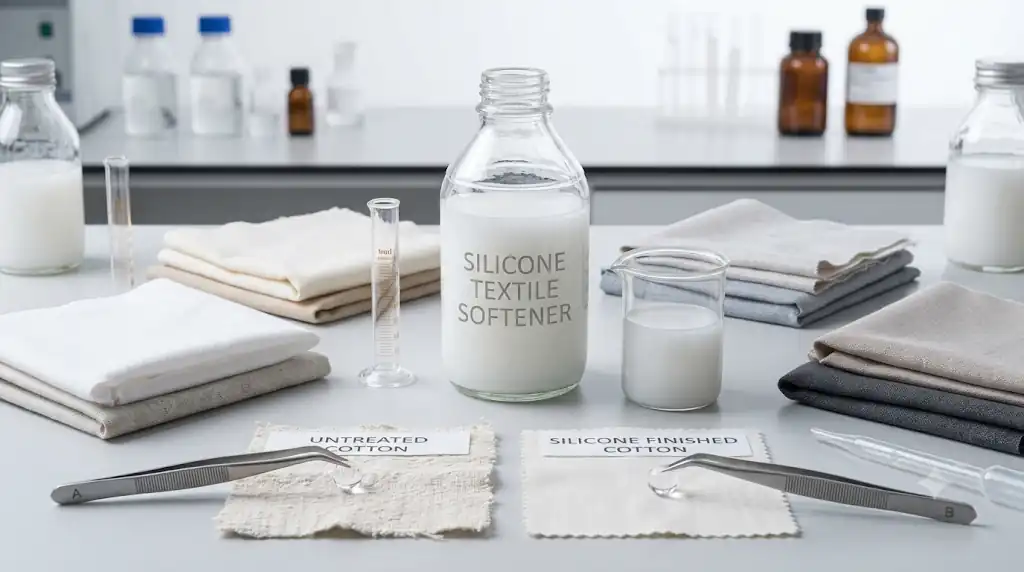
Silicones uses and properties in textile softeners all trace back to one idea: a flexible, slippery polymer chain that coats each fibre and lets it glide against its neighbours. That glide is what a shopper feels as softness and what a finishing mill sees as better drape and handle. This guide explains how silicone softeners work, the main types, where each one fits, what can go wrong, and how to apply them with fewer surprises.
Few finishing chemicals have such a wide reach. Technical reviews describe silicones as some of the most widely used softeners in textile finishing, and silicone softeners in textiles now appear on everything from cotton knits to sportswear.
Key Takeaways
- Silicone softeners rest on a polysiloxane chain of alternating silicon and oxygen atoms, which is highly flexible and has low surface tension.
- They soften by lowering fibre-to-fibre friction, leaving fabric smoother and more elastic.
- Amino grades feel softest but can yellow, polyether grades absorb water, and epoxy grades feel drier.
- Silicones uses and properties in textile softeners span cotton knits, towels, sportswear, wool and nonwovens.
- Overdosing, unstable emulsions and the wrong bath pH cause most problems.
- In the EU, D4, D5 and D6 cyclic siloxanes are restricted at 0.1% or more after 6 June 2026.
What Are Silicone Softeners and How Do They Work?
A silicone softener is a finishing product built on polysiloxane, usually polydimethylsiloxane (PDMS) or a modified form of it. It is normally applied after dyeing as one of several water-based silicone emulsions, forming a very thin layer over each fibre. That layer is the core idea behind silicones uses and properties in textile softeners.
Softness comes down to friction. Silicone-coated fibres glide over one another more easily, so fabric bends, hangs and recovers with less effort. Reviews credit the flexible chain and its low surface tension, which help the film spread evenly.
Modified grades go further. Their amino groups hydrogen-bond to hydroxyl and amino sites in cotton, wool, silk and polyamide, anchoring the film in place. A well-chosen silicone softener for textiles therefore keeps its feel after repeated washing.
Key Properties of Silicone Softeners
The chemistry behind silicones uses and properties in textile softeners is easy to summarise: a stable, flexible backbone that sits well on fibres. Five features matter most.
- Flexible backbone: the silicon-oxygen chain rotates freely, and its methyl side groups attract each other only weakly. Si-O bonds also take less rotational energy than C-O bonds, which helps explain the soft feel.
- Low surface tension: methylsilicone oils measure about 18.7 to 21.5 mN/m depending on viscosity, well under mineral oils and most organic liquids, so they spread and wet fibres readily.
- Very low glass transition: reported values of roughly -100 to -120 °C keep the chain elastic and give finished fabric its spring.
- Thermal and oxidative stability: useful on finishing lines, where temperatures usually stay below 215 °C and often under 175 to 200 °C.
- Adjustable water behaviour: a methyl-rich surface repels water, while polyether groups make it hydrophilic, so the properties of silicone softeners can be tuned from water-repellent to absorbent.
Silicones Uses and Properties in Textile Softeners by Type
This table compares the properties of silicone softeners across the main types in the technical literature.
| Type | Hand feel | Main strength | Watch out for |
| Amino silicone | Smooth, silky, springy | Good wash resistance, better tear strength | Slight yellowing; emulsion may break and leave oil spots |
| Epoxy-modified | Dry, resilient | Better tear strength; suits water-repellent soft finishes | Lacks fullness; not hydrophilic |
| Polyether-modified | Smooth, less plush | Hydrophilic, no yellowing, instant water uptake | Softness and absorbency fade faster |
| Amino/polyether | Better hand than polyether alone | Balances softness and absorbency | Slightly more yellowing |
| Multiblock copolymer | Full, fluffy, silky | Hydrophilic, stable, low yellowing, easy to disperse | Varies by grade, so trial first |
Emulsion size matters too. Macro-, micro- and nano-emulsions look different, and nano-emulsions are transparent and enter the fabric interior more easily. In one knitwear study, nano-silicone improved pilling resistance but weakened abrasion resistance, with colour fastness largely unaffected. Quaternary-modified grades are reported to stand up well to alkali and shear.
Four Generations of Silicone Softeners
The history of silicones uses and properties in textile softeners explains why today’s products differ from early ones. Over the decades, silicones for textile softening have moved from plain oils to engineered copolymers.
- First (1950s and 1960s): plain PDMS oils with weak wash resistance and unstable emulsions, now used mostly as yarn lubricants and fibre treatments.
- Second (from the 1980s): amino and epoxy-modified polysiloxanes with much better wash durability.
- Third (1990s): polyether-modified types, more emulsion-stable and hydrophilic.
- Fourth (around 2000): linear multiblock copolymers combining softness, hydrophilicity and low yellowing.
How Silicone Softeners Compare with Other Softener Families
Each softener family has its own trade-offs, so silicones uses and properties in textile softeners are best judged against the alternatives
- Cationic: the best softening among classic agents, fairly good wash durability, plus antistatic and even antibacterial effects. They can lower the light fastness of direct and reactive dyes and raise soiling.
- Non-ionic: heat-resistant and hardly yellowing, so a good fit for optically brightened whites and knits.
- Amphoteric: a milder softening effect, but added antistatic behaviour and hydrophilicity, and gentle on skin, so they suit hygiene products and towels.
- Anionic: negatively charged carboxyl, sulfonate or phosphate groups, which need a sulfonation or phosphate step in manufacture.
- Silicone: reviews rate silicones as more effective than the other families, with a hand from silky to dry and behaviour from hydrophobic to hydrophilic.
Main Uses of Silicone Softeners in Textiles
Silicones uses and properties in textile softeners are closely linked, since the chemical type decides where a product performs best. The uses of silicone softeners reach well beyond a soft T-shirt.
- Cotton knits and wovens: amino silicone softeners are widely used on cotton. One study found an amino-functional silicone outperformed cationic and non-ionic types on knitted cotton, and another reported better whiteness and softness on white cotton.
- Towels and absorbent goods: polyether and multiblock grades soften while keeping water uptake.
- Sportswear and technical wear: silicones help produce light, durable, water-repellent sportswear that stays breathable, often through water repellent finishes.
- Wool, silk and polyamide: amino groups bond with these fibres, adding elasticity and a soft handle.
- Polyester and other synthetics: hydrophobic silicone segments interact strongly with polyester, and amino grades give an especially soft hand on non-polar fibres.
- Natural-fibre blends: a jute-cotton knit treated with an enzyme and an amino silicone shifted from water-repellent to water-absorbing, and its moisture-management rating rose from very poor to good.
- Home laundry conditioners: researchers have blended amino silicone oil into an esterquat and guar softener base. The vesicle structure was unaffected and the formulation stayed stable.
- Beyond softening: silicones also serve as fibre and thread lubricants for high-speed sewing, water repellents, and silicone defoamers in dyeing, bleaching and washing. Silicone rubber coatings, used on architectural fabrics and parachutes, are a separate use.
Benefits of Silicone Softeners in Textiles
When silicones uses and properties in textile softeners suit the fabric, mills usually gain the following:
- A smoother, softer handle from lower fibre friction.
- Better elasticity, stretch recovery and crease recovery.
- Higher tear strength and easier sewing with several modified grades.
- Softness that survives repeated washing when the finish is well anchored.
- Good results at very low dosages.
- Less pilling in some cases, and antistatic help from certain polyether grades.
Limitations and Common Problems
No finish is perfect, and silicones uses and properties in textile softeners carry trade-offs worth knowing early.
- Yellowing: amino types can discolour fabric slightly, which matters most on whites and pale shades.
- Whiteness and shade: effects depend on the grade. One amino emulsion barely changed whiteness and left dyed shades untouched on cotton, while a polyether-amino grade gave better whiteness than a standard amino type.
- Oil spots: amino emulsions are pH-sensitive. In an alkaline bath the ammonium groups lose protons, emulsion stability falls, and oil spots may appear.
- Greasy handle: older amino silicones can feel too greasy, and dosage matters. A knitted-cotton study found comfort peaked at 1% softener and fell beyond it.
- Lower absorbency: epoxy finishes are not hydrophilic, and one study reported weaker moisture transfer and air permeability with some silicone coatings on cotton knits.
- Flammability: in one study, silicone-treated polyester burned more readily than untreated fabric.
- Bath compatibility: test the softener with other finishing chemicals before bulk runs.
How to Apply Silicone Softeners Step by Step
Knowing silicones uses and properties in textile softeners helps, but results still depend on process control and on the textile finishing chemicals used alongside them.
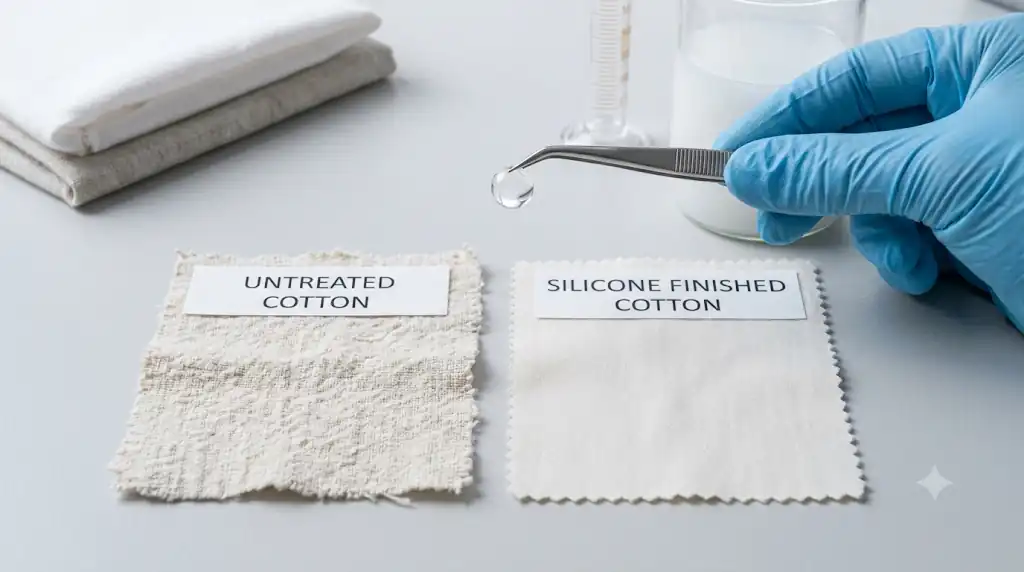
- Match the grade to the fibre and end use with the type table above.
- Dilute the emulsion to the strength your fabric needs, following the supplier’s technical data sheet.
- Apply by padding or exhaustion; spraying suits targeted jobs.
- Keep the bath mildly acidic for amino types, since transfer to the fibre improves at lower pH.
- Prepare the fabric well. Wetting agents help the liquor wet and penetrate the cloth, and hydrophobic silicone finishes need leftover surfactants removed first.
- Dry and cure as the supplier advises. For water-repellent silicone finishes, the literature describes drying at 100 to 120 °C, then heating at 150 to 155 °C for 3 to 4 minutes. Reactive Si-H grades need roughly 120 to 150 °C, while plain PDMS needs about 100 °C more but feels softer.
- Run a small trial and check handle, whiteness, absorbency and wash durability before bulk production.
Choosing the Right Silicone Softener for Textiles
Once you understand silicones uses and properties in textile softeners, choosing a grade comes down to three questions: which fibre, which end use and which process?
- Soft hand on cotton knits: amino-functional grades.
- Towels and activewear that must absorb water: polyether or multiblock grades.
- White or pale goods: low-yellowing grades, confirmed by a trial.
- Alkaline or high-shear processes: quaternary-modified grades.
- Compliance: ask suppliers for cyclic siloxane content and REACH status.
Environmental and Regulatory Points to Know
Sustainability questions now sit beside silicones uses and properties in textile softeners in most buying discussions. A peer-reviewed review in Polymers reports that methyl silicones showed no harmful environmental effect in testing and no sign of toxicity to aquatic, land or bird life.
Rules on cyclic siloxanes are tightening, though. Under EU Regulation 2024/1328, D4, D5 and D6 may not be placed on the market, alone, as constituents or in mixtures, at 0.1% or more by weight after 6 June 2026, with some listed exemptions. Some silicone fluids contain cyclic siloxanes and some suppliers now offer reduced-level grades, so request the data and read the safety data sheet.
Where Silicone Softeners Are Heading
silicones uses and properties in textile softeners keep evolving. Nano-emulsion softeners are reported to be spreading quickly in industry, since the fine droplets reach deep into the fabric. Multiblock products aim to combine softness, absorbency and low yellowing. Reviews also see room for new silicone compounds to improve fabric performance, and even a future role in therapeutic medical textiles.
FAQ
What is silicone softener used for in textiles?
It makes fabric softer, smoother and more elastic, and some types also improve tear strength, sewing and crease recovery. Silicones uses and properties in textile softeners include water repellence or absorbency too, so the uses of silicone softeners vary by fabric.
What is the difference between cationic and silicone softeners?
Cationic softeners are the strongest of the classic types and wash fairly well, but they can reduce dye light fastness and raise soiling.Reviews rate silicones as more effective overall, and silicones uses and properties in textile softeners cover a wider hydrophobic to hydrophilic range.
Why does silicone softener turn fabric yellow?
Amino silicones are the usual cause, as they tend to discolour fabric slightly. Polyether and multiblock grades yellow less.
Does silicone softener wash out?
A well-anchored finish lasts. Reviews say silicone-treated textiles stay soft after repeated washing, and one amino emulsion kept about 60% of its feel after several washes.
Is silicone softener eco-friendly?
PDMS-based finishes are described as a minor environmental concern, but the EU now restricts cyclic siloxanes D4, D5 and D6. Check the supplier’s safety data sheet and local rules.
Bottom Line
Silicones uses and properties in textile softeners explain why these finishes dominate modern fabric care: a flexible siloxane chain, low surface tension and adjustable chemistry deliver softness, elasticity and durability on almost every fibre. Match the type to the fibre and end use, control dosage, pH and yellowing, and confirm cyclic siloxane compliance before scaling up. Choose the right silicone softener for textiles, test small, measure handle and absorbency, then roll out.