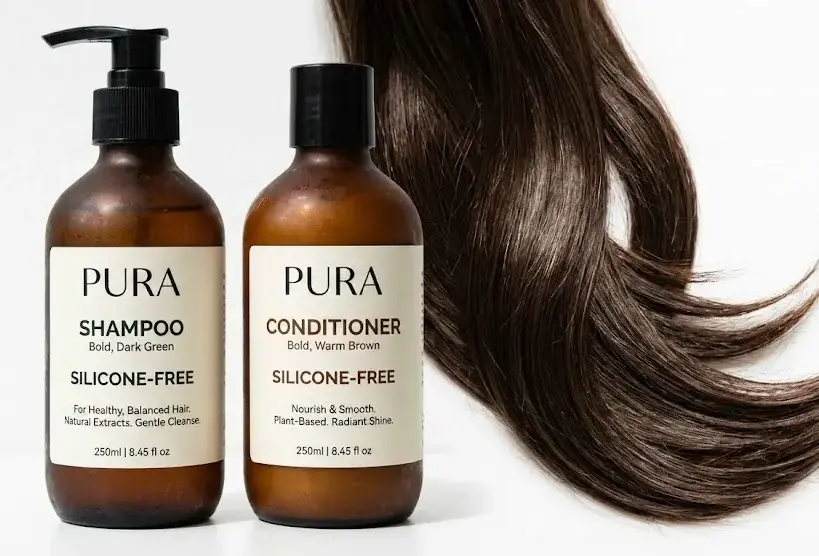
Silicone fluid (also known as silicone oil or polydimethylsiloxane / PDMS) is a synthetic liquid polymer featuring an inorganic silicon-oxygen backbone with organic methyl side chains.
That hybrid design explains almost everything about it. The inorganic backbone brings heat and chemical resistance, while the methyl groups keep the molecules slippery and water-repellent. The result is a clear liquid with almost no smell that barely changes when conditions get tough.
You have probably met it already in a hair serum, a car polish or a damped control knob. This guide covers what it is, how factories make it, which types exist, how it compares with mineral oil and how to choose the right grade. Safety and handling notes are included too.
Key Takeaways
- It is a synthetic liquid polymer with a silicon-oxygen backbone and methyl side chains.
- Thickness runs from thinner than water to almost solid, depending on chain length.
- Heat, cold, oxidation and shear affect it far less than they affect mineral oils.
- Silicone fluid comes in dimethyl, phenyl, amino, fluoro and volatile types.
- It lubricates rubber and plastic well but not heavily loaded metal parts.
- Above about 150°C in air it can release formaldehyde, so ventilate when heating.
- Match viscosity, type and certification to the job before buying.
What Is Silicone Fluid?
In practice, the grade most people mean is the dimethyl type. Instead of the carbon chain found in petroleum oils, its backbone alternates silicon and oxygen atoms, the same linkage found in quartz and glass. That hints at the toughness.
The backbone is the secret. Silicon-oxygen bonds are stronger than carbon-carbon bonds, so the liquid shrugs off heat, oxidation, mechanical stress and many chemicals.
Each silicon atom also carries methyl groups. They keep neighboring chains from clinging together, so the chains glide past one another. Surface tension ends up very low, roughly 19 to 22 dynes per centimeter, so a drop spreads quickly over skin, fabric or rubber.
You will also see it sold as silicone oil, and some labels say silicone liquid instead. Chain length sets the thickness. Grades start near 0.65 centistokes, which is thinner than water, and climb into the millions.
How Silicone Fluid Is Made
The story starts with ordinary sand. Silica is refined into elemental silicon, which is then reacted with methyl chloride at high temperature over a copper catalyst. This direct route is called the Rochow process.
The reaction produces a mix of chlorosilanes. Dimethyldichlorosilane is the one that matters most, and distillation separates it from the rest.
Water is added next. The chlorosilane hydrolyzes into silanols, which condense into short chains and small rings, with hydrochloric acid as a by-product.
Those rings are then opened and linked into long chains using a catalyst, commonly a strong base. A capping agent such as hexamethyldisiloxane stops the growth at the right point, and the amount used sets the final viscosity.
Finally, the catalyst is neutralized and vacuum stripping removes leftover small molecules. Fine filtration leaves a clear product. Good producers test viscosity, volatile content and purity on every batch.
Key Properties of Silicone Fluid
These are the traits that justify the higher price compared with ordinary oils.
- Thermal stability. Published technical data lists 175°C for 1,000 hours in air and 200°C without oxygen for conventional grades. Phenyl and specialty grades go higher.
- Wide temperature window. Manufacturers quote a working range of about -60°C to +300°C, and conventional grades can have pour points near -70°C. Treat the top figure as a limit and check the data sheet for your grade.
- Steady viscosity. Thickness changes much less with temperature than it does in petroleum oils.
- Low surface tension. The liquid wets and spreads easily, which also makes it an effective antifoam and release agent.
- Shear stability. It resists breaking down under mechanical stress, so it lasts longer in high-speed equipment.
- Water repellency. Water beads off treated surfaces, which is why it shows up in textile and building protection.
- Low volatility. Standard grades evaporate very little, unlike the volatile cyclic types.
- Radiation resistance. It holds up to UV and particle radiation better than most organic polymers.
- High compressibility. About 9% at 20,000 psi, roughly double a typical paraffin oil, which suits dampers and liquid springs.
- Chemical inertness. It contains no acid-forming ingredients, so it does not stain or corrode common materials.
- Electrical insulation. Dielectric strength sits around 360 to 400 volts per mil for conventional grades.
- Low flammability. Typical flash points sit between about 205°C and 260°C.
Heat limits matter for finished products too, so our guide to the silicone melting point is a useful companion read.
Silicone Fluid vs Mineral Oil
This table shows typical comparative values for a standard dimethyl fluid and an additive-free paraffin mineral oil, taken from Gelest’s published comparison.
| Property | Standard dimethyl fluid | Paraffin mineral oil |
| Long service in air (1,000 hours) | 175°C | 130°C |
| Pour point | -70°C | -30°C |
| Surface tension | 19.2 to 21.6 dynes/cm | 21 to 28 dynes/cm |
| Compressibility at 20,000 psi | 9.1% | 4.4 to 4.9% |
| Steel-on-steel wear scar (smaller is better) | 2 to 3 mm | 0.7 mm |
The silicone side wins on temperature range and surface behavior. Mineral oil wins on wear protection between metal parts, which is why gears and bearings still run on oil or grease.
Main Types and Grades
Not every grade is plain polydimethylsiloxane. Gelest groups the family into six classes: conventional, thermal, organic-compatible, fluorosilicone, hydrophilic and low-temperature. Chemists tune each one by swapping or adding groups on the chain.
- Dimethyl (PDMS). The standard grade, used for damping, heat transfer, polishes, release agents and cosmetic bases.
- Phenyl-modified. Phenyl groups lift heat resistance to about 250°C in air for long periods, so these suit hot baths and high-temperature greases.
- Amino-functional. They bond to fibers and hair, which is why they appear in textile softeners and conditioners.
- Volatile (cyclic and low-viscosity). They evaporate cleanly and carry actives in antiperspirants and hair sprays. In the EU, the cyclic types D4 and D5 have been limited to under 0.1% in wash-off cosmetics since 31 January 2020, and wider limits that include D6 have since been adopted.
- Fluorosilicone. Built to resist fuels and solvents in demanding environments.
- Polyether-modified. Water-friendly versions that adjust skin feel in water-based products.
- Low-temperature grades. Specialty fluids reach pour points near -100°C.
- Reactive (hydroxy, vinyl, hydrogen). These are rarely used alone. They are building blocks for sealants and rubber.
How Silicone Fluid Viscosity Relates to Chain Length
Thickness is really a measure of how long the chains are. Wacker’s data shows how quickly chains grow as the liquid thickens.
| Viscosity (mPa·s) | Mean chain length | Molar mass (Da) |
| 0.65 | 2 | 162 |
| 10 | 16 | 1,200 |
| 100 | 70 | 5,200 |
| 1,000 | 200 | 15,000 |
| 10,000 | 500 | 37,000 |
| 100,000 | 1,000 | 74,000 |
Suppliers usually quote centistokes (cSt), which equal mm²/s, while some quote mPa·s. Kinematic viscosity is dynamic viscosity divided by density. Because these fluids have a density around 0.9 to 1.0 g/cm³, the two numbers are close. Always check which unit a data sheet uses.
Forms of Silicone Fluid on the Market
- Neat oil. Used straight from the drum or bottle.
- Solutions. Diluted in solvents and usually supplied at 10% to 50% active content.
- Emulsions. Oil-in-water mixes, usually 20% to 60% active, that dilute easily with water. They are common in textiles, shampoos and household care.
- Pastes and greases. Water-resistant, good electrical insulators and useful as assembly aids.
- Waxes. Fluids modified with long-chain alkyl groups to give different melting points, used in creams and leather care.
- Antifoams. Sold as compounds, emulsions or powders, depending on the foaming system.
Common Industrial and Everyday Uses
Personal care. Shampoos, conditioners, creams and hair oils use it for a light, non-greasy feel. Our guide to silicone in skin care looks at that side in detail.
Textiles and leather. Softeners and water repellents give fabric a smooth hand.
Home and car care. Polishes and protectants use it to leave a slick, glossy film.
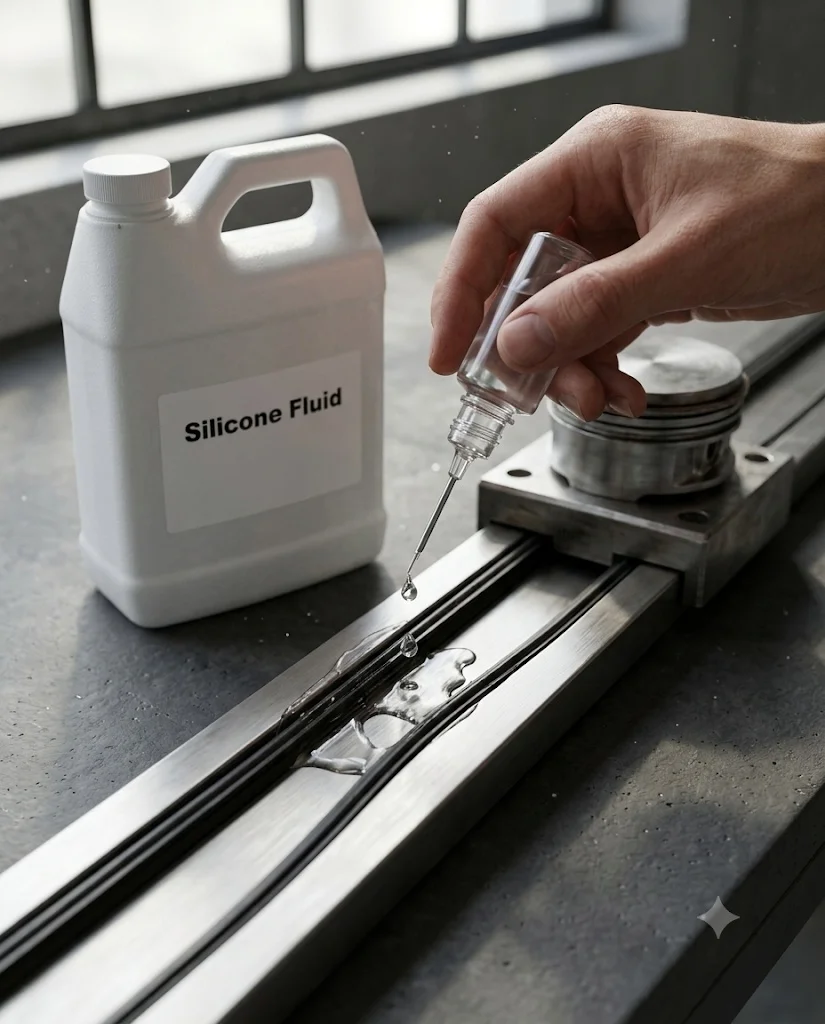
Machinery and electronics. It works as a damping liquid in instruments and shock absorbers, a fluid in viscous clutches, a heat-transfer bath liquid and an insulating oil in capacitors and transformers.
Manufacturing aids. Mold release for rubber, plastics and tires, antifoam in food processing and chemical plants, and slip or leveling additives in paints all rely on it.
Food and pharma. Special grades carry NSF H1 registration for incidental food contact, and others are used to treat vials and syringes.
Agriculture. Silicone-based adjuvants help sprays spread across waxy leaves.
Specialist uses. These include ultrasonic sensors and sonar buoys, fiber optics, diffusion-pump fluids, water-repellent treatment of glass and mineral wool, and drilling fluids.
How to Choose the Right Silicone Fluid Grade
Start with viscosity, because it drives most performance differences.
- Low (about 0.65 to 20 cSt). Cosmetic carriers, light damping and low-temperature baths.
- Medium (about 50 to 1,000 cSt). Heat transfer, mold release, polishes and general lubrication of rubber and plastic.
- High (5,000 cSt and above). Dampers, viscous clutches, and base oil for greases and compounds.
Next, run through a short checklist before you order.
- Operating temperature range, and whether air is present.
- Materials it will touch, such as rubber, plastic, metal or skin.
- Required certification, such as cosmetic, food-contact or electrical grade.
- Risk of contaminating surfaces that will be painted or glued later.
- The supplier’s technical data sheet and safety data sheet for the exact grade.
If you want a quick look at the viscosities and pack sizes on offer before contacting a supplier, a marketplace listing for silicone fluid is an easy way to compare. Always confirm the grade against its technical data sheet.
Is Silicone Fluid Safe to Handle?
For most users, yes. Silicone liquid is chemically inert, with low flammability and low toxicity. Safe handling still matters, though.
- Overheating. Above about 150°C in the presence of air, it can form formaldehyde vapors. Manufacturer safety data sheets describe formaldehyde as an irritant and a potential cancer hazard, so ventilate well or wear suitable protection.
- Slip hazard. Spills make floors extremely slippery, so soak them up with absorbent material and finish with a degreasing cleaner.
- Surface contamination. Even minute traces can cause craters, known as fisheyes, in paint and coatings, so keep it away from those work areas.
- Storage. Keep containers sealed and away from heat and dust.
- Disposal. Do not pour it down drains. Follow local waste rules.
For anything that touches skin, use cosmetic-grade material only. Industrial grades are not tested for that purpose.
Limits to Know Before You Use It
It is not a miracle liquid. Standard dimethyl grades have weak film strength under heavy metal-on-metal sliding, so gears and bearings need a purpose-built grease. Our guide to silicone based lubricants explains where silicone products fit and where they do not.
Silicone liquid also costs more than mineral oil, and it can interfere with painting and bonding. Test on a small area first.
FAQ
What is silicone fluid used for?
It is used wherever a stable, low-friction, heat-tolerant liquid is needed. Typical jobs include hair and skin products, textile softening, polishes, mold release, antifoam, damping devices, transformer insulation and heat-transfer baths.
Is silicone oil the same as silicone fluid?
In everyday use, yes. Both names usually mean PDMS, although suppliers also apply them to modified types such as phenyl or amino versions. Check the data sheet instead of trusting the name.
Is silicone oil toxic or safe for skin?
Cosmetic-grade polydimethylsiloxane, listed as dimethicone on labels, has been reviewed by the US Cosmetic Ingredient Review panel, which found it safe as used in cosmetics. Clinical and animal studies reported no absorption through the skin, and animal tests showed only minimal irritation. If irritation develops, stop using the product and speak to a dermatologist.
What temperature can it handle?
Published data for conventional grades lists 175°C for 1,000 hours in air and 200°C without oxygen, with pour points near -70°C. Phenyl types reach about 250°C in air. Above about 150°C in air, formaldehyde can form, so ventilation matters.
Can silicone fluid lubricate metal parts?
Not well under load. Dimethyl grades excel on rubber, plastic and O-rings but lack the film strength for heavy metal-on-metal sliding. A purpose-built grease is the safer choice for gears and bearings.
Bottom Line
Silicone fluid earns its place through consistency. It stays stable when heat, cold, friction and chemicals would wear down ordinary oils, and its wide family of types serves everything from hair care to transformers.
Pick the grade by viscosity, temperature range and certification, read the data sheet and handle it with basic care. Do that, and the material will do its job quietly for a long time.