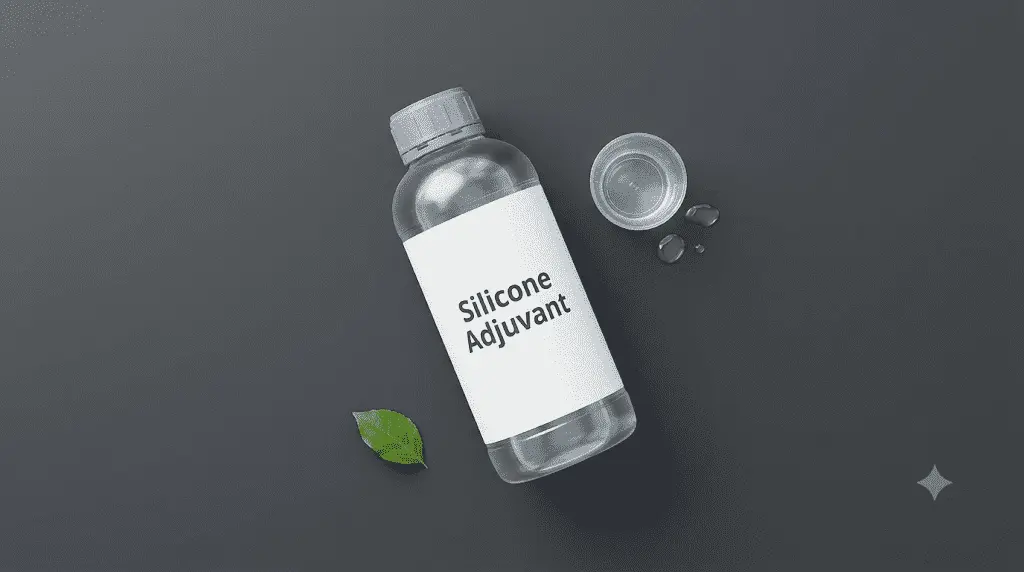
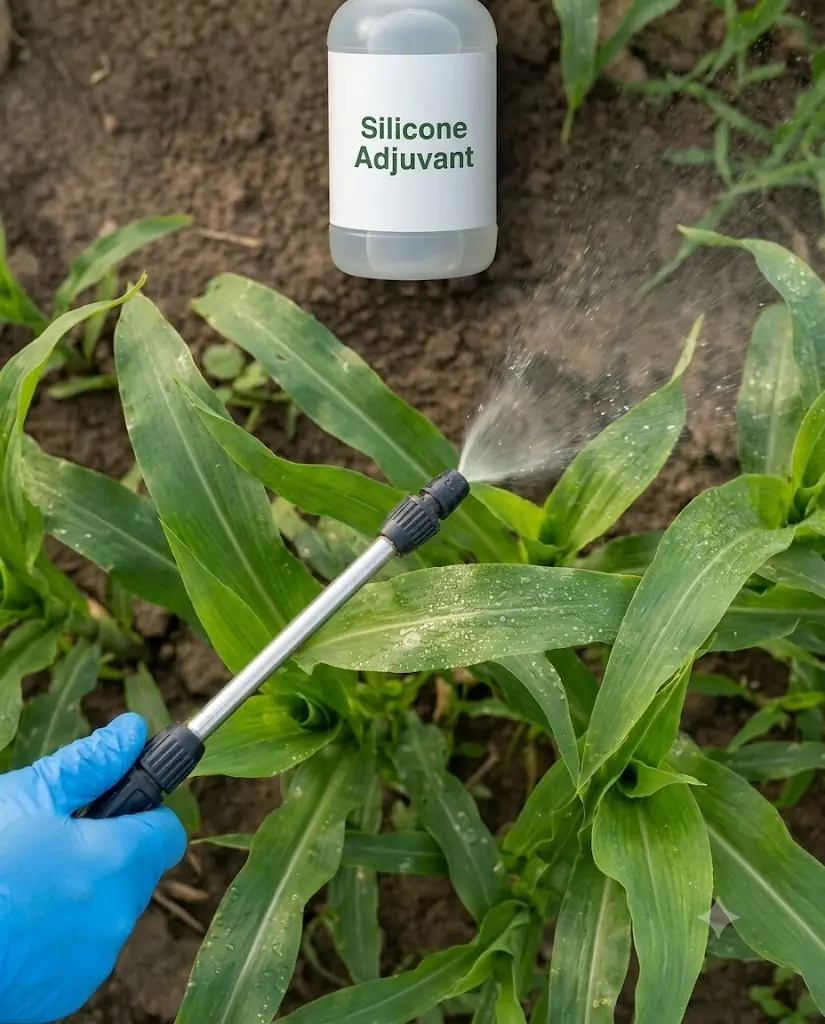
A silicone adjuvant can be the difference between a spray that beads off the leaf and one that actually works. Add a small amount to the tank, and droplets flatten out, cling to the leaf and reach the surface a pesticide needs to touch.
But it is not a free upgrade. Used carelessly, it can scorch a crop or wash off before it does anything. Here is how it works, where it helps, where it backfires and how to mix it safely.
Key Takeaways
- A silicone adjuvant lowers surface tension, so spray spreads into a thin film instead of beading up.
- Coverage improves on waxy or hairy leaves, and the rain-free window after spraying can get shorter.
- Stronger uptake cuts both ways: crop injury is more likely in heat or with products that already penetrate well.
- Water pH, mixing order and label rates matter more than the brand name.
- It is not a cure-all. It cannot rescue poor timing or the wrong active ingredient.
- Test a small area first and always follow the pesticide label.
What Is a Silicone Adjuvant?
An agricultural adjuvant is any additive that helps a pesticide, herbicide or foliar nutrient do its job. A silicone adjuvant is one built on organosilicone chemistry, most often a trisiloxane with a water-loving tail attached. On many labels you will simply see the words organosilicone surfactant.
That mixed structure is the secret. One end likes water and the other avoids it, so the molecule settles at the boundary between the droplet and the leaf and pulls surface tension down hard. Researchers have studied this behaviour since the 1970s, which is why these products are often nicknamed superspreaders.
One quick note on the name. Search results sometimes mix this product up with vaccine adjuvants or silicone gel sheets for scars. Those are entirely different things. Here, we are talking only about the agricultural adjuvant used in spray tanks.
How It Works on the Leaf
Plain water beads up on a waxy leaf, much like rain on a freshly waxed car. Beads cover very little surface, so a lot of the active ingredient never touches the plant. A silicone surfactant drops surface tension from about 72 mN/m for water to about 20 to 22 mN/m, and the droplet collapses into a thin film.
That single change brings several practical effects:
- Wetting and spreading. Droplets cover far more leaf area, including hairy or waxy surfaces.
- Stickiness and rainfastness. The spray is taken up sooner, which can shorten the wait needed before rain.
- Penetration. More contact area means more active ingredient gets absorbed. Researchers still debate how much of this comes from entry through the stomata.
- Fewer coverage gaps. Dense foliage is easier to reach when droplets spread instead of skipping across the surface.
Extension specialists place organosilicone surfactants in the nonionic family and note that they cut surface tension, boost spreading and improve rainfastness. They also warn that the wrong surfactant can weaken a product or injure plants, which is why the label always has the last word.
Spray Volume, Water Quality and Foam
Spray volume. Better spreading means you can sometimes get good coverage with less water. Some labels say organosilicone products work best in low-volume spraying, at about half the normal volume or less. There is a catch, though. In Australian vineyard trials, spraying with organosilicone adjuvants at half the dilute volume sometimes over-wetted the outer canopy and cut deposits, so they are not recommended for high-volume fungicide sprays.
Droplet size and equipment. Nozzle choice, pressure and droplet size all change how a spray lands. At least one label lists droplet size, water hardness and equipment as reasons rates may need adjusting, so watch the first few passes for runoff.
Water quality. Many products work best when the tank water sits near neutral. Several labels name a working pH window of about 6 to 8, though some allow roughly 5 to 9. Outside that range the product can break down, so spray soon after mixing or buffer the water first. Hard water matters too, because water conditioners exist to bind calcium and magnesium.
Foam. Organosilicone products can foam in the tank. Several labels advise filling the tank to the planned volume before adding the product, and using an approved defoamer if foam is expected.
Where It Helps Most
The payoff is biggest wherever plain spray struggles to wet the target.
Tough weeds. Hairy leaves, thick cuticles and waxy grasses are hard to wet. It often improves herbicide performance on exactly these species, and it can help products that dissolve poorly in water.
Insect and disease sprays. Insects and fungi sit on or under leaf surfaces where coverage is patchy. Better spreading helps the product reach more of them.
Foliar fertilizers. Micronutrient sprays rely on absorption through the leaf. A well-wetted surface can improve uptake, although results depend on the crop and the product.
Drone applications. Drone spraying uses very low water volumes and small droplets, so poor wetting and fast evaporation hurt more. An organosilicone adjuvant can help, but drift control and label approval for aerial use still need checking.
Biological products. Biopesticides contain living organisms, and not every surfactant is gentle on them. Some organosilicone products have been tested with beneficial fungi, but confirm compatibility for your exact product before mixing.
Silicone Adjuvant vs Other Spray Adjuvants
Not every spray problem needs this product. Sometimes a simpler spray adjuvant does the job with less risk. Here is how the main types compare.
| Type | Best at | Watch out for |
| Nonionic surfactant | General wetting and spreading with most pesticides | Less spreading power than organosilicones |
| Crop oil concentrate | Penetrating waxy leaf surfaces | Can injure crops in hot weather |
| Methylated seed oil | Strong penetration, even in dry conditions | Higher injury risk on sensitive crops |
| Silicone adjuvant | Very fast spreading and rainfastness at low rates | Tight pH limits and injury risk in heat |
In practice, start with the pesticide label. Some products require one type of adjuvant and forbid others, and that instruction beats any general rule.
Risks and Limits You Should Know
This is where the miracle-additive idea falls apart. The same power that improves uptake can push too much product into the plant.
- Crop injury in heat. Some technical guides warn of plant damage when temperatures climb above roughly 90°F (32°C). Spray in the cooler parts of the day.
- Stacking boosters. Adding an organosilicone adjuvant to a product that already contains a penetrant or strong surfactant can overshoot. Check what is already in the jug.
- Sensitive crops and growth stages. Seedlings and delicate crops can react differently, so run a small test strip first.
- Easier entry for pathogens. Strong wetting may also let bacteria and fungi reach leaf openings more easily, a point raised in agronomy guides.
- Bees and non-target life. A 2016 mini review in Frontiers in Public Health asked whether organosilicone surfactants might affect honey bees. The evidence is limited, so avoid spraying open blooms and follow the label’s pollinator rules.
- Quality differences. Adjuvants are not registered like pesticides in many places, so strength and purity can vary. Buy from a supplier that provides a label and safety data sheet.
None of this means you should avoid it. It means you should treat it as a tool, not a cure-all.
When to Skip It
- The pesticide label forbids adding a surfactant.
- The forecast shows a hot day, or you can only spray in the heat of the afternoon.
- You are spraying a sensitive crop or growth stage and have not run a small trial.
- The pesticide product already contains a penetrant or strong surfactant.
- You are making a high-volume fungicide application where over-wetting is likely.
- Flowers are open and pollinators are active.
How to Use It Safely
- Read both labels. The pesticide label and the adjuvant label set rates, crops and timing. If they disagree, the pesticide label wins.
- Check your water. Many trisiloxane products lose strength in strongly acidic or alkaline water, so check the stated pH range and test your tank water.
- Do a jar test. Mix small amounts of everything in a clear jar before filling the sprayer, and look for clumps, layers or sludge.
- Follow the mixing order. A proper tank mix starts with water and agitation, and the adjuvant usually goes in near the end unless the label says otherwise.
- Use the lowest label rate. These products work at tiny concentrations. More is not better, and it raises the injury risk.
- Spray soon after mixing. Some labels ask you to spray within 36 hours. If your water is outside the safe pH range, some products should be sprayed within about 6 hours.
- Pick the weather. Avoid hot afternoons, strong wind and the hours just before rain.
- Rinse the sprayer. Clean the tank, hoses and nozzles before switching products.
Common Mistakes to Avoid
- Adding more than the label rate because a little seemed to help.
- Pouring it into the tank before filling to volume, which invites foam.
- Skipping the jar test when mixing with a new product.
- Leaving the tank to sit after mixing, especially in acidic or alkaline water.
- Spraying in the heat of the day or just before rain.
- Treating it as a fix for poor timing or the wrong active ingredient.
Storage and Shelf Life
Keep the product in its original container, tightly closed, in a cool, well-ventilated place. Beyond that, labels differ. Some say do not freeze and suggest storing between about 40°F and 90°F, while others say freezing does not harm the product but makes it thicker, so you should warm it before use.
Shelf life varies by product, so check the date code, label and safety data sheet. Shake the jug well before use, and throw out anything that looks separated or has changed in smell or colour.
How to Choose a Product That Fits
- Match the spray adjuvant to the job: herbicide, fungicide, fertilizer or biological.
- Check crop and aerial approvals on the label of any agricultural adjuvant.
- Read the ingredient statement. Some labels list the organosilicone surfactant as the whole formula, while others sell a blend with methylated seed oil or other surfactants. Blends behave differently.
- Ask for the safety data sheet and technical data, including the recommended pH range.
- Compare cost per treated hectare or acre, not cost per litre, because the dose is so small.
- Be wary of any supplier that promises big yield or savings numbers without trial data.
A Quick Note on Regulation
In the United States, spray adjuvants are not registered by the EPA because they have no pesticidal action, although a few states, including California and Washington, require registration. Labelling and quality can therefore vary from product to product. Rules differ by country, so check with your local authority and ask the supplier for the label and safety data sheet.
When you compare retail options, read the ingredient statement and rate range on any silicone adjuvant before you buy, and keep the label with your spray records.
Frequently Asked Questions
What is a silicone adjuvant used for?
A silicone adjuvant is used in agricultural spray tanks to help pesticides, herbicides and foliar fertilizers spread, stick and absorb better on the leaf. It is a wetting and spreading aid, not a pesticide itself.
What is the difference between a silicone surfactant and a regular surfactant?
A regular nonionic surfactant lowers surface tension moderately. A silicone surfactant lowers it much further, so droplets spread wider and faster. The trade-off is a higher chance of crop injury and tighter limits on pH and temperature.
How much silicone adjuvant should I add to a spray tank?
There is no universal number. Rates come from the product label and the pesticide label, and they are usually a very small fraction of the spray volume. Start with the lower label rate, especially on sensitive crops.
Can it damage plants?
Yes, mostly through over-use, hot weather or pairing with products that already penetrate strongly. Test a small area first and avoid spraying in the heat of the day.
Is silicone adjuvant safe for bees and the environment?
It depends on the specific product and how it is used. Some reviews have raised questions about bees, so avoid spraying flowering crops while pollinators are active, follow label directions and local rules, and ask your supplier for ecotoxicity data.
Bottom Line
A silicone adjuvant earns its place when coverage is the real problem: waxy weeds, dense canopies, low-volume drone passes or rain-prone seasons. It is not a cure-all, and it will not fix bad timing or the wrong chemistry.
Choose a quality organosilicone adjuvant, keep to the label rate, watch the heat and the water pH, and test before you scale up. Do that, and a silicone adjuvant becomes one of the cheapest ways to make every spray count.