

Anyone who has watched a truckload of concrete stiffen on a hot afternoon knows the feeling. The formwork isn’t ready, the pump is late, and the mix is already losing its slump. That is the moment a retarder admixture earns its place. It slows the early chemistry of cement so the concrete stays workable for longer, which gives your crew time to place, compact and finish it properly.
Below, we’ll walk through how it works, the main types, how to choose and dose one, and the slip-ups that cause trouble on site.
Key Takeaways
- A retarder admixture delays the setting of concrete by slowing early cement hydration, without changing the basic mix.
- Hot weather, long hauls, big pours and tricky finishes are the usual reasons to use one.
- ASTM C494 groups retarding admixtures as Type B (retarding), Type D (water-reducing and retarding) and Type G (high-range water-reducing and retarding).
- The delay you get depends on temperature, cement, supplementary materials and dose, so a trial mix beats any rule of thumb.
- Used correctly, long-term strength holds up, but early strength can dip and the longer plastic stage needs protection and curing.
- Overdosing is the most common error, and it can leave concrete soft for days.
What Is a Retarder Admixture in Concrete?
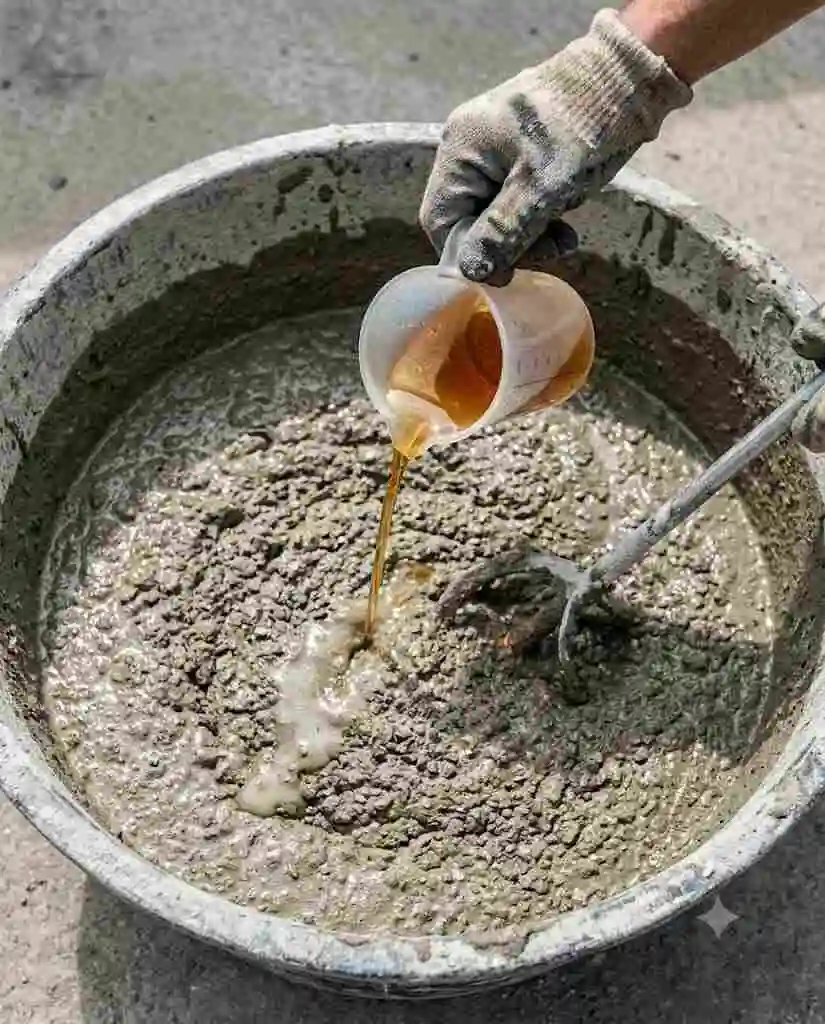
A retarder admixture is a chemical added to concrete in small amounts, usually at batching, to delay the time it takes to set. The concrete doesn’t stay soft forever. It simply remains plastic for a few extra hours, so you decide when it stiffens instead of leaving it to the weather.
Setting is normally tracked as initial set and final set, measured with a penetration resistance test such as ASTM C403. A good product pushes both back by a predictable amount.
Pure retarders do little else. Most products sold today are retarding plasticisers, which also reduce the water needed for a given slump. That means longer workability and a lower water-cement ratio from the same dose.
How a Retarder Admixture Works
When cement meets water, its grains start to dissolve and form calcium silicate hydrate, the gel that gives concrete its strength. Retarding molecules interrupt that early reaction in two main ways. They cling to the surface of cement grains and the first hydrates, forming a thin barrier. They can also tie up calcium ions in the pore water, which delays the crystals that trigger stiffening.
The reaction is postponed, not cancelled. Once the retarder is used up or outweighed, hydration picks up again and strength gain follows. Because the gel forms more slowly, it tends to be more orderly and dense, which is one reason properly cured retarded concrete can match plain concrete in the long run.
Four Ways Retarders Slow Hydration
Researchers usually describe four overlapping routes by which a retarding molecule slows the cement reaction. Which one dominates depends on the chemical used and on the cement it meets.
- Adsorption: the molecules stick to the surfaces of cement grains and early hydrates, shielding them from water and slowing dissolution.
- Nucleation poisoning: they attach to the tiny seed crystals of calcium silicate hydrate and calcium hydroxide, so those crystals cannot grow until the retarder is consumed or displaced.
- Complexation: they bind calcium ions in the pore solution, which holds back the moment when the liquid becomes saturated enough for crystals to form.
- Precipitation: some form a thin, poorly soluble layer of calcium or other metal compounds around the grains, a temporary coating that breaks down over time.
Cement Compatibility: C3A, Sulfate Balance and False Set
The aluminate phase in cement (C3A) reacts very quickly, and the sulfate in the cement keeps that reaction under control. Retarders adsorb strongly on aluminate phases and can upset this balance. A cement with high C3A, high alkali content or an unusual sulfate level may therefore respond far more strongly, or more oddly, to the same dose.
In rare cases the result is premature stiffening, known as false set, instead of a delay. The dose response is not predictable either: at the low end of a range some combinations show almost no effect, and a small increase can then produce a large jump in delay. Treat every new cement source as a reason to test again.
When Should You Use a Retarder Admixture?
The short answer is whenever the clock, not the mix, is your biggest risk. These are the situations that come up most:
- Hot weather: heat speeds up hydration, while wind and low humidity dry the surface. A set retarder helps offset this, alongside cooled materials and good planning.
- Long hauls and delays: traffic, slow unloading or a late pump can eat the working time of an ordinary mix.
- Large continuous pours: keeping earlier layers workable helps new batches knit into them, which avoids cold joints, the weak seams that form when fresh concrete meets concrete that has already started to set.
- Demanding finishes: exposed aggregate, stamped patterns and power-trowelled floors all need finishers to have time on their side.
- Pumping, tremie and slipform work, where an unplanned stoppage can ruin a run.
- Mass concrete: a retarder pushes the temperature peak later, which can help with placing sequences, but it does not cut the total heat released, so thermal control still needs its own plan.
Other Jobs Where a Retarder Earns Its Keep
- Bored piles, drilled shafts and diaphragm walls: concrete is placed by tremie over many hours and must stay mobile until the full depth is filled.
- Ready-mixed mortar: retarded masonry and plastering mortars can stay usable for many hours, and some products for a few days, so a delivery does not have to be used up at once.
- Oil and gas well cementing: grout pumped deep into hot wells has to remain pumpable for hours at high temperature, so specialised retarders are formulated for the purpose.
- Precast exposed-aggregate panels: a surface retarder applied to the mould face lets the paste at the surface be washed away the next day. This is the surface product described later, not an admixture added to the mix.
Types of Retarding Admixtures
Standards sort chemical admixtures by what they do. Under ASTM C494, the retarding admixtures fall into three groups, while Europe’s EN 934-2 has its own retarding category. Hydration-stabilising products sit just beyond them for extreme delays.
| Type | What it does | Typical use |
| Type B | Retards setting only | Hot weather, long hauls, big pours where extra water reduction is not needed |
| Type D | Reduces water and retards setting | General-purpose choice, the most common on site |
| Type G | High-range water reduction plus retardation | Low water-cement ratio, high-strength and flowing mixes |
| Hydration stabiliser | Severely slows or pauses hydration for an extended period | Very long delays, returned concrete and truck wash-out management |
For the formal definitions and test limits, specifiers usually turn to the ASTM C494 standard specification for chemical admixtures. It also sets a floor, requiring Type B concrete to reach at least 90 percent of the control mix strength at the specified test ages, so a product can’t pass simply by delaying set and giving up strength.
Chemically, common ingredients include lignosulfonates, hydroxycarboxylic acids such as gluconate, citric and tartaric acid, sugars and phosphonates. Each behaves differently with different cements, so two products with the same label can perform very differently.
One more thing: don’t confuse these with surface retarders. Those are applied to formwork or a slab surface to stop the top layer hardening so aggregate can be exposed later. They are a different product for a different job.
How Setting Time Is Measured
Setting time is usually measured with the penetration resistance method in ASTM C403, which tests mortar sieved from the concrete. Initial set is recorded when the resistance reaches 500 psi (3.5 MPa) and final set at 4,000 psi (27.6 MPa). The European approach is laid out in EN 480-2. Run the test at the temperature you expect on site, because a result from a 20°C laboratory can mislead when the pour happens at 35°C or at 8°C.
Strength Limits by Type
ASTM C494 compares each admixture against a control mix. Type B concrete must reach at least 90 percent of control strength. Type D is held to a higher bar of about 110 percent at 3, 7 and 28 days, and Type G to roughly 125 percent at 3 and 7 days and 115 percent at 28 days. Because requirements are revised from time to time, confirm the figures in the current edition before quoting them in a specification.
Regional Standards Worth Knowing
- ASTM C494: the main specification for chemical admixtures in the United States and many export markets.
- BS EN 934-2: the admixture standard used across the UK and Europe, with its own retarding and retarding-plasticiser categories.
- IS 9103: the Indian standard for concrete admixtures.
- AS 1478.1: the Australian standard for chemical admixtures.
Hydration Stabilisers and Zero-Waste Concrete
Hydration stabilisers go further than an ordinary retarder. They put cement hydration into a near-pause for several hours, or even a day or more, and an activator or a fresh batch of concrete is then used to restart it. Some suppliers also offer two-component extended-set systems built on the same idea.
The practical payoff is waste reduction. Returned concrete or the residue left in a truck can be held back and reused instead of being dumped, and stabilised wash water can go into the next batch as part of the mixing water. That cuts disposal costs and the volume of material sent to landfill. The trade-offs are that dosing must be precise, the supplier’s procedure has to be followed exactly, and the reused mix needs its own trials for slump, air content and strength.
Retarder Admixture Dosage: Typical Ranges and a Worked Example
Dosage is normally stated as a percentage of the cement mass. The ranges below reflect general practice and are only a guide. The manufacturer’s data sheet always takes priority, and a trial mix should confirm the final figure.
| Retarder type | Indicative dose (% of cement mass) | Notes |
| Lignosulfonate (retarding water reducer) | About 0.2 to 0.5 | Common in Type D products; can entrain some air and increase bleeding. |
| Hydroxycarboxylic acids, such as gluconate | About 0.02 to 0.1 | Powerful at low dose; small errors cause large changes in delay. |
| Sugar | About 0.02 to 0.1 | Very sensitive and erratic; a modest excess can stop setting for days. |
| Commercial liquid retarders and retarding plasticisers | Follow the label; many fall roughly between 0.2 and 1.0 | Formulations differ widely, so the data sheet is the only safe guide. |
Worked Example
Suppose the mix holds 350 kg of cement per cubic metre and the data sheet allows a dose of 0.3 percent. That is 350 x 0.003 = 1.05 kg of admixture per cubic metre. If the liquid has a density of about 1.10 kg per litre, this is roughly 0.95 litres per cubic metre, or about 5.7 litres for a 6 m3 truck load. Always use the density printed on your own product’s data sheet.
Where Overdosing Begins
There is no single universal limit. As a rule, the trouble starts once you move past the upper end of the supplier’s range, or when a hot-weather dose is left unchanged after the temperature drops. Typical symptoms are a surface that stays soft for days, extra bleeding and weaker early strength. If a dose is borderline, test it rather than guess.
Can Sugar Be Used as a Retarder?
Sugar does retard cement strongly, and it has been used as an emergency measure on sites far from supply. It is a poor choice for structural work, though. The response is erratic, a slight excess can leave concrete unset for days, and the material is not a controlled, tested product. Unless an engineer has approved a trial, use a manufactured admixture with a data sheet instead.
What Changes How Much Delay You Get
The same dose can behave very differently from one job to the next. Watch these factors:
- Temperature: warm concrete reacts faster, but a cool night after a hot day can stretch the delay far beyond what you planned.
- Cement: type, fineness and chemistry all change how a retarder behaves.
- Supplementary materials: fly ash and slag already slow early setting, so the effects stack.
- Dose: more usually means longer delay, but not in a straight line, and too much invites problems.
- Time of addition: adding a set retarder a little after the water and cement make contact can lengthen the effect, so follow the supplier’s guidance.
- Other admixtures: superplasticisers and air-entraining agents can interact, so test the combination rather than assume.
Retarders Combined with PCE Superplasticisers
Polycarboxylate (PCE) superplasticisers and retarders often work together to hold slump for longer, which is why Type G products exist. The pairing has limits, though. Both ingredients delay early hydration, so their effects add up, and a dose that suits each product alone can produce an unexpectedly long delay together. The order in which they are added and the point in the batching cycle can also change the result, so confirm both on a trial mix before committing to a pour.
Low-Carbon Cements and Blended Binders
Mixes with high fly ash or slag content, limestone cements and calcined-clay blends all hydrate differently from plain Portland cement. Some start more slowly and need less retarder; others react to specific chemistries in unfamiliar ways. When you change to a lower-carbon binder, treat the old dose as a starting point only and rerun the setting-time and strength checks.
Effects on Fresh and Hardened Concrete
In the fresh state, you get slower stiffening and better slump retention. Some products increase bleeding a little, and some lignosulfonate types draw in extra air, so check both during trials.
In the hardened state, the picture is mixed. Strength at one to three days can be lower because hydration starts later. Over the longer term, strength and durability are normally equal to plain concrete, and sometimes better, provided curing is good. When water is reduced as well, the benefits can be larger.
The catch is the longer plastic stage. Fresh concrete stays exposed to wind and sun for more hours, which raises the risk of plastic shrinkage and settlement cracking. Cover it, fog it or use a curing compound early.
Formwork Pressure and Striking Time
Retarded concrete stays fluid for longer, so it keeps exerting full liquid pressure on the formwork down to a greater depth, and for a longer period, than ordinary concrete would. Design guidance such as ACI 347 accounts for the effect of retarders when calculating pressure, so tell the formwork designer when one is planned. Striking times also have to follow the later set and slower early strength. Rather than relying on the usual timetable, confirm readiness with cubes or a maturity-based estimate.
Using a Retarder in Cold Weather
Cold weather already slows hydration, so a retarder is seldom needed and can stretch the delay well beyond what you planned. Below roughly 10°C the extra delay can leave the surface unfinished for hours and expose it to frost or freezing before it has gained strength. If a retarder is still required, for example for a long haul, trial it at the expected temperature, protect the concrete with insulation, and plan formwork striking and loading around the slower strength gain.
How to Choose and Use a Retarder Admixture
- Decide how much delay you really need, counting the time from batching to final finishing, plus a sensible buffer.
- Check the forecast, including overnight lows, not just the daytime high.
- Match the type to the job. Type B for simple delay, Type D for everyday work, Type G for high-range mixes.
- Read the data sheet for the dosage range and the recommended way to add it.
- Run trial mixes with your own cement, supplementary materials and admixtures at the expected temperature. Record setting time, slump retention and early strength.
- Dose accurately and consistently through the batching system, rather than by hand where you can avoid it.
- Protect and cure the concrete from the moment it is placed.
There is no universal dose. Published ranges for commercial products vary widely, which is exactly why the manufacturer’s data sheet and a trial mix matter more than any figure you read online.
Common Mistakes When Using a Retarder
- Overdosing. More is not better. It can delay set by days and compromise the surface and strength.
- Skipping trial mixes and trusting a figure from a different project.
- Forgetting that a cool evening can double the delay.
- Treating the product as a fix for hot concrete. You still need to keep the mix cool. ACI 305.1 hot-weather guidance, for example, points to keeping fresh concrete at or below about 35°C (95°F) at discharge unless testing shows otherwise.
- Weak curing, which turns a longer plastic stage into surface cracking.
- Stripping formwork on the usual timetable even though the concrete set later than normal.
- Inconsistent dosing between loads, which gives you one pour with several different set times.
Troubleshooting Retarded Concrete
| Symptom | Likely cause | What to do |
| Still soft after 24 hours | Overdose, a cold night, or a high share of fly ash or slag | Keep it protected and moist, do not strip forms, inform the supplier and engineer, and test before loading. |
| Weak, dusty surface | Overdose with heavy bleeding, early finishing, or poor curing | Finish only after bleed water has gone, cure early, and assess the surface hardness before remedial work. |
| Plastic shrinkage cracks | Long plastic stage with wind or sun | Use windbreaks, fog the surface, apply an evaporation-reducing film, and start curing early. |
| Different set times between loads | Inconsistent dosing, temperature swings, or a change of cement batch | Calibrate the dispenser, record concrete temperatures, and keep a single dosing point. |
| Stiffening instead of delay | Cement and admixture incompatibility, such as an aluminate and sulfate imbalance | Stop, change the dose, product or cement, and rerun the trial. |
| Low strength at 1 to 3 days | Expected lag from late hydration | Hold off striking until cubes or maturity data show the strength is adequate. |
| Heavy bleeding or segregation | Overdosed retarding water reducer or a lean, low-fines mix | Adjust the dose or mix proportions and re-test the fresh properties. |
Retarder Myths, Cleared Up
- “It weakens concrete.” Not when dosed and cured properly. Early strength may lag, but later strength usually catches up.
- “It’s only for summer.” Heat is the classic reason for a set retarder, but logistics and finishing needs justify it all year.
- “More retarder means more workability.” It means more delay, plus more risk.
Retarder vs Accelerator vs Water Reducer
| Admixture | Effect on set | Main purpose |
| Concrete retarder | Slower | Extends working time and offsets heat |
| Accelerator | Faster | Speeds early strength, helps in cold weather |
| Water reducer | Little or none | Lowers water demand or improves workability |
Safe Storage and Handling
Treat every concrete retarder like any other chemical on site. Read the safety data sheet, wear gloves and eye protection, and keep containers sealed. Store the product within the temperature range on the label, protect it from freezing and contamination, and never top up one admixture container with another. If a liquid has separated, agitate it as the supplier directs.
Is a Retarder Admixture Worth the Cost?
The admixture adds only a small amount to the cost of each cubic metre. Set that against what it protects: a rejected load, a cold joint that needs repair or coring, a crew standing idle waiting for a late pump, or a finish that has to be redone. On jobs where timing is uncertain, the comparison nearly always favours using one. Where the pour is small, close to the plant and in mild weather, you may not need it at all. Judge each job by its own timing risk.
FAQ
What is a retarder admixture used for?
It is used to delay the setting of concrete so it stays workable longer. It is common in hot weather, long deliveries, large pours and jobs with demanding finishes.
How long does a concrete retarder delay setting?
It depends on the product, dose, temperature and cement. A typical dose might add a few hours, while hydration stabilisers can hold concrete back far longer. The only reliable answer comes from a trial mix under your site conditions.
Does a retarder admixture reduce concrete strength?
Early strength at one to three days can be lower. With correct dosing and proper curing, later strength is generally equal to, or better than, plain concrete.
What happens if you add too much retarder admixture?
Concrete can stay soft for days, bleed more, show surface defects or lose strength. If you suspect an overdose, stop, contact your supplier and the engineer, and do not strip forms until testing shows the concrete is ready.
What is the difference between a retarder and a plasticiser?
A retarder slows setting. A plasticiser makes concrete flow more easily or lets you use less water. Many commercial products combine both, which is why you will see Type D and Type G in specifications.
Bottom Line
A retarder admixture is one of the cheapest ways to buy time on a concrete job. Choose the right type, test it at your real site temperature, dose it carefully and cure early, and it will protect your finish and cut the risk of cold joints. Get those steps wrong and the same product becomes a source of delays. When in doubt, ask your supplier for trial data and let the results decide.