
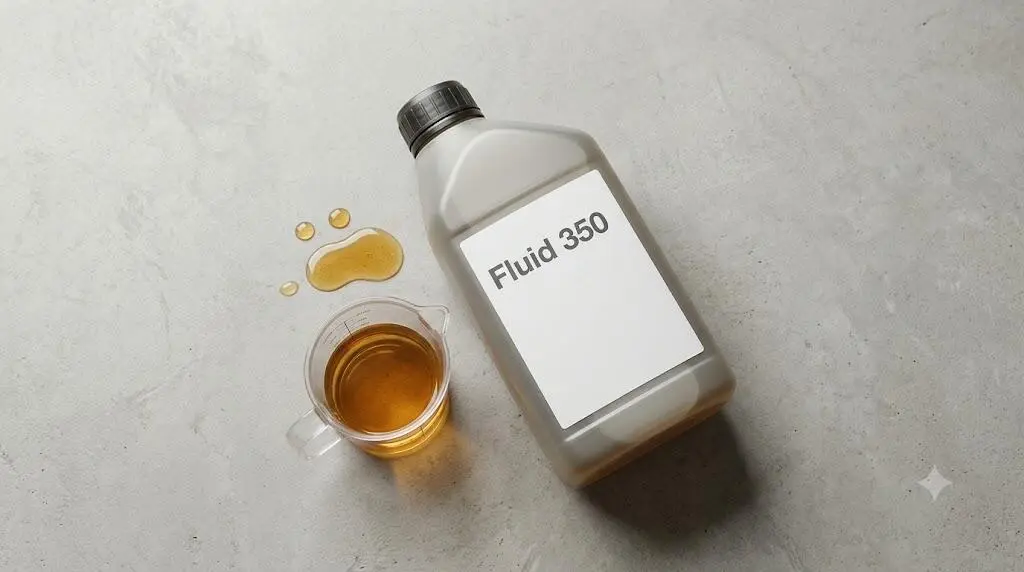
Fluid 350 is the shorthand many suppliers use for a polydimethylsiloxane (PDMS) oil with a viscosity of around 350 centistokes at 25 °C. It is a clear, nearly odorless liquid that barely changes with temperature, repels water and stays chemically calm in places where ordinary oils break down. That is why you will find it in mold release sprays, rubber and plastic lubricants, polishes, damping devices and skin-care creams.
Key Takeaways
- What it is: fluid 350 is a straight-chain silicone oil that stays chemically inert, with a viscosity of about 350 cSt at 25 °C.
- How it feels: it pours slowly, a little like warm maple syrup, which makes it a handy middle ground between thin and very thick silicone oils.
- Main uses: mold release, lubricating rubber and plastic, damping, polishes and cosmetic formulas.
- Temperature: supplier data points to roughly −40 °C to 150 °C in open air, and higher in closed systems.
- Grades: industrial, cosmetic, food-contact and pharmaceutical versions share a viscosity but not the same paperwork, so check the certificate before you buy.
- Handling: spills are slippery, and stray silicone can ruin a paint finish.
What Is Fluid 350 and What Does the Number Mean?
The number is the kinematic viscosity, measured in centistokes (cSt) at 25 °C. One centistoke equals one square millimetre per second, so 350 cSt and 350 mm²/s mean exactly the same thing. Water sits at about 1 cSt, which tells you this oil is far thicker, although it still flows freely.
Chemically, it is a long chain with a silicon-oxygen backbone and methyl groups hanging off the sides. Major manufacturers publish data under their own names. WACKER, for example, lists its Fluid 350 as a straight-chain PDMS that does not react with most chemicals, with a viscosity near 350 mm²/s, while Dow sells a close equivalent as XIAMETER PMX-200 (350 cSt).
You will also see it called silicone oil, dimethyl silicone fluid, PDMS or dimethicone. Cosmetic and pharmaceutical writers often say dimethicone 350, and the Merck Index lists that grade with a density of about 0.965 to 0.973 and a refractive index close to 1.40.
One quick warning: simethicone is a different product. It is dimethicone blended with silica and is sold as an anti-gas medicine.
Looking for something else? The same label also turns up on thermal bath fluids rated up to 350 °C, and many people searching it simply want to convert 350 ml into fluid ounces (about 11.8 US fl oz). This guide is about the silicone oil.
Key Properties and Typical Specifications
Values shift slightly from one manufacturer to another. Treat the table below as a guide, and rely on the technical data sheet for anything critical.
| Property | Typical value | Why it matters |
| Appearance | Clear, colorless, nearly odorless | Will not stain most surfaces |
| Viscosity at 25 °C | About 350 cSt | Sets flow, film thickness and damping |
| CAS number | 63148-62-9 (PDMS fluids); dimethicone is also listed as 9006-65-9 | Appears on labels, orders and safety documents |
| Specific gravity at 25 °C | About 0.97 | Lighter than water, so it floats |
| Surface tension | Around 21 mN/m | Spreads and wets surfaces easily |
| Pour point | Around −50 °C | Stays liquid in deep cold |
| Flash point | Above 100 °C closed cup (Dow); some suppliers report far higher | Depends on the test method, so verify it |
| Water solubility | Insoluble | Repels water; needs an emulsion to disperse |
Three properties explain most of its popularity. First, its viscosity changes less with temperature than a petroleum oil, so it behaves more consistently from a cold morning to a warm machine. Second, its low surface tension lets a thin film spread quickly. Third, it is chemically unreactive and a good electrical insulator.
It is also hydrophobic, so water beads up on a treated surface instead of soaking in.
Where Fluid 350 Is Used in Real Life
Mold release and rubber processing
In rubber, plastic and composite molding, a very thin film of PDMS 350 helps parts leave the mold cleanly. It is usually applied as a diluted solvent mix or as a water-based silicone emulsion, because the neat oil does not mix with water. Dow notes that amounts as small as 0.1% can be enough when the oil acts as a surface agent.
Lubricating plastics, rubber and seals
It works best on rubber, plastic and elastomer parts such as gaskets, sliding plastic gears and switches. It is not the right pick for heavily loaded steel-on-steel contacts, where silicones protect less well than a proper mineral or synthetic grease. For sealing and sliding parts that need a stay-put film, a silicone grease is often the better partner.
Damping and electrical insulation
High damping action and good dielectric strength make 350 cSt silicone oil useful in instrument dampers, viscous couplings and some insulation tasks. Heating baths usually run on a thinner 50 cSt silicone oil, which circulates more easily.
Polishes and water-repellent finishes
Car, furniture and metal polishes use silicone oil as a film former, which adds gloss and makes water bead up.
Cosmetics and personal care
As dimethicone 350, it appears in hand creams, lotions, hair serums and foundations. It spreads easily, cuts stickiness and leaves a light barrier that slows moisture loss. Dow suggests roughly 1 to 10 percent in hand creams and lotions to build a uniform film.
Medical and pharmaceutical use
Medical-grade silicone oils at this viscosity are sold in NF (National Formulary) grade versions, and they are used to lubricate needles, syringes and some devices. Many web pages stretch this into implants and drug delivery, but those are tightly regulated areas. A general industrial fluid 350 should never be assumed suitable; only material documented for that purpose belongs there.
Industrial, Cosmetic, Food and Pharma Grades: What Changes
Viscosity is the same across grades. What differs is purity, process control, testing and paperwork.
- Industrial: the everyday choice for release, lubrication and polish. Documentation is basic.
- Cosmetic: listed as Dimethicone on ingredient labels, with tighter control of odor and volatile content.
- Food-contact: made and documented to meet the rules of the region where it is used.
- Pharmaceutical and medical: made to compendial standards such as NF or Ph. Eur., with lot traceability.
Before you buy, ask for the data sheet, safety data sheet and certificate of analysis. Then confirm that the compliance statement covers your exact use and market. A label alone proves very little.
How 350 cSt Silicone Oil Compares With Other Viscosities
- 50 cSt: thin, easy to pump, popular for bath fluids and light lubrication.
- 100 cSt: a flexible all-rounder that spreads quickly.
- 350 cSt: runs off more slowly and leaves a longer-lasting film, yet is still simple to dilute or emulsify.
- 1,000 cSt: thicker, with stronger damping and a film that stays put, but harder to spread.
Many users settle on PDMS 350 because it is thick enough to last yet thin enough to handle without special pumps. For heavier damping, a 1,000 cSt silicone oil is the usual step up.
Silicone Oil vs Mineral Oil: Which Fits Your Job?
Buyers often weigh silicone against ordinary mineral oil, so here is the short version.
| Factor | Silicone oil (350 cSt) | Mineral oil |
| Change with temperature | Thickens and thins only slightly | Changes much more |
| Heavy steel-on-steel loads | Weaker protection | Usually the better choice, especially with additives |
| Rubber and plastic parts | Gentle on most, a strong fit | Can swell some rubbers |
| Contamination risk | High: can spoil paint and bonding | Lower |
| Cost | Typically higher | Typically lower |
Neither one wins everywhere. Choose silicone when temperature swings, water repellency or rubber and plastic contact matter most. Choose mineral oil when heavy loads and cost come first.

How to Use Fluid 350 Without Wasting It
- Define the job. Release, lubrication, damping and formulation all need different amounts.
- Check compatibility. Test on a scrap piece first. Silicone oil can swell silicone rubber seals.
- Start light. A thin film beats a heavy coat. Excess oil migrates and collects dust.
- Dilute or emulsify. It dissolves in many organic solvents but not in water, so use a solvent or an emulsion.
- Protect paint and bonding areas. Even tiny traces can cause cratering in coatings and weaken adhesive joints.
- Blend only if you must. Mixing a thin and a thick silicone oil gives an in-between viscosity, but the result is not a simple average, so measure a test batch first.
Buying Guide: What to Check Before You Order
A few minutes of checking saves money and avoids returns.
- Confirm the identity. Look for CAS 63148-62-9 on the label or data sheet. Cosmetic and pharmaceutical papers may show dimethicone under 9006-65-9 instead.
- Verify the viscosity. A lab can measure kinematic viscosity at 25 °C using the ASTM D445 method and compare it with the certificate. A reading taken at another temperature will mislead you.
- Read the documents. You want the data sheet, safety data sheet, certificate of analysis and a compliance statement for your exact use.
- Match the pack to your volume. Small bottles suit trials, while production users commonly buy pails of roughly 20 kg or 200 kg drums.
- Know what moves the price. Grade, paperwork, pack size, order volume and brand all play a part, and documented cosmetic or pharmaceutical grades usually cost more than industrial ones.
- Start with a sample. Request a sample and test it on your own process before committing to a drum.
Safety, Storage and Environmental Notes
Silicone oil of this type is generally regarded as low in toxicity. Dow’s data sheet only warns of temporary eye discomfort, and the Cosmetic Ingredient Review panel found dimethicone safe as used in cosmetics, adding that such large molecules are unlikely to be absorbed through the skin. You can read the published safety assessment of dimethicone for the details.
That said, safe in a face cream does not mean safe everywhere. Read the supplier’s safety data sheet, wear gloves and goggles where splashing is possible, and rinse skin or eyes after contact.
Spilled oil is the real everyday hazard because it makes floors very slippery. Soak it up with an absorbent, wash the area with detergent and dispose of the waste under local rules. Keep it out of drains.
To clean silicone oil off a surface, remove the bulk first, wipe with a suitable solvent, then wash with detergent and water. Repeat until water spreads evenly instead of beading, which tells you the film is gone.
Store the fluid 350 container tightly closed in a cool, dry place, away from heat and ignition sources. Dow lists a shelf life of about three years for its 350 cSt product, but your supplier’s figure applies to your batch.
Heat is the other limit. Supplier data suggests stable use around 150 °C in open air, and up to roughly 230 °C in closed systems that exclude oxygen. Push beyond that in an open system and the oil can thicken and degrade.
Common Mistakes to Avoid
- Assuming every PDMS 350 drum is identical, whatever its grade.
- Using it as an all-purpose grease on heavily loaded metal parts.
- Letting it drift into paint, coating or bonding areas.
- Overheating it in open air for long periods.
FAQ
What is fluid 350 used for?
It is mainly used as a release agent, a lubricant for rubber and plastic, a damping fluid and a polish ingredient. As dimethicone, it is also a skin and hair-care ingredient, and medical-grade versions lubricate needles and syringes.
What does 350 mean in silicone oil?
It is the kinematic viscosity in centistokes at 25 °C. A 350 cSt silicone oil is about 350 times thicker than water in kinematic terms, yet it still pours.
Is silicone fluid 350 the same as dimethicone?
Chemically, yes. Both are linear polydimethylsiloxane. “Dimethicone” is the name used in cosmetic and pharmaceutical settings, where purity and documentation are stricter. A cosmetic dimethicone 350 and an industrial one share the polymer, so do not swap them freely.
Is it safe for skin and food contact?
Cosmetic-grade versions are widely used on skin, and the review panel mentioned above considers dimethicone safe as used. Food contact is different. It depends on the grade and the rules that apply, so use only material with a compliance statement for that purpose.
What temperature range can fluid 350 handle?
Suppliers typically quote about −40 °C to 150 °C in open systems and up to roughly 230 °C when air is excluded. The pour point sits around −50 °C.
Bottom Line
The bottom line is simple: fluid 350 earns its place by being steady, versatile and gentle on most materials. Pick the grade that matches the job, test on a small scale first and keep the paperwork in order. Do that, and 350 cSt silicone oil is one of the easier industrial fluids to work with.
Whenever you are unsure, ask your supplier for the data sheet and certificate of analysis before committing to a large batch.