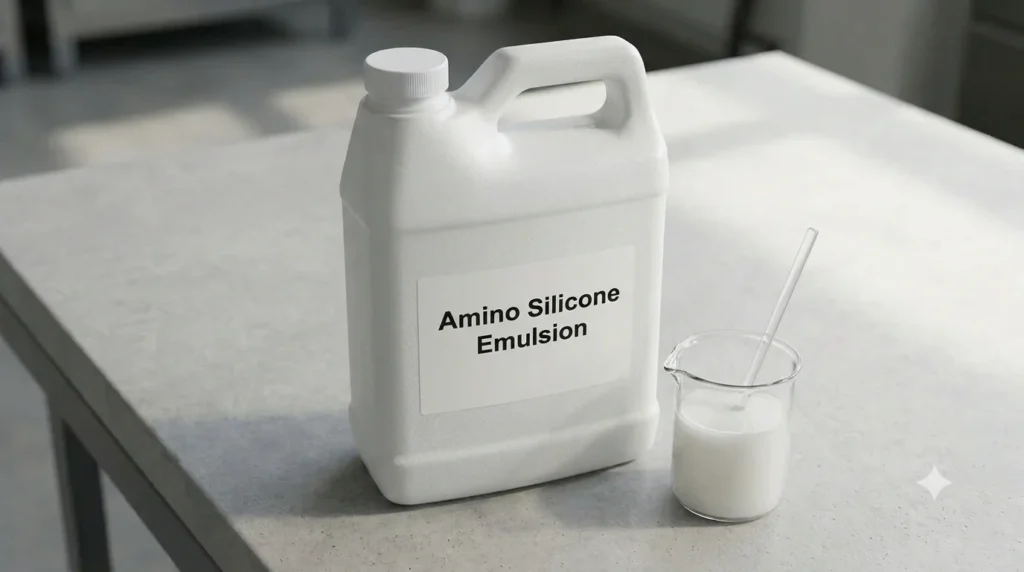
Amino silicone emulsion is a water-based dispersion of amino-functional silicone, in which tiny silicone droplets are held in water by surfactants. The amino groups help the silicone attach to fibers and other surfaces, which gives them a soft, smooth and long-lasting feel.
It is used mainly to soften and finish textiles, and also for yarn lubrication, leather treatment, paper surfaces, hair-care products and polishes.
Key Takeaways
- It is silicone with amino groups, dispersed in water so it mixes easily into ordinary finishing baths.
- The amino groups help it attach to fibers, which is why the softness tends to last through washing.
- Active content, droplet size, ionic charge, amine level and pH matter more than the product name on the drum.
- A higher amine level generally gives a softer hand, but it also raises the risk of yellowing.
- Compare the cost per kilo of active silicone, not the price per kilo of liquid, and test before you buy in bulk.
- Textiles are the biggest market, but leather, paper, hair care and polishes use it too.
What Is Amino Silicone Emulsion?
It is a silicone fluid carrying amino groups on its polymer chain, broken into very small droplets and held in water. The silicone does not dissolve. It stays suspended, much like fat in milk.
The backbone is polysiloxane, built on the same chemistry as ordinary PDMS. The amino groups contain nitrogen, and they are what set this material apart from plain methyl silicone.
You will also see it sold as amino silicone oil emulsion or as an amino silicone softener. There is no single formula. Published datasheets show active content from about 15% to nearly 60%, and every supplier balances surfactants and amine level differently.
How It Works on Fabric
When the emulsion is applied, the droplets spread over the fibers. As the water leaves during drying, a thin silicone film stays behind. That film lowers friction between fibers, so the fabric feels smoother and drapes better.
The amino groups do the extra work. They can form hydrogen bonds with fibers such as cellulose, wool, silk and polyamide. In acidic conditions they also pick up a positive charge, which draws them toward negatively charged fiber surfaces.
One research paper on cotton calls amino-functional silicone softeners the most widely used type of soft finish, because of their lasting softness. That is the main reason an amino silicone softener is so common in textile mills.
Heat during drying and curing completes the job. Finishing temperature and time therefore matter as much as the chemistry.
Key Properties That Decide Performance
Active content. This is the share of real silicone in the liquid. It takes 2 kg of a 50% product to deliver the same silicone as 4 kg of a 25% one, so judge value by cost per kilo of active material.
Droplet size. It decides whether the liquid looks milky or translucent and how finely the silicone spreads. The next section explains the types.
Ionic character. Cationic grades are drawn to negatively charged fibers such as cotton. Nonionic grades can be easier to combine with other chemicals in the bath.
Amine level. It is reported in different ways, including milliequivalents per gram, millimoles per gram and percent nitrogen, so compare like with like. Patent literature notes that a higher amine level improves softness but makes yellowing more likely.
pH. Grades are built for different ranges. One cationic textile grade lists a pH of 4.5 to 5, while patents for hair-care emulsions describe a pH of 5.0 to 7.0. Always follow the datasheet.
Stability. Check storage stability and stability after dilution. A product that looks fine in the drum but splits in the bath is no use to anyone.
Macroemulsion or Microemulsion: Which Do You Need?
Droplet size changes both the look and the behavior. Standard emulsions have droplets above roughly 300 nm and look milky white. Mini-emulsions look bluish-white to translucent, and microemulsions are translucent or even clear.
Patent literature describes microemulsions as having droplets below about 140 nm, and some processes produce droplets of 5 to 50 nm. Clear hair-care formulas rely on this finer form.
Finer does not always mean softer. A study on dyed cotton blended macro and micro grades 1:1, and the mix improved properties that each type had weakened when used alone. Other research on cotton points to amine level as the bigger driver of softness, with droplet size and viscosity playing a smaller role.
Where Amino Silicone Emulsion Is Used
Textile finishing. This is the core market. Cotton, polyester, blends and knits receive it for softness, smoothness, better crease recovery and easier sewing. On synthetic fibers it can also reduce static.
Yarn and fiber lubrication. A thin silicone layer reduces friction on machines, which helps spinning, knitting and stitching run more smoothly.
Leather. Tanneries use it to give leather a softer touch and more gloss while keeping the surface breathable.
Paper. In surface treatment it can improve smoothness, printability and flexibility.
Hair care. In acidic formulas the amino groups carry a positive charge, which draws the silicone toward damaged, more negatively charged hair. Manufacturers describe easier combing and less static. One supplier recommends use levels of 0.25% to 3% for its amino silicone hair-care grade.
Polishes and surface care. Some household and furniture polishes use amino-functional silicone for slip and shine.
Amino Silicone Emulsion vs Other Softeners
Conventional cationic, nonionic and anionic softeners are cheap and widely used. They mostly work by leaving a lubricating film on the fiber. An amino silicone softener also attaches through hydrogen bonding and electrostatic attraction.
The usual trade-off is yellowing. Textile references note that amino silicones yellow more than nonionic softeners, and that they clash with anionic auxiliaries such as optical brighteners.
Chemists have developed fixes. Blocked or amide-modified amino silicones cut yellowing, and one 2024 study found a blocked grade also resisted repeated washing better. Polyol or polyether-modified types add water absorbency, and epoxy-modified types may improve durability.
In short, this emulsion usually wins on feel and durability, while other types win on whiteness or absorbency.
Emulsion or Fluid: What Is the Difference?
Amino silicone fluid is the raw oil. The emulsion is that oil already dispersed in water.
Formulators buy the amino silicone fluid when they want to build their own emulsion. Mills usually prefer the ready-made amino silicone oil emulsion, because it only needs dilution. The chemistry underneath is similar, so the real difference is the delivery form.
How Amino Silicone Emulsion Is Made
There are two main routes. In the first, a finished amino silicone fluid is blended with emulsifiers and emulsified mechanically, with water added in stages under high-speed mixing. In the second, called emulsion polymerization, the silicone polymer is built directly in the water phase.
A mild acid such as acetic acid is often added to bring the pH into range. A translucent look usually points to a very fine dispersion. Each route has trade-offs, and exact ratios vary by supplier, so treat any single recipe as an example rather than a rule.
How to Apply It: Padding, Exhaust and Spray
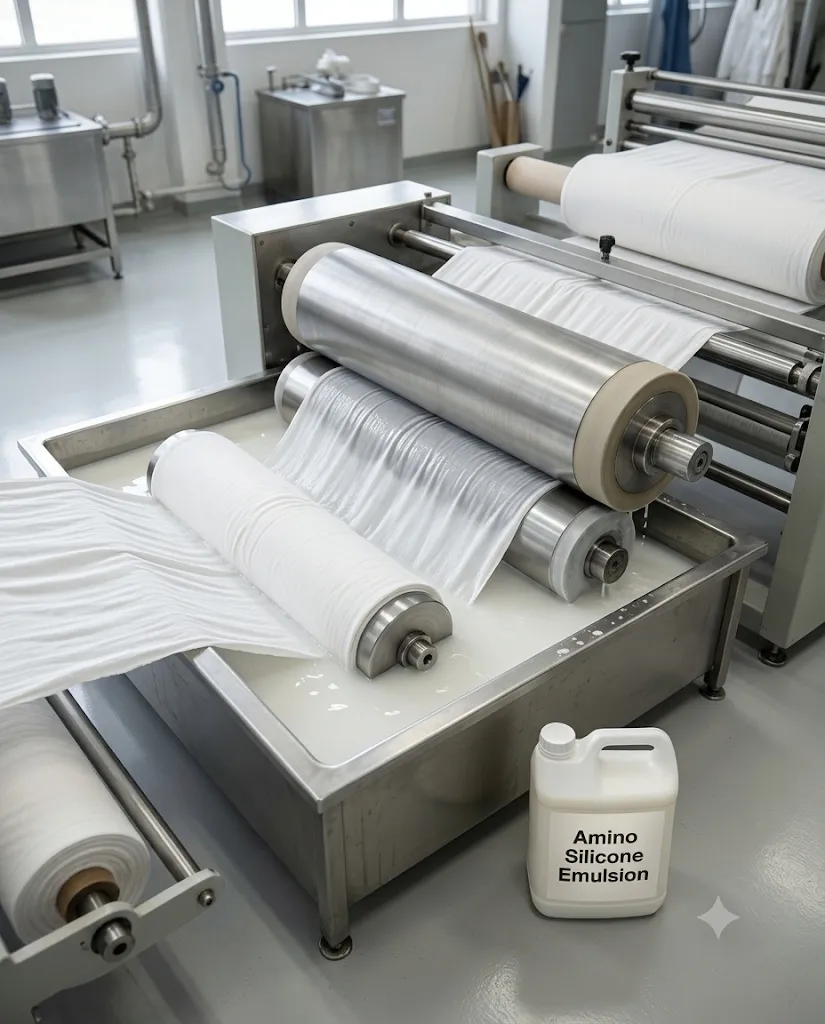
Padding and exhaust are the common methods, and spraying is also used. Whichever you choose, control concentration, pH, temperature, wet pickup and drying conditions.
Dosage depends heavily on the grade, so treat these as examples only. One cationic grade with about 25% solids recommends 2% to 4% on the weight of fabric for exhaust and roughly 20 to 30 g/l for padding. In a pad-dry-cure study on cotton and polyester, concentrations from 15 to 60 g/l were tested, and about 45 g/l worked best for the two silicone types studied.
Apply after soaping and rinsing the dyed fabric. For cationic grades, keep the bath slightly acidic, often with acetic acid, and remove residual alkali and anionic auxiliaries first. Then dry and cure as the datasheet directs.
How to Choose the Right Grade
- Name the substrate first: cotton, polyester, a blend, yarn or leather.
- Decide on the hand you want, whether soft, silky, fluffy or slick.
- Think about colour. For whites and pastels, ask for a low-yellowing grade.
- Compare active content and calculate the cost per kilo of active silicone.
- Match the ionic type to the other chemicals in your bath.
- Ask for dilution and storage stability data.
- Run a trial on your own fabric, dosage, pH and drying conditions.
How to Test a Grade Before Buying in Bulk
A small trial catches most problems early. These checks cover the essentials.
- Stability: test dilution stability and storage stability. One patent describes stable amino silicone microemulsions that survived 60 minutes in a centrifuge at 4,000 rpm.
- Softness: compare hand feel before and after repeated washing, ideally with a touch tester as well as human judgment.
- Yellowing: measure whiteness after heat. One manufacturer’s test uses 170°C for one minute with the AATCC 110 whiteness method.
- Absorbency: run the AATCC 79 water absorbency test, especially for towels and sportswear.
- Strength: check stiffness and tensile strength, as a cotton study did, so the finish does not harm the fabric.
Common Mistakes and Fixes
Overdosing. More silicone does not mean better fabric. Excess deposition can change the fabric handle, its water absorbency and later processing.
Mixing blindly. One manufacturer warns that cationic grades combined with anionic auxiliaries, such as optical brighteners, can coagulate. Run a compatibility test first.
Silicone spots and deposits. These appear when an emulsion cannot cope with shear in the machine. Choose grades with good shear stability and keep the bath clean.
Ignoring bath conditions. Water quality, pH and temperature all influence stability, so keep them consistent.
Judging only the first impression. A fabric can feel wonderful straight off the line and lose it after a few washes. Test durability, not just the initial feel.
Buying, Price Factors and Storage
Most industrial buyers order drums through chemical suppliers, but it pays to begin with a small trial quantity of amino silicone emulsion. That lets you see how the grade behaves in your own process before you commit. Whatever you choose, compare the technical datasheet with your process before anything reaches production.
Price follows active content, amine level, droplet size and the surfactant system, so ask for the price per kilo of active silicone. Also request a safety data sheet, a sample and a certificate of analysis showing active content and particle size.
For hair care or consumer goods sold in Europe, ask about residual cyclic siloxanes. Under EU Regulation 2024/1328, D4, D5 and D6 are restricted at 0.1% by weight or more from June 2026, with leave-on cosmetics following in June 2027. Check the rules for your own market.
Keep containers sealed and away from freezing temperatures and strong heat, because repeated temperature swings can make an emulsion split. Stir gently before use and follow the safety data sheet for handling.
FAQ
What is amino silicone emulsion used for?
Mostly for softening and finishing textiles. It also appears in fiber lubrication, leather treatment, paper surface treatment, hair-care products and some polishes.
Is amino silicone emulsion water soluble?
Not in the true sense. The silicone is dispersed in water as tiny droplets rather than dissolved, which is why it looks milky or translucent instead of clear.
What is the difference between amino silicone oil and amino silicone emulsion?
The oil is the concentrated silicone fluid. An amino silicone oil emulsion is that fluid already mixed into water with surfactants, so it can be diluted and applied directly in water-based processes.
Does amino silicone emulsion cause yellowing?
It can, mainly with high-amine grades on white or pale fabrics, and heat makes it more visible. Blocked and low-amine grades exist, and a small whiteness test will show whether your fabric is affected.
How do you dilute amino silicone emulsion?
Dilute it with clean water as the datasheet directs, adding it in portions while stirring gently, and prepare only what the batch needs. Check the recommended pH and ratio first, since some systems react badly to salts or incompatible additives.
Bottom Line
Amino silicone emulsion earns its place in textile finishing because it delivers soft, smooth fabric that lasts, in a form that mixes easily with water.
The best grade is not the one with the biggest number on the label. It is the one that suits your fabric, your colour sensitivity and your process, and proves itself in a trial. Start small, compare active content honestly and test after washing.