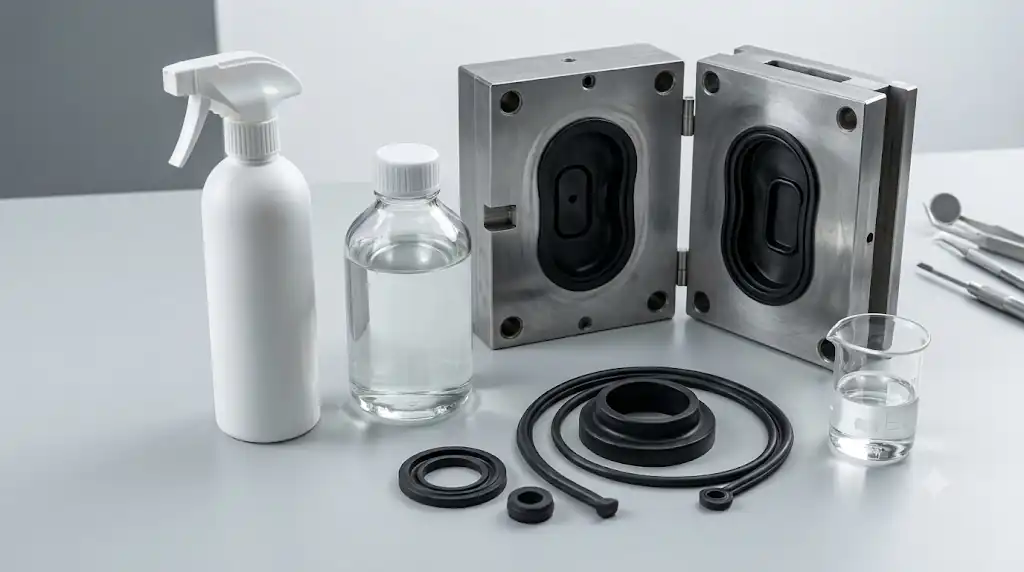
A rubber mould release agent is the thin film that lets a cured rubber part leave the mould without tearing, sticking or dragging residue behind. Choose the wrong one and you pay for it in scrap, slow cleaning cycles and bonds that fail later.
This guide shows you how to choose and use one properly. You will see how sacrificial, semi-permanent and internal types differ, when silicone becomes a problem, how to apply a coat that works, and why moulds still foul when the spray is right. It also includes a troubleshooting list and the PFAS rules that buyers selling into the EU now need to watch.
Key Takeaways
- A rubber mould release agent stops cured rubber from gripping the tool, so parts come out whole and with the finish you expect.
- Sacrificial agents are used up and reapplied every cycle. Semi-permanent agents stay on the mould for several cycles.
- Silicone-based products can interfere with bonding, painting and coating, and silicone rubber moulding commonly calls for a silicone-free agent.
- More is not better. A thin, even coat on a clean mould beats a heavy one.
- A release agent prevents sticking, but it does not prevent mould fouling, so cleaning schedules still matter.
- If you sell into the EU, ask your supplier whether the product is PFAS-based, because the rules are still being settled.
What Is a Rubber Mould Release Agent and Why Does It Matter?
A release agent is a coating that keeps one material from sticking to another surface. In rubber work it sits between the hot mould and the compound. As rubber cures it softens and turns tacky, so without that barrier it can grip the metal and tear when you open the tool.
If you want a neutral overview of how release agents are classified across industries, Wikipedia’s release agent entry is a good place to start.
The payoff on the shop floor is practical rather than glamorous. A well-chosen product helps you:
- Remove parts without tearing or surface damage.
- Keep gloss, texture and geometry consistent from cycle to cycle.
- Cut scrap caused by sticking.
- Spend less time pulling moulds out for cleaning.
Types of Release Agent for Rubber Moulding
Every rubber mould release agent can be sorted in two useful ways: by how long the film lasts, and by what carries the active ingredient.
By How Long the Film Lasts
- Sacrificial (conventional): sprayed on before every cycle. Most of the film is gone by the time the part comes out, and anything applied too heavily can pile up on the mould.
- Semi-permanent: attaches to the mould surface and stays effective for several releases. The first coat needs a clean mould, and operators have to learn the right touch-up rhythm. Many moulders prefer it to sacrificial coatings for rubber parts.
- Internal: blended into the compound, which carries it to the mould surface as parts are made. This can cut down on spraying, but it does not always replace an external agent.
- Permanent coatings: durable films on the mould surface, often called release coatings.
By Carrier
- Water-based: the active ingredients are suspended in water as an emulsion. VOC emissions are low or absent, the product does not burn, and fumes are lighter. Against that, these products are harder to make stable, can react badly to leftover moisture, and may draw heat out of the mould.
- Solvent-based: simple to apply and good at laying down a uniform film, and the choice of solvent lets the supplier set how fast it dries. The price is stricter health, safety and environmental handling, and most of the solvents involved are flammable.
- Carrier-free: a dry powder, usually put on with an electrostatic spray gun. There are no vapours and no liquid waste to deal with, but careless application can leave dust in the air.
Here is how that looks side by side:
| Type | Fits best | Watch out for |
| Sacrificial | Intricate cavities; spots where heavy spraying of open areas is a problem | Frequent reapplication; build-up if over-applied |
| Semi-permanent | Longer runs where fewer sprays per shift matter | A clean mould is needed; touch-up discipline |
| Internal | Reducing reliance on external spray | May still need an external agent |
| Water-based | Sites that prioritise low VOC and non-flammable products | Moisture sensitivity; mould cooling |
| Solvent-based | Easy application and an even film | Flammability and exposure controls |
Conventional agents have not gone away. When you pick a release agent for rubber moulding, they still earn their place on moulds with intricate cavities, and wherever heavy spraying of the easy-to-reach surfaces would do more harm than good.
Silicone or Silicone-Free: Which Rubber Release Agent Fits?
Silicone gives excellent release, particularly on difficult jobs. The catch is what it leaves behind: depending on the grade and how much is used, the residue can get in the way of painting, coating or bonding afterwards. Silicone-free grades aim to leave less greasy film on the part, which can spare you a cleaning pass.
Silicone rubber is the special case. Silicone-based rubber products commonly need a non-silicone release agent, which is why suppliers list silicone-free grades for silicone elastomers and RTV. Sticky fluoroelastomers such as FKM are another area where silicone-free, water-based grades are widely offered. Whatever the compound, the right rubber mould release agent is rarely the one with the strongest release alone.
As a rule of thumb, if the part will be bonded, painted or coated afterwards, treat any silicone-based rubber release agent with suspicion until you have tested it on your own process.
How to Choose a Mould Release Agent for Rubber
There is no single best release agent for rubber moulding, only the best fit for your process. Start with the problem you are trying to solve, not the product catalogue. A few questions narrow the field quickly:
- What are you moulding? Natural, synthetic, silicone and fluoroelastomer compounds all stick in their own way.
- What happens to the part afterwards? Bonding, painting or coating decides whether silicone is acceptable.
- How demanding is the tool? Cavity shape, temperature, pressure and cycle time all limit which type will cope. Intricate cavities may favour a conventional spray.
- What finish do you need? A gloss or matte surface can depend on the film left behind.
- What should one coat deliver? Decide how many good parts you need per application and how often the mould can come out for cleaning.
- What limits apply to you? Health, safety and environmental rules, including low-VOC and PFAS-free requirements.
Then run a controlled trial. Clean the mould properly, change one variable at a time and record how many good parts you get per application. A datasheet tells you what a product was designed for. Only your own press tells you how it behaves. Whichever rubber mould release agent you shortlist, judge it on release quality, residue and cycle-to-cycle consistency, not on the first few shots.
Release Agent Needs by Rubber Type and Process
The same spray does not suit every job. Supplier ranges usually separate products by rubber type and by process:
- Compounds: natural rubber, EPDM, nitrile, SBR, neoprene, HNBR, FKM and silicone all appear in supplier selection guides. Sticky fluoroelastomers and silicone elastomers usually have dedicated grades.
- Processes: compression, injection and transfer moulding are the common ones. Extrusion, rubber-to-metal bonding and crumb rubber moulding each bring their own demands.
- Hoses and tyres: hoses built on mandrels use mandrel lubricants rather than a standard mould spray, and tyre curing has its own release products.
Check that the grade you are offered names your rubber type and your process, not just rubber in general.
Silicone Contamination and Rubber-to-Metal Bonding
A release agent and an adhesive pull in opposite directions. One exists to stop things sticking, the other to make them stick. When release product reaches a metal insert or a bonded surface, trouble follows.
Silicone is the usual culprit. It has very low surface energy and spreads easily: it can pass from a treated tool to whatever touches it, and it can drift through the air as residue, so it can turn up where you never sprayed it. NASA research on deliberately contaminated bond surfaces found that the effect depends on the system: some bond systems showed no loss in tensile strength at the silicone level tested, while others were clearly sensitive. There is no universal safe level, so test your own combination.
For rubber-to-metal bonding, moulders commonly choose silicone-free grades, keep silicone sprays and lubricants away from the bonding area and handle prepared inserts with gloves. A mould release agent for rubber that works beautifully on plain parts can still sabotage a bonded one.
How to Apply a Rubber Mould Release Agent Properly
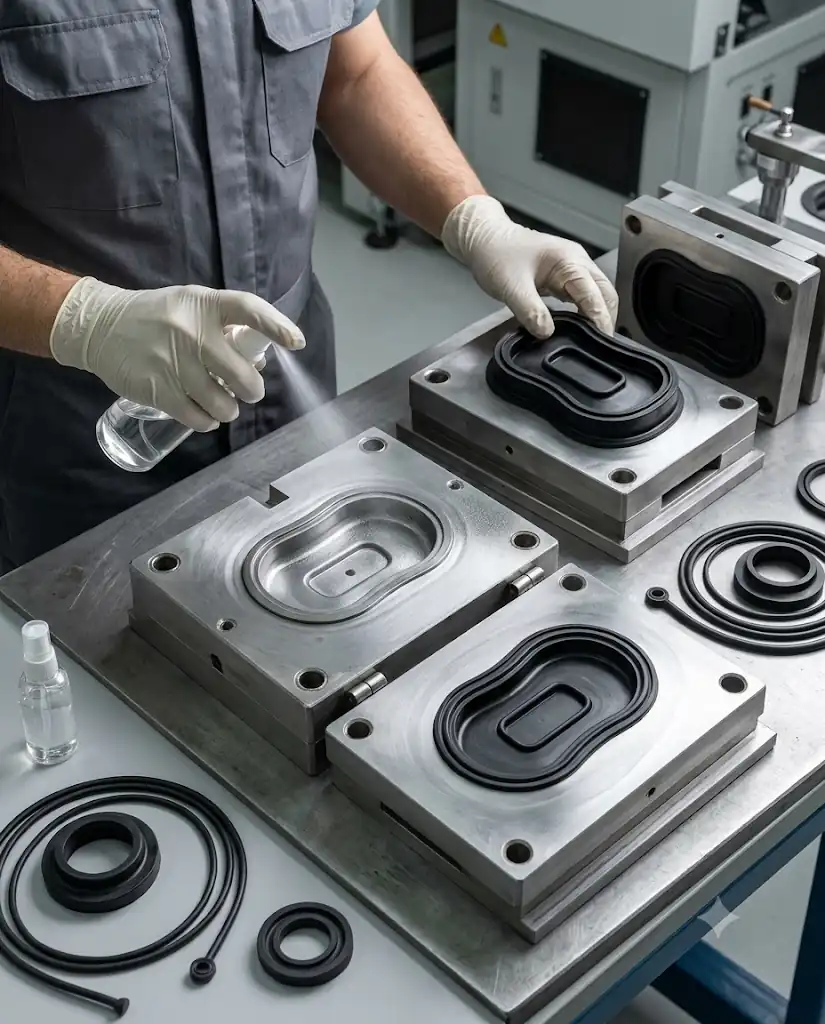
Application technique matters as much as chemistry for any mould release agent for rubber. Many problems blamed on the product trace back to how it went on. A simple routine works best:
- Clean the mould first. Strip off old residue and baked-on carbon, and clear anything else from the surface before you trial a new product. Semi-permanent agents in particular need a clean surface to react with.
- Apply a thin, even coat. Use an aerosol or spray gun by hand, or an automated system. Automated rigs with programmable, multi-nozzle spraying repeat the same coverage shot after shot.
- Avoid pooling. Heavy application can cause moulding defects and leave a residue layer behind.
- Let it dry. Water-based products are generally sprayed onto a mould that is already hot, so the water evaporates almost at once. Let each coat dry before you close the tool.
- Touch up only where needed. If parts stick in one spot, spray that spot and let it dry instead of re-coating the whole mould.
- Train the operators. Correct touch-up timing is what makes semi-permanent products pay off.
When you change products, clean the mould first. Leftover film from the old product can get in the way of the new one.
Mould Fouling: What a Release Agent Can and Cannot Do
Mould fouling is the gradual build-up of residue on the cavity surface after repeated vulcanisation. It spoils the look of the part, leaves rough or lumpy surfaces, raises scrap and eventually pulls the mould out of production for cleaning.
A rubber mould release agent stops rubber sticking to the mould. On its own, it does not stop fouling. Fouling comes mainly from the compound and the cure chemistry, with trapped air and incomplete part stripping adding to it. Peer-reviewed work on EPDM found that the deposits most probably consisted of softener oil and rubber fragments, and that ground metal surfaces resisted deposition better than the other surfaces tested.
In rubber-to-metal work, the bonding adhesive can be a major contributor too.
A sensible plan has three parts: pick a low-residue rubber moulding release agent, avoid over-application that thickens the layer and clean on a schedule. Particle blasting and immersion in a cleaning liquid are the long-standing ways to clean a fouled mould.
Common Problems and the First Thing to Check
Before blaming the rubber mould release agent itself, run through this short list:
- Parts still sticking: check for uneven coverage or a worn film, then review touch-up timing.
- Sticking in one spot: touch up that area and let it dry.
- Visible build-up on the mould: suspect over-application, then clean the mould.
- Poor bonding or coating after moulding: look for silicone transfer from the rubber release agent.
- Surface defects on parts: check for pooling or uneven spray.
- Knit lines: excess or uncured release agent can be pushed through the cavity and form knit lines. Apply less, and let semi-permanent products cure fully.
If none of these fits, bring your compounder and your supplier into the same conversation. The cause may sit in the compound or the mould surface rather than the spray.
Safety, Environment and PFAS: What to Check Before You Buy
Read the safety data sheet of any rubber mould release agent before it reaches the press. Water-based grades typically bring little or no VOC and no flammability. Most solvent-based grades use flammable solvents and need stricter exposure and fire controls.
Regulation is the other live issue. In the EU, a proposal under REACH would restrict the manufacture, use and sale of PFAS, a group that includes fluoropolymers such as PTFE. ECHA’s risk assessment committee adopted its final opinion in March 2026, and the socio-economic committee was aiming to adopt its own by the end of 2026, after which both go to the European Commission. Both committees support an EU-wide restriction with targeted derogations.
No restriction had been adopted as of mid-2026, so check ECHA’s website for the current position. If you export rubber parts to Europe, ask any supplier of a rubber moulding release agent a direct question: is this product PTFE-based or otherwise PFAS-based, and what is the plan if the rules change?
FAQ
What is a rubber mould release agent?
It is a coating or spray applied to the mould surface so that cured rubber does not stick. It forms a barrier between the compound and the tool, which makes demoulding easier and protects the part surface.
What is the difference between water-based and solvent-based release agents?
Water-based products emulsify the active ingredients in water, so they bring little or no VOC and are non-flammable, but they can be more moisture-sensitive and may cool the mould. Solvent-based products are easier to apply and form even films, but most solvents are flammable and exposure controls matter more.
Can I use a silicone-based release agent for rubber-to-metal bonded parts?
It is risky. Silicone can transfer to surfaces and reduce adhesion, and it can travel as airborne residue. Moulders commonly use silicone-free grades for bonded parts. Test the agent with your own adhesive system before committing.
How often should I apply a rubber mould release agent?
It depends on the type. Sacrificial agents go on before every cycle. Semi-permanent agents last several cycles, and the right interval depends on your compound, mould and process, so find it by trial and touch up only where parts start to stick.
Does a release agent stop mould fouling?
No. It prevents sticking, but fouling comes from residue produced by the compound during repeated curing. Regular cleaning, low-residue products and avoiding over-application all help.
Bottom Line
The right rubber mould release agent is the one that releases your compound cleanly, leaves no trouble for the next process and lasts for the number of cycles you need. Match the type to your elastomer, keep silicone away from anything you plan to bond or coat, apply thinly, clean on a schedule and check PFAS status before you commit.
Then test the rubber moulding release agent in your own press. Record releases per application, residue and part quality, and let those numbers, not a brochure, make the decision.