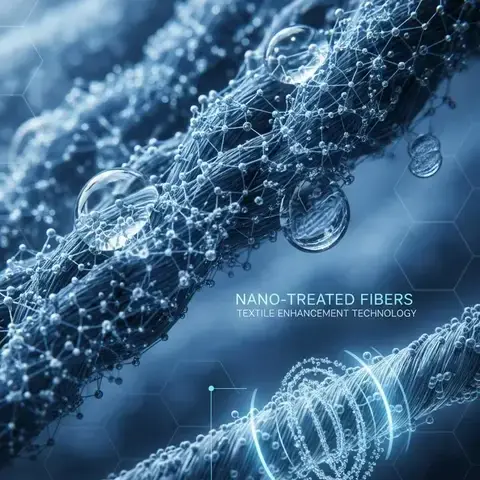
Nano chemicals for textiles are specialized chemical compounds engineered at the nanometer scale to modify or enhance fabric properties. These nano-sized particles interact at the fiber surface to deliver functionalities that conventional finishes cannot achieve. How are they redefining the next generation of performance fabrics?
Key Takeaways
- Nano chemicals improve fabric durability, UV resistance, and hygiene.
- Application methods include sol–gel, plasma, and pad-dry-cure finishing.
- Silver, TiO₂, and graphene are leading functional nanomaterials.
- Regulation ensures environmental safety and user protection.
- Smart, sustainable nano-finishes represent the industry’s next frontier.
What Are Nano Chemicals for Textiles and How Do They Work?
Nano chemicals for textiles function by depositing nanoparticles on or within fiber matrices, creating molecular-level coatings that enhance durability and responsiveness. Their mechanisms include:
- Surface modification: Altering fiber chemistry for hydrophobicity or antimicrobial behavior.
- Encapsulation: Embedding nano agents like silver or titanium dioxide.
- Layer-by-layer deposition: Building nano-thin protective films for UV and moisture resistance.
These reactions allow permanent binding even after multiple washing cycles.
Which Types of Nano Chemicals Are Commonly Used in Textiles?
Key categories of nano chemicals used in textile applications include:
| Type | Primary Function | Common Nanomaterials |
| Antimicrobial agents | Prevent bacterial growth | Silver nanoparticles, zinc oxide |
| UV protection | Reflect harmful radiation | Titanium dioxide, cerium oxide |
| Self-cleaning finishes | Break down dirt and pollutants | Titanium dioxide (photocatalytic) |
| Water & oil repellents | Impart superhydrophobicity | Silica, fluorocarbon nanoparticles |
| Conductive coatings | Enable smart textiles | Carbon nanotubes, graphene |
How Are Nano Chemicals Applied in Textile Manufacturing?
Nano chemicals are integrated using conventional textile finishing methods with nanoscale adaptation:
- Pad-dry-cure method: Nanoparticle dispersions applied during finishing.
- Sol–gel technique: Forms stable, inorganic nano-coatings.
- Electrospinning: Embeds nanomaterials within polymer fibers.
- Plasma treatment: Enhances surface reactivity for better nanoparticle adhesion.
The term textile chemical liquid is typically referenced alongside nano finishing agents, auxiliaries, and binders employed in coating and preparatory stages.
What Are the Industrial Applications of Nano Chemicals in Textiles?
Nano chemicals are widely used in:
- Healthcare: Antibacterial hospital uniforms and wound dressings.
- Outdoor and sportswear: UV-resistant and moisture-wicking garments.
- Military fabrics: Flame retardant and stealth coatings.
- Home textiles: Stain-proof upholstery and odor-free linens.
- Smart textiles: Integration with sensors and energy-harvesting materials.
These applications demonstrate the convergence of nanotechnology with advanced textile engineering.
What Are the Advantages and Limitations of Nano Chemicals for Textiles?
Advantages:
- Enhanced mechanical strength and wear resistance.
- Permanent finishes that resist washing.
- Functional versatility (UV, antibacterial, hydrophobic).
- Reduced need for repeated chemical treatments.
Limitations:
- Potential nanoparticle toxicity.
- Complex wastewater treatment requirements.
- The fabrication process is more expensive than typical fabric finishing techniques.
What Are the Emerging Trends and Regulatory Considerations?
Emerging trends include biodegradable nanocoatings, graphene-based conductive fabrics, and smart fabrics nanotechnology integrating AI-driven sensors. Regulatory bodies such as OEKO-TEX and REACH oversee compliance to ensure environmental and human safety.
Future developments will likely emphasize recyclability, eco-friendly nanomaterials, and transparent material traceability.

Conclusion
Nano chemicals for textiles are transforming fabric design by merging nanoscience with sustainable innovation. As safety frameworks advance, textile manufacturers will increasingly align nano formulations with certified systems such as iso textile perspiration chemicals, ensuring both performance and compliance in global markets.
FAQ
What are the nanomaterials used in textile?
Common nanomaterials include silver, titanium dioxide, zinc oxide, silica, and carbon nanotubes.
What are the 4 types of nano materials?
The four major types are carbon-based, metal-based, dendrimers, and composite nanomaterials.
What are nano chemicals?
Nano chemicals are engineered substances with nanoscale particles (1–100 nm) that modify material properties at the molecular level.
Which chemical is used in textiles?
Textile finishing uses diverse chemicals, including surfactants, softeners, and nanochemicals like silver and silica-based agents.
Sources
https://aces.onlinelibrary.wiley.com/doi/10.1002/cnma.202300205
https://www.sciencedirect.com/science/article/pii/S0921510723003781
https://nanoman.co.in/product/fabric-water-proofing/
https://www.azonano.com/article.aspx?ArticleID=5897
https://ebooks.inflibnet.ac.in/hsp09/chapter/role-of-nano-technology-is-textile-finishing/
https://www.espublisher.com/uploads/article_html/es-food-agroforestry/10.30919-esfaf1019.htm
https://percenta-nanoproducts.com/nano-coating-for-textile
https://pmc.ncbi.nlm.nih.gov/articles/PMC7152132/
https://www.fibre2fashion.com/industry-article/1651/functional-nano-finishes-for-textiles