
If your treadmill has started squeaking, jerking under your feet, or running warmer than it used to, the fix is often simpler than it sounds. A silicone-based treadmill lubricant, applied in a thin layer between the running belt and the deck, restores smooth movement, protects the motor from unnecessary strain, and can add years to a machine that would otherwise wear out early. This guide covers what a silicone-based treadmill lubricant actually does, how to tell when your machine needs it, and exactly how to apply it without over-doing it.
Tip 1: Know What You’re Applying — Silicone vs. Other Lubricant Types
A silicone-based treadmill lubricant is a fluid made from synthetic silicone rather than mineral oil or petroleum distillates. Most formulas sold for treadmills are close to 100% silicone, with no added solvents. That matters for two practical reasons.
First, silicone doesn’t react with the rubber, PVC, or polyurethane materials used in most treadmill belts, so it won’t cause the slow softening or degradation that some petroleum-based products can cause over months of use. Second, quality silicone-based treadmill lubricant is typically colorless, odorless, and non-toxic, which is one reason it’s the type most treadmill manufacturers recommend, and in many cases require, for warranty compliance.
Unlike a water-based lubricant, silicone based trademill lubricant doesn’t evaporate quickly, so a single application keeps working for weeks or months rather than days. Not every lubricant sold for household use is suitable for a treadmill belt, though — the table below compares the main options.
| Lubricant type | Pros | Cons |
| Silicone-based (100% silicone) | Won’t break down rubber/PVC belts; low dust attraction; usually odorless and non-toxic; long-lasting | Costs a little more than generic oils |
| Petroleum-based oil | Cheap and widely available | Can degrade rubber and plastic over time; may void manufacturer warranty; attracts dust |
| PTFE / dry spray | Clean, fast-drying application | Lower viscosity; wears off sooner; needs more frequent reapplication |
| Wax-based | Long shelf life in the bottle | Can build up residue on the belt over repeated applications |
General-purpose household oils, WD-40, and cooking oils are not recommended. They’re formulated for metal-on-metal contact, not the rubber-and-wax belt materials used in treadmills, and can cause the belt to become sticky or brittle over time.
Tip 2: Understand Why Silicone Based Trademil Lubrication Actually Matters
Every time the belt completes a loop, it passes over the deck under constant pressure from your body weight. Without adequate lubricant, that repeated contact generates friction, and friction generates heat. Heat is the enemy of nearly every moving part on a treadmill: the belt fibers, the deck surface, and eventually the motor and control board.
There’s also a mechanical reason thinner lubricants wear out faster: a phenomenon sometimes called lubricant shear. As the belt repeatedly compresses the lubricant layer, a low-viscosity (thin) product gradually loses its internal structure and stops forming an effective barrier between the two surfaces. A higher-viscosity, 100% silicone lubricant resists this breakdown for longer, which is why it typically needs reapplying less often than a thin spray-on product.
In practical terms, that means less noise, less heat buildup, less strain on the drive motor, and a belt and deck that last longer before needing replacement.
Tip 3: Watch for the Warning Signs It’s Overdue
Most manufacturers suggest a time- or hour-based schedule, but your machine will usually tell you before then. Watch for:
- A squeaking, chirping, or rhythmic noise as the belt moves
- The belt feels “grabby” or hesitates slightly under your foot
- The belt slips or slides when you speed up
- The deck feels noticeably warm after a short session
- It’s been more than three months, or roughly 130 hours of use, since the last application
- Lifting the belt edge reveals a dry, dull-looking deck surface rather than a light sheen
Tip 4: Follow a Usage-Based Schedule, Not a Guess
There’s no single correct interval for every machine — usage intensity matters more than the calendar. The table below is a reasonable starting point; always check your owner’s manual, since some manufacturers specify a different schedule for their model.
| Usage level | Typical frequency | Example |
| Light (under 3 hours/week) | Every 4–6 months | Occasional walker |
| Moderate (3–7 hours/week) | Every 3 months, or ~130–150 hours | Regular home runner |
| Heavy / commercial (8+ hours/week) | Every 4–6 weeks | Gym or shared household machine |
Tip 5: Apply It the Right Way — and Safely
Once you know it’s time, the application itself only takes a few minutes:
- Unplug the treadmill completely before doing anything else.
- Wipe down the belt and the exposed deck edges with a dry or lightly damp cloth to remove dust and debris.
- Let the surface dry fully before applying anything.
- Loosen the belt at each side, following your model’s manual, so you can access the space between the belt and the deck.
- Apply a thin, zigzag line of silicone-based treadmill lubricant across the width of the deck — a light, even coat, not a puddle.
- Repeat on the opposite side of the belt.
- Move the belt by hand for a few rotations, or run the treadmill at a low speed for 30–60 seconds with nobody on it, to spread the lubricant evenly.
- Wipe away any excess that has seeped onto the top of the belt surface.
- Plug the treadmill back in and walk at a low speed for a minute or two to confirm the belt moves smoothly before a full workout.
A few safety and product notes make this tip complete:
- Always unplug the treadmill before applying lubricant — never work on a powered unit.
- Avoid over-applying; excess lubricant can seep toward the motor housing or make the belt surface slippery.
- Check your owner’s manual — using an unapproved lubricant type can affect your warranty.
- If your model has an enclosed or self-lubricating belt, confirm with the manufacturer before applying any product, since some designs don’t require, or don’t allow, manual lubrication.
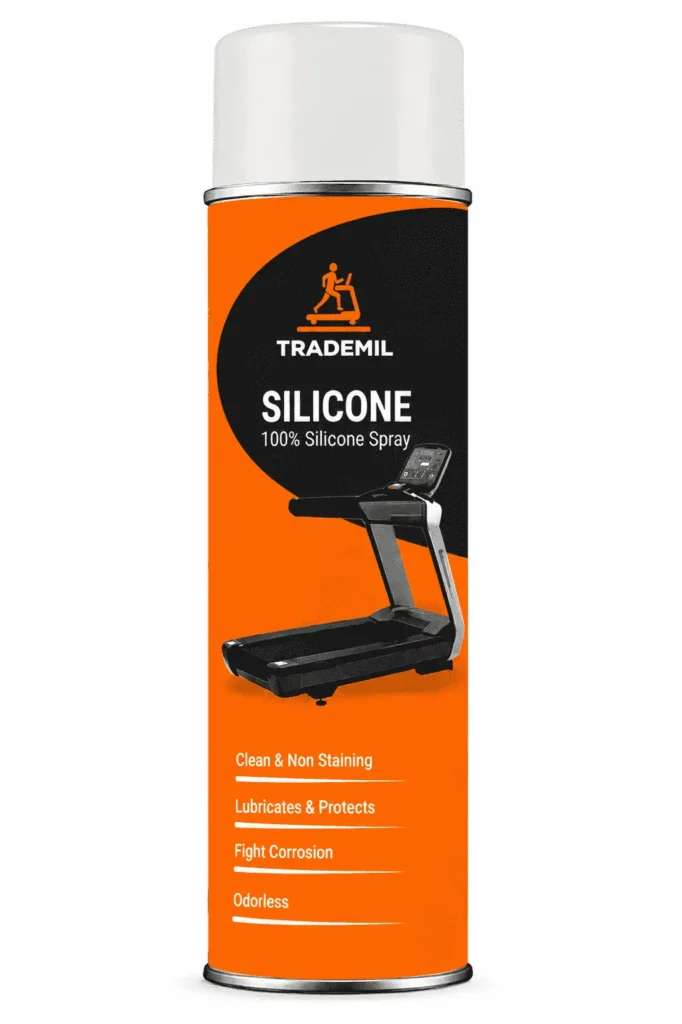
- When choosing a bottle, look for a label that specifies 100% silicone rather than a blend, ideally with a long, thin applicator nozzle so you can reach the full width of the deck without fully disassembling the belt.
Faqs
Is silicone-based treadmill lubricant safe for all treadmill brands?
Most brands recommend or require a 100% silicone-based treadmill lubricant, but the specific product and application method can vary. Check your owner’s manual before applying anything, since a small number of models use sealed or self-lubricating belts that shouldn’t be manually lubricated.
How much silicone treadmill lubricant should I use?
A thin, even zigzag line across the width of the deck on each side is enough. More is not better — excess lubricant can seep past the belt edges or make the surface unpleasantly slick.
Can I use WD-40 or 3-in-1 oil instead of silicone lubricant?
It isn’t recommended. These products are designed for metal parts, not rubber or PVC belts, and can cause the belt material to soften, degrade, or attract dust over time.
What happens if I don’t lubricate my treadmill?
Friction and heat build up between the belt and deck, which increases motor strain, creates noise, and accelerates wear on the belt and deck. Over time, this can lead to a belt that needs replacing far sooner than it should, or a motor that fails prematurely.
Can too much lubricant damage my treadmill?
Yes. Over-application can make the belt slippery underfoot and, in some cases, allow lubricant to migrate toward the motor housing or electronics. A thin, controlled application is always preferable to a heavy one.
How long does one bottle of silicone treadmill lubricant last?
This depends on bottle size and usage, but a standard 2–4 oz bottle typically covers three to four applications for a household treadmill, which usually works out to roughly a year of maintenance at a normal home-use schedule.
Is treadmill silicone lubricant the same as general-purpose silicone spray?
Not always. General silicone sprays sometimes include propellants or additives not intended for repeated skin or floor contact. A product labeled specifically as treadmill lubricant is formulated and tested for that use case, so it’s worth buying the dedicated version rather than substituting a generic spray.
Storing Your Silicone-Based Treadmill Lubricant for Maximum Shelf Life
Store the bottle upright in a cool, dry spot away from direct sunlight and heat sources, such as a furnace, a water heater, or a garage wall that gets hot in summer. Extreme heat can thin silicone-based treadmill lubricant and warp or leak the container. Repeated freeze-and-thaw cycles can also affect viscosity, making the product harder to apply evenly.
A closet shelf, a basement bin, or a spot near the treadmill itself all work well, as long as it’s out of direct sun. Most unopened bottles of silicone-based treadmill lubricant carry a shelf life of two to three years when stored this way, and a properly sealed bottle used every few months should stay usable for the life of the container.
It’s worth keeping the original label or box, since it lists the exact silicone percentage and any manufacturer guidance specific to that product — handy to reference before your next application.
Before each use, do a quick visual check rather than assuming an older bottle is still good. Separation, unusual cloudiness, a color change, or an off smell are signs the silicone-based treadmill lubricant has degraded or been contaminated. It’s better to replace the bottle than risk an inconsistent application on the belt.
A quality silicone-based treadmill lubricant isn’t classified as hazardous waste, so an empty bottle can typically go out with regular household trash, though checking local guidelines is always a safe habit. Avoid pouring leftover product down a drain, and rinse recyclable bottles before disposal.
Finally, resist buying the largest bottle available if you only lubricate a home treadmill a few times a year. A smaller 2–4 oz bottle used up within its shelf life serves you better than a large one that sits half-full for years and gradually loses quality.
Conclusion
Regular use of a silicone-based treadmill lubricant is one of the simplest and least expensive ways to protect a treadmill from premature wear. It cuts friction and heat where the belt meets the deck, quiets a noisy machine, and helps you avoid the far larger cost of replacing a belt or motor. Check your manual for your model’s recommended interval, watch for the warning signs covered above, and apply a thin, even coat rather than assuming more is better. A few minutes of maintenance every few months is a small trade-off for a treadmill that keeps running smoothly for years.