
Silicone textile challenges present significant technical hurdles for fabric manufacturers trying to achieve optimal softness, water repellency, and elasticity. Step into any contemporary fabric manufacturing facility, and you will find silicones quietly doing their job in imparting garments with their characteristic drape and plush feel, as well as waterproof coatings. Thermal yellowing on white cotton goods remains one of the most persistent silicone textile challenges encountered during high-temperature curing. However, there are numerous technicalities in the chemical finishing process that make the task difficult and leave many things open to error. From oil marks on the stenter machine to water repellent formation leading to loss of absorbency, silicone finishing requires process control and careful choice. Let’s find out more here.
Why Do Silicone Applications Require Careful Control?
Addressing silicone textile challenges early in the finishing stage prevents spot staining and uneven oil distribution on dyed fabrics. The types of silicones will depend on the application on the fabric. Several factors that may determine the success of the process include:
- Silicone formulation
- Fabric construction
- Temperature of the process
- Application technique
- Chemical reaction
- Conditioning and drying
- Machine maintenance
With proper control of these variables, manufacturers can achieve consistent quality of their fabrics with minimal processing problems.
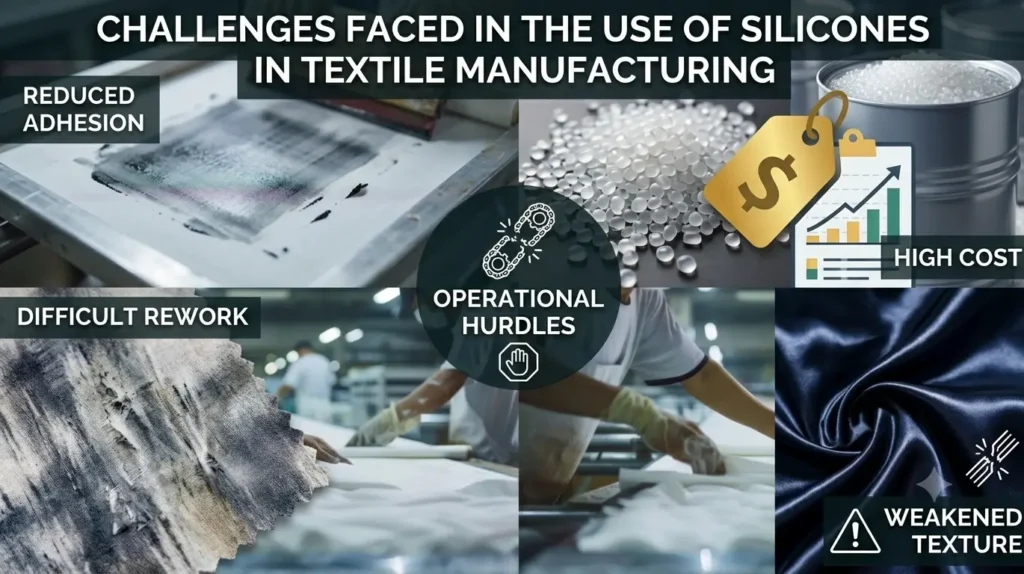
Common Challenges in Textile Manufacturing
Textile mills frequently face severe silicone textile challenges when high-shear padding processes break down delicate silicone emulsions. Although silicones provide numerous benefits, manufacturers must manage several practical challenges during production.
1. Selecting the Right Silicone Formulation
However, different types of fabrics will need different kinds of silicone treatments. An inappropriate treatment can interfere with the desired finish or make the process inefficient.
These factors determine what kind of silicone to use:
- Natural or artificial fibers
- Kind of fabric construction
- End uses
- Needed finishes
2. Compatibility with Textile Finishing Chemicals
Sometimes, silicones are used in combination with other chemicals such as dyeing or finishing agents or resins. Incompatibility among different chemicals can affect the efficiency of the process or influence the quality of the fabric.
Compatibility tests are normally performed by manufacturers before the mass production of the textiles.
3. Achieving a Consistent Finish on Textiles
The problem with achieving an even coating of silicones throughout the fabric can arise in some cases. Chemical engineers constantly refine emulsifier systems to resolve silicone textile challenges related to bath compatibility and hard water sensitivity.
The following factors can affect the evenness:
- Padding pressure
- Application devices
- Fabric speed
- Drying conditions
- Concentration of silicones
4. Process Control During Finishing
These factors must be kept under close watch during the process of textile finishing.
Process control mistakes could lead to:
- Inconsistency in coating
- Uneven feel of the fabric
- Low efficiency in the process of finishing
- Variability in the quality of the products.
5. Cost Factors
High-quality silicon-based solutions tend to drive up production costs when compared to other standard textile finishing solutions.
Manufacturers usually need to take into account:
- Performance of the product
- Amount of material used
- Efficiency of the process
- Overall production costs
6. Equipment Cleaning and Maintenance
Over time, residues of the silicon-based solutions may build up inside the manufacturing equipment.
Regular maintenance will assist with:
- Consistency in the application
- Minimizing production downtime
- Better performance of the machinery
- Extending machine life
Major Silicone Fabric Treatment Defect Issues
Understanding these silicone textile challenges helps plant managers choose the right amino-functional silicones to maintain fabric absorbency and performance.
| Challenge | Impact on Manufacturing |
| Product selection | Influences finishing quality and process performance |
| Chemical compatibility | Affects production consistency |
| Uniform application | Determines fabric appearance and finish quality |
| Process control | Supports consistent product performance |
| Production cost | Influences manufacturing efficiency |
| Equipment maintenance | Helps maintain reliable production |
| Quality monitoring | Ensures consistent finished products |
| Skilled operation | Supports accurate silicone application |
In high-speed machinery, unaddressed silicone textile challenges often lead to sticky roller buildup and unexpected machine downtime. Proper planning and quality control allow manufacturers to address these problems while maintaining efficient production.
Best Practices to Minimise Roadblocks
Textile manufacturers can reduce processing issues by following established production practices. While silicone finishes improve hand-feel, navigating key silicone textile challenges, such as emulsion breakdown, fabric yellowing, and bath instability, is essential to prevent costly production downtime and fabric defects.
| Best Practice | Purpose |
| Select suitable silicone formulations | Match material performance with fabric requirements |
| Conduct laboratory trials | Verify compatibility before full-scale production |
| Monitor processing parameters | Maintain consistent application quality |
| Calibrate equipment regularly | Improve process accuracy |
| Train production personnel | Reduce operational errors |
| Perform routine equipment cleaning | Prevent silicone residue build-up |
| Inspect finished fabrics | Identify quality variations early |
Implementing these practices supports reliable textile production while improving overall manufacturing efficiency.
Future Outlook
Advances in silicone chemistry continue to improve textile processing technologies. Manufacturers are developing specialised formulations with improved compatibility, easier processing, and enhanced performance for technical textiles, performance apparel, and industrial fabrics.
Increasing automation, digital process monitoring, and sustainable manufacturing practices are also helping textile producers optimise silicone applications while improving production consistency and resource efficiency.
Final Thoughts
Silicones have proven their importance in the field of textile processing, as their contribution to innovation in softness, durability, and performance cannot be ignored. But tackling the technological difficulties in the factory setting demands continuous process improvement and efficient chemical collaborations. Keeping up with the latest developments in formulation technology guarantees an easier and more profitable production process.
Partner with experts who understand your operational needs. Discover tailored textile chemical solutions at BioPol Chemicals. Choose advanced formulations designed for tomorrow’s production needs.
Frequently Asked Questions
1. Why is choosing the right type of silicone significant for textile manufacturing?
Various types of fabrics and finishes demand various types of silicones. The selection of the proper type will ensure the intended finishing properties of the fabric.
2. How could manufacturers make the application process of silicone more consistent?
Controlled processing conditions, calibration of equipment, laboratory tests, and parameter control during production will ensure better consistency of the finish on the fabric.
3. Can the type of fabric affect the performance of silicone?
Certainly. The reaction of natural fibers, artificial ones, and their blends to silicone will be different, and the selection of the type of silicone corresponding to the type of fabric will guarantee the desired results.
4. How can quality control contribute to the process of using silicone in textile manufacturing?
Quality control will ensure consistency of the process of applying silicone, as well as the consistency of its performance on the fabric.
Also Read