Silicone compound manufacturers produce formulated silicone materials by blending silicone polymers with fillers, additives, and curing agents to achieve specific mechanical and chemical properties. These compounds are widely used in industries requiring high heat resistance, flexibility, and environmental stability. What factors determine the quality and suitability of silicone compounds for industrial applications?
Key Takeaways
- Silicone compound manufacturers create engineered silicone mixtures for specialized applications.
- These compounds are formulated with polymers, fillers, additives, and curing agents.
- Major types include HTV, RTV, liquid silicone rubber, and fluorosilicone compounds.
- Industries such as automotive, electronics, and healthcare depend on silicone materials.
- Compliance with standards like ISO, FDA, and ASTM ensures safety and reliability.
What Do Silicone Compound Manufacturers Produce?
Silicone compound manufacturers develop customized silicone mixtures designed for processing into seals, gaskets, insulation materials, and molded components.
Typical silicone compound products include:
- High-temperature silicone compounds
- Medical-grade silicone elastomers
- Electrical insulation silicone
- Food-grade silicone materials
- Weather-resistant construction sealants
These compounds are usually delivered in forms such as:
| Form | Typical Use |
| Solid rubber compound | Molded components |
| Liquid silicone compound | Injection molding |
| Paste or gel compound | Coatings and sealants |
Manufacturers adjust the composition depending on required elasticity, heat tolerance, or chemical resistance.
How Are Silicone Compounds Manufactured?
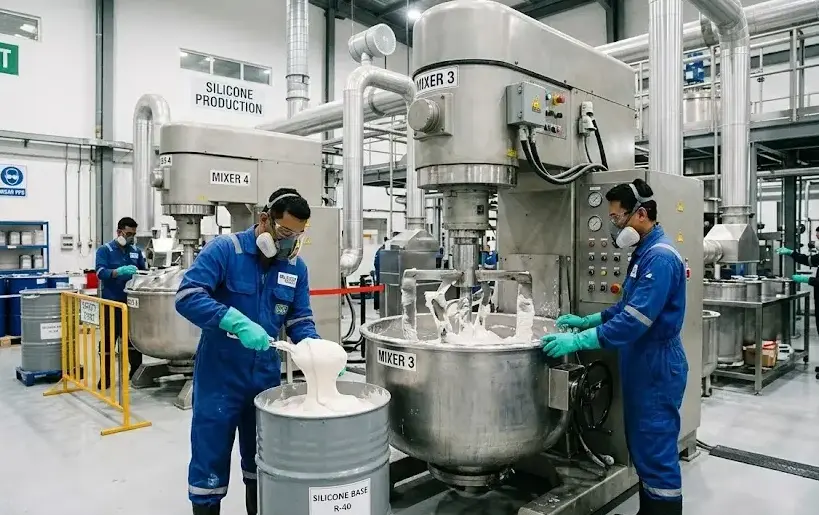
Silicone compound manufacturers follow controlled chemical formulation and mixing processes to ensure consistent material performance.
A typical production workflow includes:
- Base polymer preparation – Silicone polymers are synthesized from silicon-based raw materials.
- Filler integration – Reinforcing fillers such as silica improve strength and durability.
- Additive blending – Pigments, stabilizers, and flame retardants are incorporated.
- Compounding and mixing – High-precision mixers ensure homogeneous distribution.
- Quality testing – Mechanical, thermal, and chemical properties are verified.
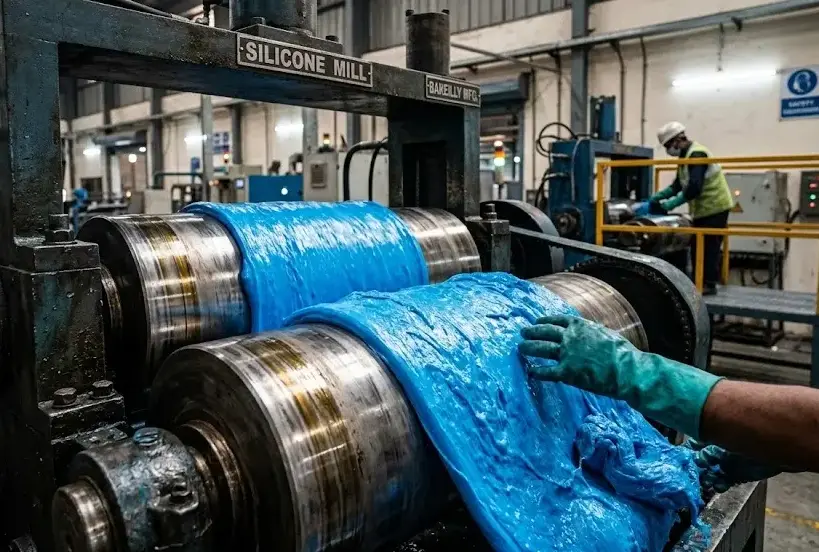
Industrial mixers, kneaders, and extrusion equipment are commonly used during this stage.
What Types of Silicone Compounds Are Available?
Silicone compound manufacturers supply multiple categories depending on curing systems and application environments.
Common classifications include:
| Type | Characteristics | Typical Applications |
| High-temperature vulcanizing (HTV) silicone | High mechanical strength | Automotive gaskets |
| Room-temperature vulcanizing (RTV) silicone | Easy curing at ambient conditions | Sealants and adhesives |
| Liquid silicone rubber (LSR) | Injection-moldable | Medical devices |
| Fluorosilicone compounds | Chemical resistance | Aerospace components |
Each category meets different engineering specifications.
Which Industries Depend on Silicone Compound Manufacturers?
Silicone compound manufacturers support multiple technical industries due to the material’s durability and flexibility.
Major application sectors include:
- Automotive: seals, hoses, vibration dampers
- Electronics: insulation, encapsulation materials
- Healthcare: medical tubing and implants
- Construction: weatherproof sealants
- Food processing: hygienic silicone components
Some readers also explore related materials such as silicone rubber compounds, silicone sealants, and silicone elastomer formulations when comparing industrial silicone solutions.
What Quality Standards Must Silicone Compounds Meet?
Silicone compound manufacturers must comply with several industrial and regulatory standards.
Key certifications and testing frameworks include:
- ISO 9001 – Quality management systems
- FDA compliance – Food-contact silicone materials
- USP Class VI – Medical-grade silicone validation
- RoHS compliance – Restriction of hazardous substances
- ASTM testing standards – Mechanical and thermal performance
Manufacturers typically conduct testing for tensile strength, elongation, hardness, and thermal stability.
How Do Industries Select Reliable Silicone Compound Manufacturers?
Selecting silicone compound manufacturers requires evaluation of production capabilities, certifications, and technical support.
Important evaluation criteria include:
- Material customization capability
- Compliance with global safety standards
- Batch consistency and testing protocols
- Industry-specific compound development
- Supply chain reliability
Companies often request sample compounds and technical data sheets before committing to large-scale procurement.
Conclusion
Silicone compound manufacturers play a critical role in supplying engineered materials that meet demanding industrial, medical, and environmental standards. Their ability to tailor formulations ensures performance across diverse sectors such as automotive, electronics, and healthcare. For organizations exploring the broader silicone supply chain, understanding the role of silicone chemical manufacturers helps clarify how base materials evolve into specialized compounds used in advanced manufacturing.
FAQ
What are silicone compounds used for?
Silicone compounds are used to manufacture seals, gaskets, insulation materials, medical devices, and industrial coatings due to their heat resistance and flexibility.
How are silicone compounds different from silicone rubber?
Silicone compounds are formulated raw mixtures, while silicone rubber refers to the final cured material produced from those compounds.
Which industries use silicone compounds most frequently?
Automotive, electronics, construction, healthcare, and food processing industries rely heavily on silicone compounds.
What temperatures can silicone compounds withstand?
Many silicone compounds operate between −60°C and 250°C depending on formulation and curing method.
Are silicone compounds environmentally stable?
Yes. Most silicone compounds resist UV exposure, moisture, oxidation, and extreme temperatures.
Sources
https://dir.indiamart.com/impcat/silicon-compound.html
https://www.siliconeproducts.in/silicone-compound.html
http://www.chemicalbrothers.co.in/silicone-elastomer-manufacturers-in-india.php
https://www.midasrubber.com/silicone-compounds.php
https://www.siliconemulsion.com/silicon-compound.html
https://www.justdial.com/Delhi/Silicone-Compound-Manufacturers/nct-10436782
https://www.alstoneindia.in/product/silicone
http://www.tuffbondsealant.com/silicon-compound-4420017.html