“How long does silicone take to dry?” depends on the specific product formulation and environmental conditions, though most standard silicone sealants become dry to the touch within 30 to 60 minutes. Selecting high-grade formulations helps manufacturers maintain consistent silicone drying time across high-speed industrial assembly lines.
You have just finished applying a neat bead of silicone around a sink, shower, window, or joint. It looks dry on the surface, but is it actually ready for water, movement, or use? Not necessarily.
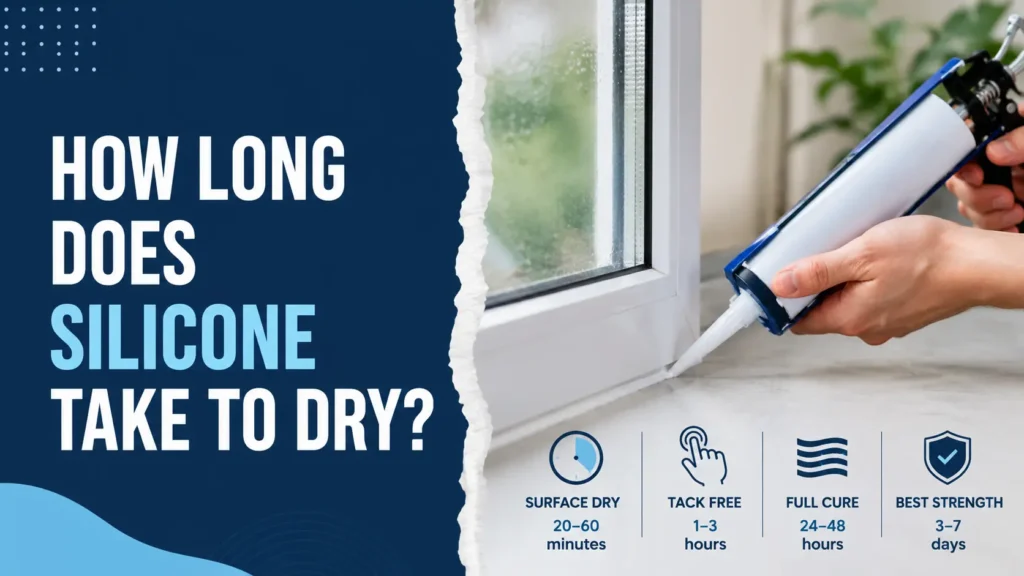
Silicone can become touch-dry relatively quickly, while the material underneath continues to cure. For most common silicone sealants, full curing takes around 24–48 hours, although the exact time depends on the formulation, thickness, temperature, humidity, ventilation, and application conditions. Screwfix similarly notes that silicone sealants typically require 24–48 hours to fully dry/cure, while some manufacturer data specifies approximately 24 hours under particular conditions.
Understanding the difference between drying, skin formation, and full curing can help prevent weak bonds, leaks, cracks, and premature seal failure.
Table of Contents
How Long Does Silicone Take to Dry? (Stages Explained)
Homeowners planning a bathroom renovation often ask how long does silicone take to dry before they can safely use the shower again. Cold weather and poor ventilation can significantly extend silicone drying time during outdoor window sealing projects.
| Stage | Approximate Time | What Happens |
| Working time | A few minutes | Silicone can still be shaped and smoothed. |
| Skin formation | Around 10–30 minutes | The surface begins forming a skin. |
| Touch-dry | Around 30 minutes–a few hours | The surface may no longer feel wet or tacky. |
| Initial cure | Around 24 hours | The silicone develops substantially more strength and stability. |
| Full cure | Usually 24–48 hours | The seal is generally ready for normal exposure, depending on the product. |
| Thick or specialised applications | Several days or longer | Deeper sections can take considerably more time to cure. |
Exact times vary by product, so the manufacturer’s technical data sheet should always take priority. For example, one Sika silicone specifies curing to a 3 mm depth in 24 hours at 23°C and 50% relative humidity. The average silicone drying time for a full cure ranges from 24 to 48 hours depending on humidity and room temperature.
Drying vs. Curing: What’s the Difference?
Understanding how long does silicone take to dry helps prevent costly mistakes, such as exposing un-cured sealant to water too early. The words dry and cure are often used interchangeably, but they do not mean exactly the same thing.
| Drying | Curing |
| Mainly describes the surface becoming dry or tack-free. | Describes the silicone developing its final properties through a chemical reaction. |
| Can happen relatively quickly. | Usually takes considerably longer. |
| The surface may look finished. | The interior is progressively becoming stronger and more stable. |
| Does not necessarily mean the seal is ready for use. | Indicates the seal is approaching or has reached its intended performance. |
Silicone sealants commonly cure through interaction with moisture in the surrounding environment. Therefore, a surface that feels dry should not automatically be considered fully cured.
Silicone Drying Time by Application
How long does silicone take to dry depends on factors like moisture levels, ambient air temperature, and the thickness of the bead applied. The amount of time you should wait depends heavily on where the silicone has been applied.
| Application | Typical Waiting Period* | Important Consideration |
| Bathroom sink | About 24 hours | Keep the area dry during curing. |
| Shower enclosure | At least 24 hours | Avoid using the shower until the seal has adequately cured. |
| Bathtub | Around 24 hours | Prevent water exposure during curing. |
| Kitchen countertop/joint | Around 24 hours | Avoid washing or soaking the sealed area. |
| Window frame | Around 24–48 hours | Protect the joint from excessive moisture and movement. |
| Outdoor joints | 24–48+ hours | Temperature and weather conditions can extend curing. |
| Thick silicone applications | Longer than 48 hours may be required | Deeper material takes longer to cure. |
What Factors Affect Silicone Drying Time?
Knowing exactly how long does silicone take to dry allows you to schedule plumbing repairs without unnecessary downtime. Silicone does not cure at exactly the same speed in every environment.
| Factor | Effect on Drying/Curing |
| Temperature | Lower temperatures generally slow curing. |
| Humidity | Because many silicones cure through moisture exposure, suitable humidity can support curing; excessively dry conditions can slow some formulations. |
| Ventilation | Good airflow can help maintain appropriate curing conditions. |
| Thickness | Thick beads take longer to cure through their entire depth. |
| Silicone formulation | Different products have different cure mechanisms and specifications. |
| Surface condition | Dirt, grease, moisture, or old sealant can interfere with adhesion. |
| Application quality | Uneven or excessively thick application can affect curing and performance. |
| Product age | Expired or improperly stored silicone may not perform as intended. |
Silicone vs Other Sealants: Drying and Curing Time
These are broad categories rather than fixed product specifications. Different formulations within the same category can have substantially different cure rates.
| Sealant Type | Approximate Drying/Curing Pattern | Common Uses |
| Silicone | Often around 24–48 hours for full cure | Bathrooms, glazing, joints, wet areas |
| Acrylic | Often quicker surface drying; cure time varies | Interior joints and decorating |
| Polyurethane | Can require considerably longer curing | Construction and demanding applications |
| Hybrid polymer | Often relatively fast, depending on formulation | Construction, bonding and sealing |
Final Thoughts
So, how long does silicone take to dry? The short answer is: usually around 24–48 hours to fully cure, although the actual time depends on the silicone formulation, bead thickness, temperature, humidity, ventilation, and application conditions.
The biggest mistake is confusing a silicone seal that feels dry with one that is fully cured. Giving the material adequate time to cure is a small step that can make a major difference to the strength, flexibility, waterproofing, and long-term reliability of the finished seal.
For manufacturers and industrial users, choosing a silicone formulation with predictable curing behaviour is equally important. Biopol Chemicals can help businesses explore silicone-based chemical solutions suited to their specific manufacturing and application requirements. If you’re looking for reliable silicone and specialty chemical solutions, connect with Biopol Chemicals to discuss your requirements and find the right formulation for your application.
FAQs
1. How long does silicone take to dry completely?
Most common silicone sealants require around 24–48 hours to fully cure, although some products can take longer depending on thickness and environmental conditions. Always follow the manufacturer’s instructions.
2. Can silicone dry in 3 hours?
It can become touch-dry or develop a surface skin within a few hours, but that does not mean it is fully cured. A silicone sealant may still require approximately 24 hours or longer to cure throughout its depth.
3. How long should silicone dry before using a shower?
As a general guideline, wait at least 24 hours before using a newly siliconed shower. Some products may require a different period, so the manufacturer’s instructions should take precedence.
4. Does silicone cure faster in humid conditions?
Many silicone sealants cure through a moisture-driven chemical reaction, so environmental humidity can affect curing. However, the ideal conditions depend on the formulation. Excessive moisture or premature water exposure should not be treated as a shortcut to curing.
5. Why is my silicone still soft after 24 hours?
Possible reasons include an excessively thick application, unsuitable temperature or humidity, poor product condition, or a formulation with a longer cure time. Check the manufacturer’s technical data before deciding whether the seal has failed.
6. Can I speed up silicone curing?
You can help create favourable curing conditions by maintaining suitable temperature, providing reasonable ventilation, and avoiding unnecessarily thick applications. However, do not try to bypass the manufacturer’s minimum cure time simply to finish a project sooner.
Also Read