The silicone melting point is one of the most searched, and most misunderstood, numbers in materials science. Here’s the surprising part: cured silicone rubber doesn’t melt into a puddle the way plastic or wax does. It stays solid, slowly changes, and eventually breaks down chemically.
So the real question isn’t “when does it melt?” It’s “how hot is too hot?” This guide gives you a practical answer on the silicone melting point, with temperature ranges for common silicone types, what happens as heat climbs, and how to judge whether a product will survive your oven, engine bay, or sterilizer.
Key Takeaways
- Cured silicone rubber has no true high-temperature melting point.
- Most grades stay stable in regular use up to about 200–250°C (392–482°F).
- Breakdown usually begins around 250–320°C (482–608°F), depending on the grade.
- The only real melting happens in the cold, near −43°C (−45°F).
- Always check whether a rating is continuous or short-burst.
- Silicone heat resistance depends on heat duration, oxygen and fillers.
- The rating printed on your product beats any general silicone melting point figure.
- Overheated silicone that smells, smokes or turns sticky should be retired.
What Is the Silicone Melting Point?
Strictly speaking, there isn’t one. A melting point is the temperature where a solid turns into a liquid and can turn back into a solid when it cools. Cured silicone rubber doesn’t work that way.
During manufacturing, the long silicone chains get chemically linked into a network. That crosslinked structure makes silicone a thermoset material. Once it has set, heat can’t soften it into a flowing liquid that re-solidifies later.
So when people talk about the silicone melting point, they usually mean something else: the silicone degradation temperature, where the rubber starts to lose its properties. For most products that sits somewhere between 250°C and 320°C (482–608°F).
Below that, silicone stays rubbery. Above it, the material hardens, cracks, and finally breaks down. So, does silicone melt? Not in the everyday sense.
Why Silicone Handles Heat So Well
The secret is in the backbone. Silicone is built on repeating silicon and oxygen atoms, called a siloxane chain. Most plastics and rubbers rely on carbon-carbon chains instead.
The silicon–oxygen bond is stronger than a carbon–carbon bond. That’s why silicone heat resistance far outperforms ordinary rubber, and why it keeps its flexibility across a very wide range, often from about −50°C up to 200°C or more.
Is There a Real Melting Point at All?
Yes, but this silicone melting point sits at the cold end. Silicone rubber is made mostly from polydimethylsiloxane, or PDMS. A recent study in Thermochimica Acta used calorimetry to examine a PDMS-based rubber and found its crystalline portion melts at around 230 K, roughly −43°C.
That’s a lab measurement on one specific vinyl methyl silicone rubber, so treat the figure as a reference point rather than a universal constant. The same study found that swelling the rubber with organic solvents such as hexane pushed that cold melting temperature down by more than 30 K.
Why does this matter? It shows that the only true silicone melting point is a low-temperature, crystal-related event. You won’t see it in an oven. It also reminds us that chemicals can change how silicone behaves, not just heat.
There’s a second cold-end event worth knowing: the glass transition, where silicone stops behaving like a rubber and turns stiff. For PDMS this happens far lower, at roughly −120°C, so it has little to do with the hot-side silicone melting point people search for. In plain terms, silicone stays flexible in freezers and winter weather, and the real trouble only starts at the hot end.
Silicone Melting Point by Type: Degradation Temperatures
Not every silicone is the same. Formulation, curing method and fillers all change the numbers. The table shows typical manufacturer-quoted ranges for the silicone degradation temperature of each type. Each one is really what people mean when they search for a silicone melting point, so use the table for orientation, not for final design decisions.
| Silicone type | Typical working range | Degradation begins |
| HTV (solid) silicone | −60°C to 250°C (−76°F to 482°F) | Around 300°C (572°F) |
| RTV silicone | −50°C to 200°C (−58°F to 392°F) | 250–300°C (482–572°F) |
| Liquid silicone rubber (LSR) | −50°C to 200°C (−58°F to 392°F) | 250–300°C (482–572°F) |
| Fluorosilicone (FVMQ) | −60°C to 230°C (−76°F to 446°F) | 280–320°C (536–608°F) |
| Food-grade silicone | −40°C to 230°C (−40°F to 446°F) | 250–280°C (482–536°F) |
| Medical-grade silicone | −50°C to 200°C (−58°F to 392°F) | 250–300°C (482–572°F) |
Notice the gap between the working range and the point where degradation starts. That gap is a safety margin, not spare room to use. Holding a part at its limit for months is a much tougher test than a short heat spike.
Continuous vs. Short-Burst Heat Ratings
Many datasheets list two numbers: one for continuous use and a higher one for short bursts. They are not interchangeable. A seal that survives 30 minutes at a high peak may still harden within weeks if it sits at that temperature every day.
When you compare products, look for the continuous figure first, because it says more about real life than any quoted silicone melting point. If a label gives only one number, assume it’s the safer one to design around.
High-Temperature Silicone Sealants and RTV
Sealants and caulks follow the same rule, and none of them has a true silicone melting point either. Standard RTV sealant suits ordinary household heat, while products sold as high-temperature RTV are formulated for hotter spots such as exhaust-adjacent parts, stove surrounds and oven doors.
Even these usually list a lower continuous rating and a higher intermittent one. They also need to cure fully before heat exposure, so read the cure time on the tube before you fire up the appliance.
What Happens as Silicone Gets Hotter
Whatever silicone melting point you’ve seen quoted online, heat damage isn’t a switch. It builds in stages, and oxygen speeds it up.
- Up to about 150°C: Silicone is very stable. Long exposure only slowly changes hardness.
- Above 150°C in air: Oxidation begins. Safety data sheets for silicone fluids note that trace formaldehyde can form above roughly 150°C when air is present, so keep hot silicone ventilated.
- From about 200°C upward: Research on PDMS shows it starts releasing small ring-shaped molecules called cyclic siloxanes, while the remaining rubber can crosslink further and turn stiff.
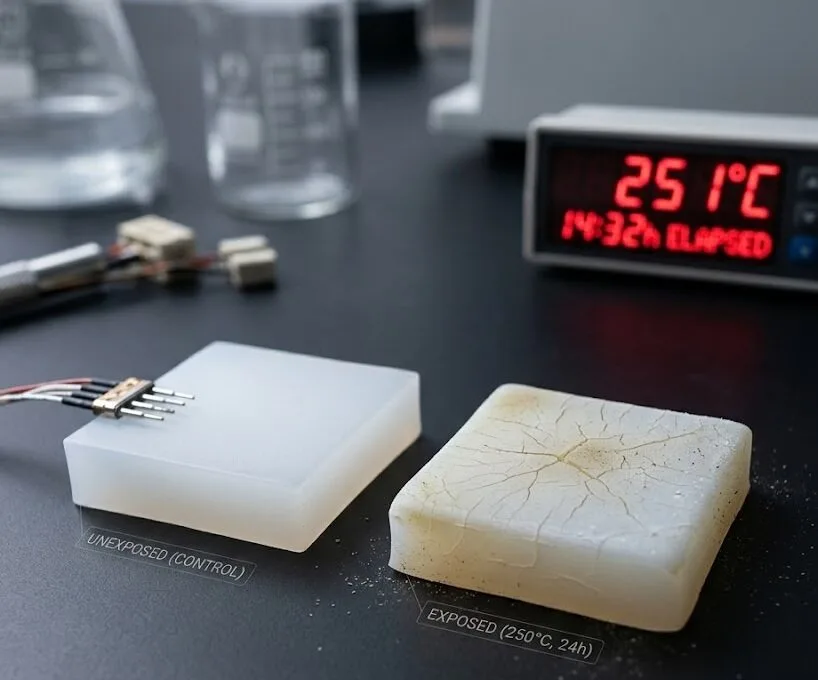
- Around 250–320°C: Expect clear loss of elasticity, hardening, cracking and discoloration.
- Beyond roughly 400°C: Silicone can ignite. Safety data sheets for silicone fluids list auto-ignition above about 400°C, and burning leaves a white silica residue.
Those last figures come from silicone fluids. Cured rubber with fillers behaves a little differently, so treat them as ballpark numbers.
Factors That Shift the Real Silicone Temperature Limit
A rated number only tells part of the story. Several things move the real silicone temperature limit up or down:
- Exposure time: Hours at 230°C is not the same as months at 230°C.
- Oxygen: Air accelerates aging, while oxygen-poor settings are gentler.
- Fillers and additives: Heat-stabilizing additives can extend life, and some fillers shorten it.
- Cure system: Platinum-cured and peroxide-cured silicones can age differently under heat.
- Post-curing: Extra curing after molding generally improves heat stability and drives off leftover volatiles, which is one reason two similar-looking products can age very differently.
- Hot steam in sealed spaces: Trapped steam can break silicone down faster than dry heat.
- Chemical contact: Oils, fuels and solvents can swell silicone and weaken it.
Silicone Temperature Limits in Everyday Products
Here’s how the numbers play out in real life:
- Bakeware and oven mats: Many are rated around 230°C (446°F). Broilers, open flames and stovetop burners go well beyond that.
- Microwave: Silicone itself doesn’t absorb microwave energy, so rated cookware is fine. The hot food inside is the real limit.
- Air fryer: Rated silicone is usually fine, but keep it away from the heating element.
- Dishwasher: Wash temperatures sit far inside the working range, so heat isn’t the issue here.
- Baby bottle nipples and pacifiers: Boiling water at 100°C and steam sterilizers sit comfortably inside the working range.
- Medical devices: Steam autoclaves typically run at 121–134°C, which medical-grade silicone is generally designed for. Always check the device’s rated cycles.
- Soldering irons and heat guns: Tips often run at 300–400°C, which will damage silicone on contact.
- Engine bays: Silicone hoses and gaskets work well here, but areas near exhaust components can exceed their limits.
Pouring Hot Materials Into Silicone Molds
Crafters often ask whether silicone molds can take molten wax, resin or metal. Candle wax usually pours well below the limits discussed above, so it’s a safe match for most molds.
Casting metals is different, because some alloys pour hotter than a mold can handle. Low-melt alloys can run hotter than a mold’s rating, and the mold will scorch or tear. Check the maker’s stated limit before you pour anything hot.
How Silicone Compares With Other Materials
Silicone heat resistance is its real advantage, mostly because of the range. Typical upper limits for common alternatives look like this:
- Polyurethane: about 80–120°C
- Nitrile rubber: about 120°C
- EPDM: about 150°C
- Polyethylene: softens and melts at roughly 110–135°C
- Polypropylene: melts at roughly 160–170°C
- Fluoroelastomers (FKM): about 200–250°C, with better oil and fuel resistance
Silicone isn’t perfect, though. It tears more easily than many rubbers, and some fuels and oils swell it. That’s where fluorosilicone or FKM may be the smarter pick.
How Silicone Heat Limits Are Tested
Manufacturers usually quote heat limits from aging tests, where samples are held at a set temperature for days or weeks and then checked for changes in hardness, strength and stretch. Lab teams also use thermal analysis to see where mass loss or phase changes begin.
That’s why a silicone melting point or heat rating always has conditions attached. A figure without a test time or atmosphere tells you very little.
What to Do If Silicone Smells, Smokes or Turns Sticky
Treat these as warning signs that you’ve passed the practical silicone melting point for that item, meaning the temperature where it starts to degrade. Switch off the heat, ventilate the room and let the item cool before touching it.
A mild smell from a brand-new item can fade after washing and airing. Stickiness, cracking, discoloration or a persistent smell means it’s time to replace it.
Common Myths About Silicone and Heat
- “Silicone is fireproof.” It resists burning better than most organic rubbers, but it can ignite at very high temperatures.
- “Food-grade means unlimited heat.” It means the material is suitable for food contact. The temperature rating still matters.
- “Liquid silicone has melted.” Liquid silicone rubber and uncured sealants are liquid because they haven’t cured yet, which is chemistry, not melting.
- “The silicone melting point is a safe working temperature.” Quoted figures near 300°C mark roughly where damage begins, not where it’s safe to live.
Faqs
What is the melting point of silicone?
Cured silicone rubber has no true high-temperature silicone melting point. It begins to degrade at roughly 250–300°C (482–572°F), depending on the grade. The only melting in the strict sense happens in the cold, near −43°C (−45°F), in the crystalline regions of PDMS-based rubber.
At what temperature does silicone break down?
Most grades start to degrade between 250°C and 320°C (482–608°F). Long exposure at lower temperatures, especially in air, can still harden the material over time, so the silicone degradation temperature depends on how long it’s heated.
Does silicone melt in the oven?
No. Standard oven temperatures sit far below the silicone melting point people usually quote, and inside the range of properly rated bakeware. It can still degrade if you exceed the label rating, use a broiler or touch a heating element. And because cured silicone is a thermoset, heating it never turns it into a moldable liquid.
Is silicone toxic when heated?
Silicone that stays within its rated temperature is generally considered stable, and silicone heat resistance is excellent. Overheating can release volatile compounds, and silicone fluids can form trace formaldehyde above roughly 150°C in air. If a product smells strongly, discolors or turns sticky, stop using it.
Can silicone go in the microwave?
Yes, if the product is labeled microwave-safe. Silicone doesn’t absorb microwave energy, and normal microwave use stays far below the silicone melting point people quote. The food can get hot enough to cause burns, so handle containers with care.
Bottom Line
The silicone melting point isn’t a single number you can look up and rely on. So, does silicone melt? Not the way plastic does. Cured silicone holds its shape, then degrades, with most grades starting to break down between 250°C and 320°C (482–608°F). In practice, stay well below that range, match the grade to the job, and let the manufacturer’s rating make the final call.