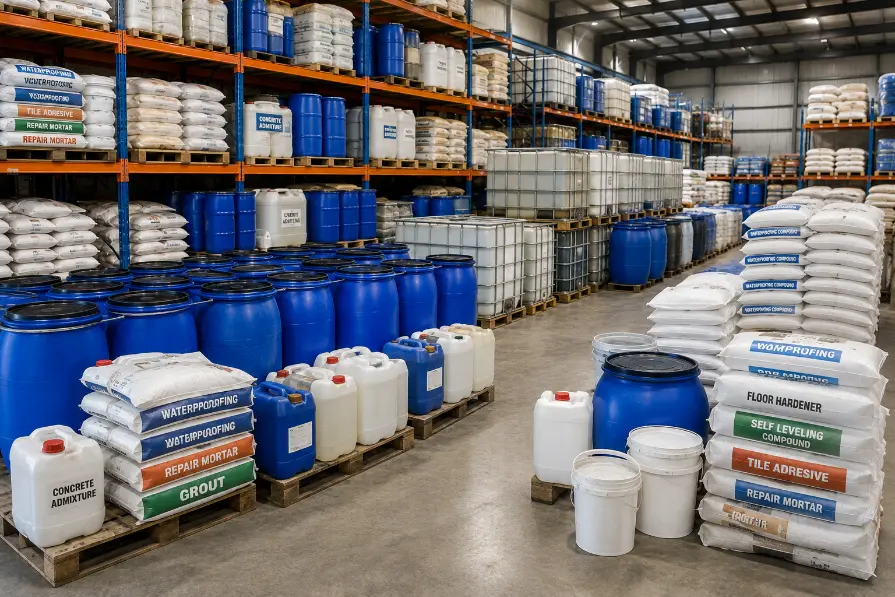

Concrete needs time to set and gain strength, but there are many construction situations where waiting for the normal setting period is not practical. Road repairs, emergency maintenance, tunnel work, and some precast applications may require concrete to become firm much sooner. This is where a fast setting concrete admixture can be useful.
Key Takeaways
- Reduces setting time: Helps concrete become firm sooner.
- Supports faster repairs: Useful for roads, bridges, floors, and emergency work.
- Works across applications: Suitable for shotcrete, precast, tunnels, and construction projects.
- Requires proper dosage: Mix compatibility, testing, placement, and curing remain important.
A fast setting admixture is added to a concrete mix to shorten the time needed for the concrete to start and complete its setting process. The right product can help contractors work within tighter schedules while maintaining the required concrete performance.
What Is a Fast Setting Concrete Admixture?
A fast setting concrete admixture is a chemical additive designed to accelerate the setting of cement-based concrete. It affects the hydration process of cement, allowing the concrete to lose its initial workability and become firm more quickly.
The admixture does not replace good mix design, proper placement, or curing. Its performance depends on factors such as cement type, temperature, water content, dosage, and compatibility with other admixtures.
It is also important to understand that faster setting does not automatically mean faster strength gain. These are related but different properties.
How Does It Work?
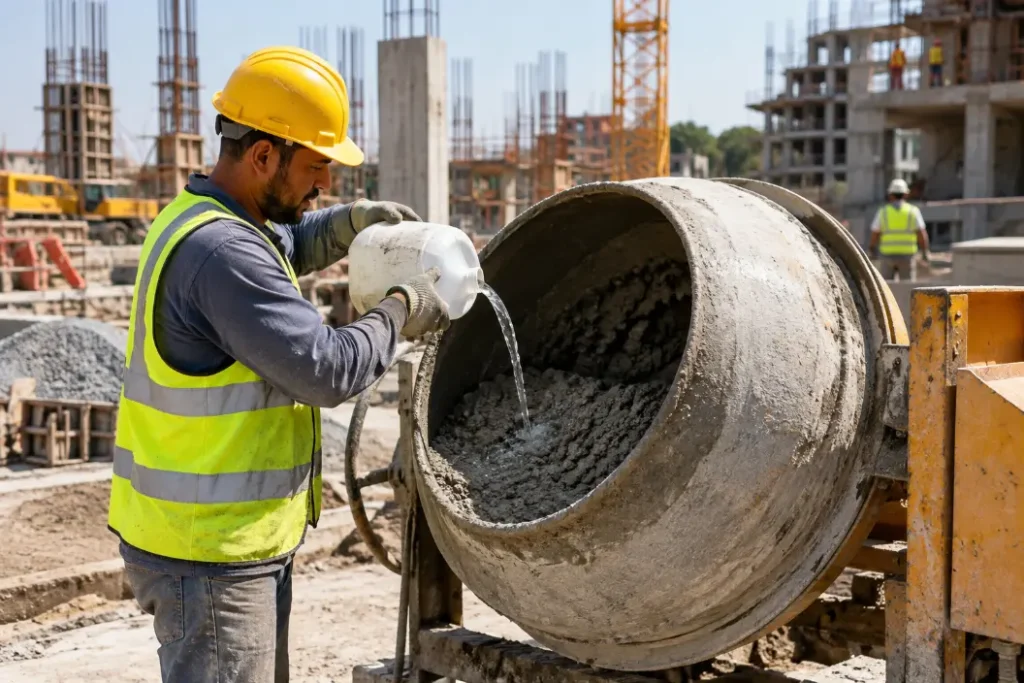
When cement and water are mixed, hydration reactions begin. These reactions gradually cause the concrete to stiffen and harden. An accelerating admixture increases the rate of these reactions, reducing the time required for setting.
The effect can vary depending on the concrete mix and site conditions. For this reason, testing the admixture with the actual cement and other materials used in the project is recommended before large-scale application.
Common Types of Fast Setting Admixtures
The choice of accelerator depends on the type of concrete and the required result.
| Type | Main Purpose | Common Uses |
|---|---|---|
| Accelerating admixture | Reduces setting time | Repairs and general construction |
| Non-chloride accelerator | Accelerates setting without adding chloride | Reinforced concrete |
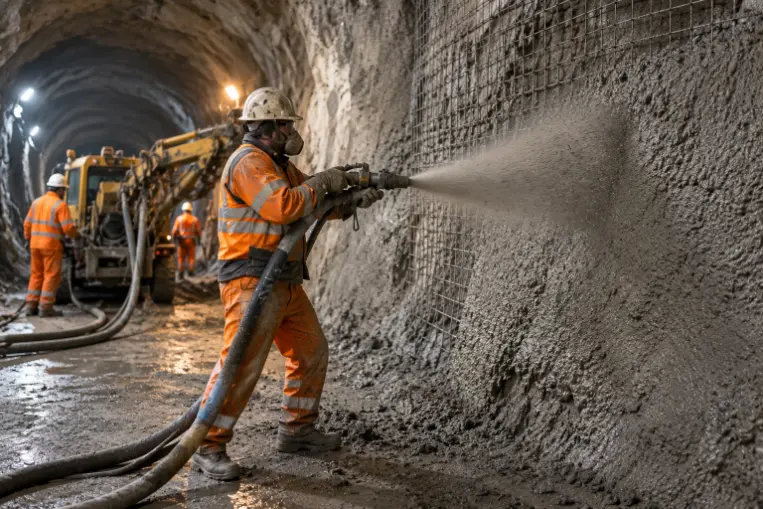
| Shotcrete accelerator | Helps sprayed concrete set quickly | Tunnels and slopes |
| Rapid-hardening admixture | Supports faster early strength development | Precast and emergency repairs |
For reinforced concrete, non-chloride products are often preferred because chloride-based materials can increase the risk of corrosion in steel reinforcement.
Benefits of Fast Setting Concrete Admixture
Using a suitable fast setting admixture can provide several practical benefits:
- Shorter waiting time: Concrete becomes firm sooner, allowing work to progress more quickly.
- Faster repairs: Roads, floors, bridges, and other concrete surfaces can be repaired where extended closure is difficult.
- Useful in cold weather: An appropriate accelerator can help reduce delays caused by slower cement hydration at low temperatures.
- Better support for shotcrete work: Sprayed concrete needs to gain stiffness quickly so it can remain on vertical or overhead surfaces.
- Reduced disruption: Faster setting can be useful in areas where construction activities need to interfere with normal operations for a shorter period.
Also Read:PCE Admixture
Where Is It Used?
Fast setting concrete admixtures are commonly considered for:
- Road and pavement repairs
- Bridge maintenance
- Tunnel construction
- Shotcrete applications
- Precast concrete
- Industrial floor repairs
- Emergency concrete work
- Underground construction
- Airport and transport infrastructure repairs
- Cold-weather concreting
The required setting time should be decided according to the specific application rather than simply choosing the fastest available product.
What Affects Concrete Setting Time?
Several factors can change how quickly concrete sets:
- Temperature: Cold conditions generally slow hydration, while high temperatures can speed it up.
- Cement type: Different cement compositions may react differently to an accelerator.
- Water-cement ratio: The amount of water in the mix influences both workability and setting.
- Admixture dosage: Too little may provide limited acceleration, while excessive dosage can create performance problems.
- Compatibility: The accelerator should work properly with the cement and other admixtures in the mix.
- Mixing: Uniform distribution is important for consistent performance.
Fast Setting vs. Rapid Hardening Concrete
These terms are often confused, but they are not exactly the same.
| Fast Setting Concrete | Rapid Hardening Concrete |
|---|---|
| Focuses mainly on reducing setting time | Focuses mainly on gaining strength quickly |
| Becomes firm sooner | Reaches useful strength sooner |
| Helpful when placement or repair time is limited | Helpful when early loading or reopening is required |
| May not always develop strength significantly faster | Designed specifically for early strength development |
Final Thoughts
A fast setting concrete admixture can be useful when normal concrete setting times do not fit the project’s schedule. It can support faster repair work, shotcrete applications, precast production, and construction in cooler conditions.
However, choosing an accelerator should not be based only on how quickly it sets concrete. The product should be compatible with the mix, used at the recommended dosage, and tested under expected site conditions. Proper placement, finishing, and curing are still essential for producing durable concrete.
Also Read: Waterproofing Admixture
Frequently Asked Questions
1. What is a fast setting concrete admixture?
It is a chemical additive used to reduce the setting time of concrete by accelerating the cement hydration process.
2. Does a fast setting admixture increase concrete strength?
It may support early strength development depending on the product, but faster setting and faster strength gain are not the same thing.
3. Can it be used with reinforced concrete?
Yes. For reinforced concrete, a suitable non-chloride accelerator is generally preferred to reduce concerns related to reinforcement corrosion.
4. Is fast setting concrete suitable for road repairs?
Yes. It can be useful for repair projects where reducing closure and waiting time is important.
5. Should the admixture dosage be increased to make concrete set faster?
No. The recommended dosage should be followed. Excessive quantities can affect concrete performance and may produce undesirable results.