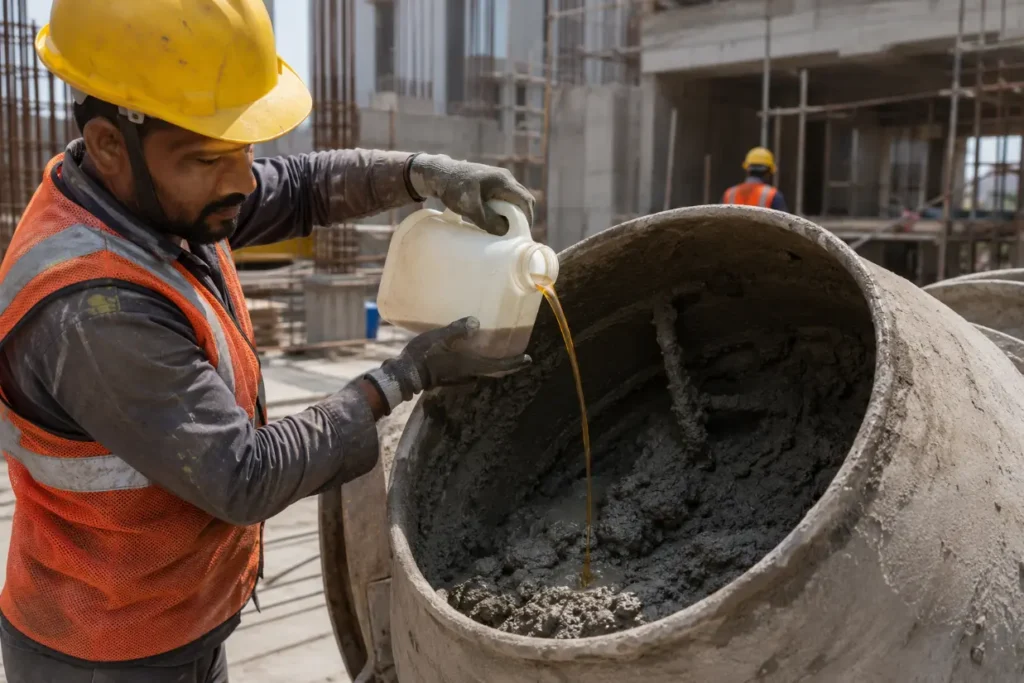
Superplasticizers are chemical admixtures commonly used in modern concrete construction. They are especially useful when concrete needs to flow easily, achieve higher strength, or be pumped over long distances.
Key Takeaways
- Reduces water: Helps lower water content while maintaining concrete workability.
- Improves flow: Makes fresh concrete easier to place, compact, and pump.
- Supports strength: A lower water-cement ratio can contribute to higher concrete strength.
- Needs correct dosage: Product selection and dosage should be based on the concrete mix and trial testing
Concrete needs enough water to remain workable during mixing, placing, and finishing. However, adding too much water can lower its strength and increase porosity. It helps solve this problem by making concrete more workable without requiring a large increase in water.
Also Read:Cement Waterproofing
What Is a Superplasticizer?
It is a high-range water-reducing admixture added to concrete to improve its workability. It allows cement particles to disperse more evenly, which helps the concrete flow with less mixing water.
This makes it possible to produce concrete that is easier to place while maintaining a lower water-cement ratio.
This are available in different chemical formulations. Common types include:
- Sulphonated naphthalene-based admixtures
- Melamine-based admixtures
- Modified lignosulphonate-based admixtures
- Polycarboxylate ether (PCE)-based admixtures
PCE-based superplasticizers are widely used where high water reduction and good workability retention are required.
How Does a Superplasticizer Work?
Cement particles naturally tend to form small clusters when mixed with water. These clusters can trap some of the available water and make the concrete less fluid.
It helps separate these cement particles. As a result, the mixture becomes more fluid and easier to handle without simply adding more water.
The basic process is:
Superplasticizer added → Cement particles disperse → Concrete becomes more workable → Less water is needed
The exact effect depends on factors such as cement type, dosage, aggregate properties, temperature, and mixing conditions.
Benefits
Using the right superplasticizer can provide several benefits in concrete production.
1. Reduces Water Content
One of its main advantages is its ability to reduce the amount of water needed for a desired level of workability. A lower water-cement ratio can contribute to better concrete strength and durability.
2. Improves Workability
It make fresh concrete easier to mix, transport, place, and compact. This is particularly useful in structures with dense reinforcement.
3. Supports High-Strength Concrete
When water content is reduced without losing the required workability, the concrete can achieve higher compressive strength, provided the rest of the mix is properly designed.
4. Improves Pumping
More workable concrete can be easier to pump through pipelines, making superplasticizers useful for high-rise buildings and large construction projects.
5. Helps With Difficult Sections
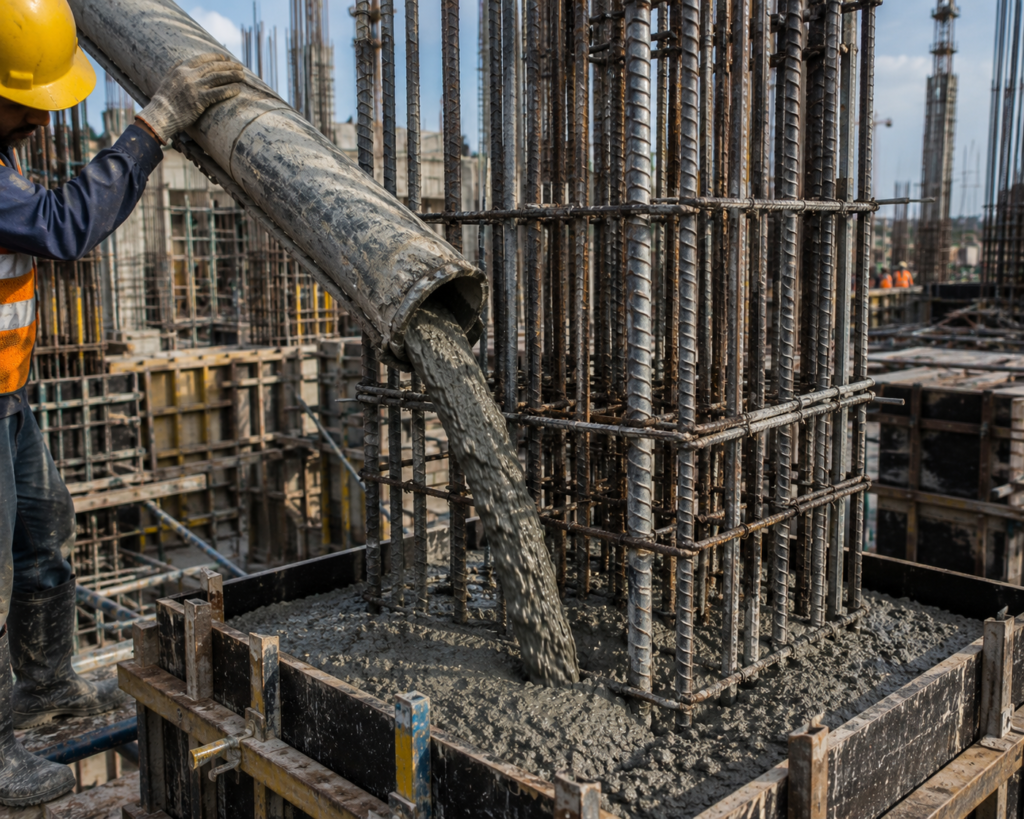
Concrete containing superplasticizer can flow more easily around reinforcement and into complex formwork. This is useful for precast elements and self-compacting concrete.
Applications of Superplasticizer
This are used in many construction projects, including:
- Ready-mix concrete
- Precast concrete products
- High-strength concrete
- Self-compacting concrete
- High-rise buildings
- Bridges and infrastructure
- Foundations
- Columns and beams
- Industrial floors
- Heavily reinforced structures
- Pumped concrete
Superplasticizer vs Plasticizer
| Feature | Plasticizer | Superplasticizer |
| Water reduction | Moderate | High |
| Workability | Improved | Significantly improved |
| Typical use | General concrete | High-performance concrete |
| Flowability | Moderate | High |
| High-strength applications | Less common | Common |
| Typical chemistry | Lignosulphonate-based | PCE and other high-range formulations |
Both admixtures are used to reduce water or improve workability, but superplasticizers generally provide a higher level of water reduction.
What Should You Consider Before Using It?
The choice of superplasticizer should be based on the specific concrete mix and the needs of the project. Before selecting a product, consider the following factors:
- Desired slump and flowability
- Type and quantity of cement used
- Water-cement ratio
- Aggregate size, shape, and grading
- Target compressive strength
- Required setting and workability time
- Compatibility with other concrete admixtures
- Concrete temperature
- Transportation time
- Setting requirements
- Compatibility with other admixtures
- Recommended dosage
Using more admixture than necessary is not always better. Excessive dosage may lead to problems such as segregation, excessive flow, delayed setting, or changes in air content. Trial mixes are therefore important before full-scale use.
Conclusion
A superplasticizer is a useful concrete admixture that improves workability while reducing the need for excess mixing water. It can help produce concrete with better flow, higher potential strength, and improved placement characteristics.
From ready-mix concrete and precast products to high-rise structures and infrastructure projects, It can be valuable when concrete needs to remain workable without increasing its water content. The best results come from choosing the right product, following the recommended dosage, and testing it with the actual concrete mix.
Also Read: Epoxy Flooring: Applications and Installation
Frequently Asked Questions
1. What is the main purpose of a superplasticizer?
Its main purpose is to improve the workability of concrete while reducing the amount of mixing water required.
2. Does a superplasticizer make concrete stronger?
It can help increase concrete strength by allowing a lower water-cement ratio while maintaining workability. The final strength also depends on cement quality, mix proportions, compaction, and curing.
3. Can superplasticizer be used in ready-mix concrete?
Yes. Superplasticizers are commonly used in ready-mix concrete to improve flow, reduce water content, and support easier placement and pumping.
4. What is PCE in superplasticizers?
PCE stands for Polycarboxylate Ether. It is a modern superplasticizer chemistry known for high water reduction and good control over concrete workability.
5. Can too much superplasticizer be harmful?
Yes. Excessive use can affect setting time, cause segregation, or make the concrete excessively fluid. The dosage should always be based on product recommendations and trial-mix results.