Concrete is a basic part of almost every construction project, from homes and commercial buildings to roads, bridges, factories, and water tanks. While concrete is naturally strong, its performance can be affected by moisture, temperature changes, cracking, poor curing, and other site conditions. This is where concrete construction chemicals can be useful.
Key Takeaways
- Improve Concrete: Admixtures can improve workability and concrete performance.
- Prevent Water Damage: Waterproofing chemicals help reduce moisture penetration.
- Support Repairs: Repair chemicals help restore damaged concrete surfaces.
- Choose Carefully: Product selection and correct application affect results.
These products are used during concrete mixing, curing, waterproofing, repair, and surface treatment. The right chemical can improve the handling and performance of concrete when it is selected and applied correctly.
What Are Concrete Construction Chemicals?
Concrete construction chemicals are products used to change, protect, repair, or improve the properties of concrete. Some are added to fresh concrete, while others are applied after the concrete has hardened.
Their purpose depends on the construction requirement. For example, an admixture may improve workability, while a waterproofing compound can reduce water penetration. Repair materials can help restore damaged concrete, and curing compounds can reduce moisture loss from newly placed concrete.
Common Types of Concrete Construction Chemicals
1. Concrete Admixtures
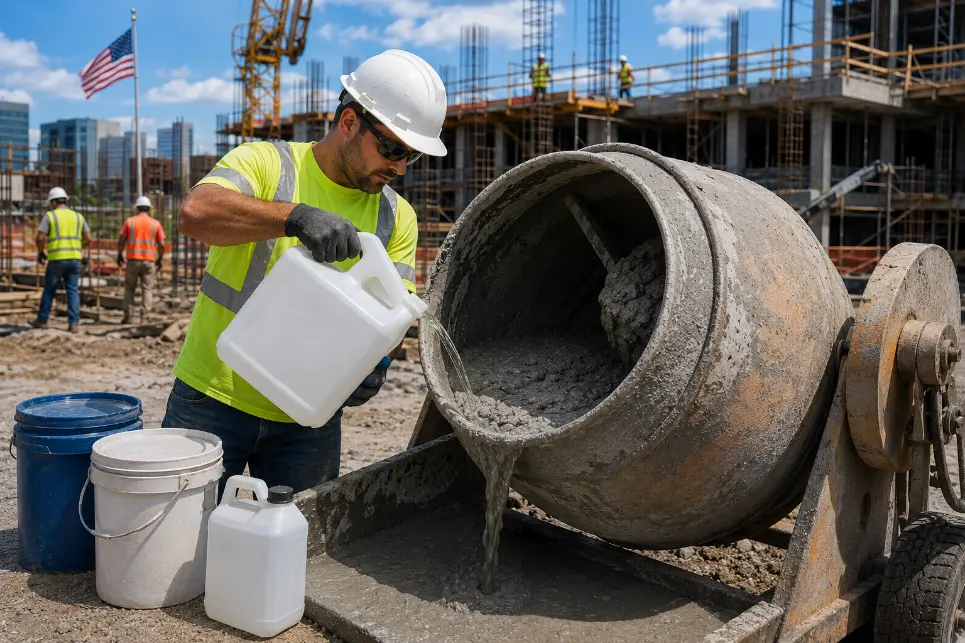
Admixtures are added to concrete in controlled quantities to modify specific properties. Water-reducing admixtures can improve workability while using less water. Superplasticizers are often used where concrete needs high flow without increasing the water content.
Accelerating admixtures can help concrete gain strength more quickly, while retarding admixtures can slow setting when concrete needs to remain workable for a longer period.
2. Waterproofing Chemicals
Water can enter concrete through pores, cracks, joints, and other weak points. Over time, moisture can contribute to surface damage and reinforcement corrosion.
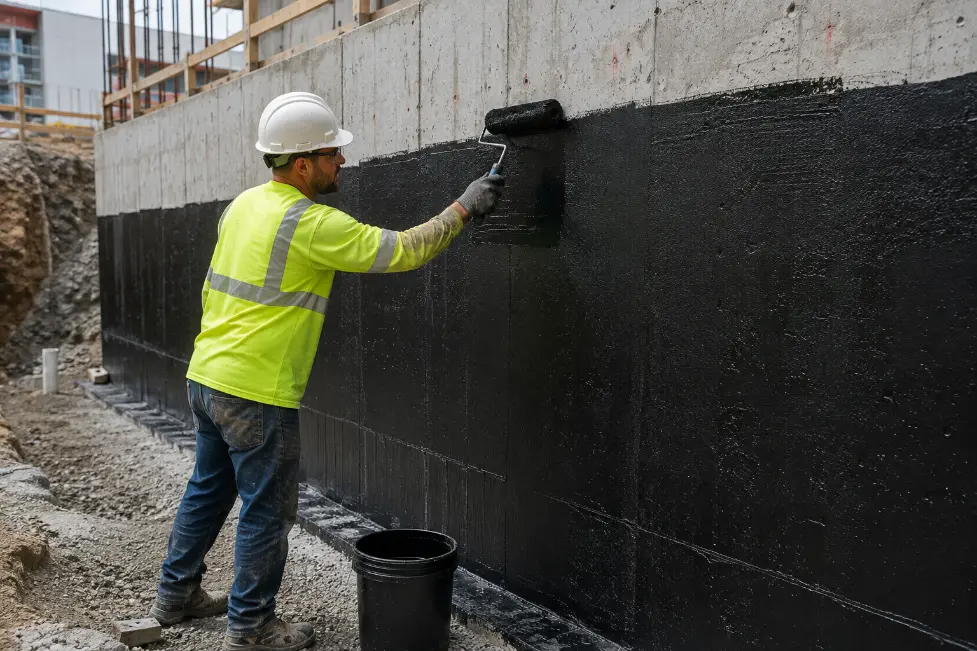
Concrete waterproofing chemicals are used in areas such as basements, foundations, bathrooms, water tanks, roofs, tunnels, and underground structures. Depending on the application, waterproofing may be added to the concrete mix or applied as a coating or treatment to the surface.
Also Read: Construction Chemicals
3. Concrete Repair Materials
Concrete may develop cracks, broken edges, surface deterioration, or voids due to age, environmental exposure, construction defects, or other causes.
Repair chemicals include polymer-modified repair mortars, epoxy compounds, bonding agents, crack fillers, and grouting materials. The choice depends on the location and extent of the damage and whether the repair is structural or non-structural.
4. Curing Compounds
Curing plays an important role in concrete strength and durability. If freshly placed concrete loses moisture too quickly, it may develop shrinkage cracks and may not achieve its expected properties.
Curing compounds are applied to the surface to help reduce moisture loss. They can be useful for large slabs, industrial floors, roads, and other areas where regular water curing may be difficult.
5. Grouting and Bonding Products
Grouts are used to fill gaps, voids, and spaces beneath equipment or structural components. They are also used for certain repair and anchoring applications.
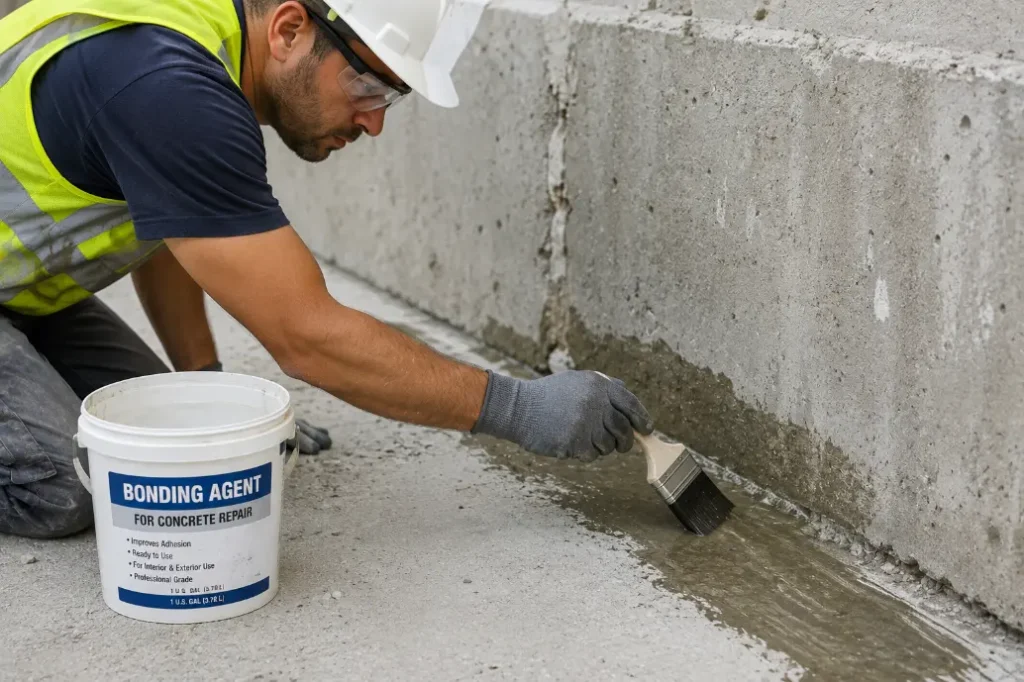
Bonding agents help new concrete, mortar, or repair materials adhere to an existing concrete surface. Proper surface preparation is important before applying these products.
Benefits of Using Concrete Construction Chemicals
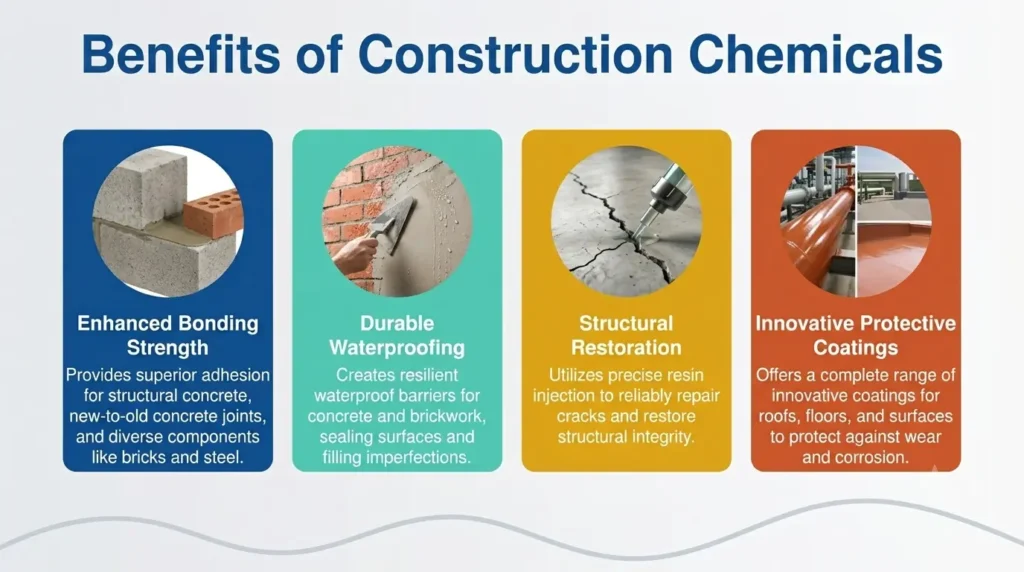
When the correct product is used at the correct dosage, concrete construction chemicals can provide several practical benefits:
- Better workability of fresh concrete
- Lower water requirements in some mixes
- Improved resistance to water penetration
- Better adhesion during repair work
- Reduced moisture loss during curing
- Support for faster strength development in suitable applications
- Improved durability of concrete
- Better performance of repaired surfaces
These chemicals should not be treated as a substitute for good concrete mix design, proper placement, adequate curing, and skilled workmanship.
How to Select the Right Product?
The right chemical depends on the actual requirement of the project. Before selecting a product, consider the type of concrete, application area, environmental conditions, required setting time, strength requirements, and exposure to water or chemicals.
Compatibility with cement and other admixtures should also be checked. Product instructions regarding dosage, mixing, storage, surface preparation, and application should be followed carefully.
Conclusion
Concrete construction chemicals can help address specific challenges during construction and repair. From admixtures and waterproofing compounds to curing agents, repair mortars, grouts, and bonding materials, each product has a particular purpose. The key is to select the right chemical for the application and use it according to technical instructions. Good materials, proper concrete practices, and careful application together determine the final quality of the work.
Also Read: Building Construction Chemicals
Frequently Asked Questions
1. What are concrete construction chemicals used for?
They are used to modify, protect, repair, waterproof, cure, or improve concrete. Their specific use depends on the construction requirement.
2. Can construction chemicals prevent concrete cracks?
Some products can help reduce the risk of certain cracks by controlling shrinkage, improving concrete properties, or protecting surfaces. However, proper mix design, placement, curing, and structural detailing are also important.
3. Are concrete waterproofing chemicals necessary for every project?
Not necessarily. Their use depends on the structure’s exposure to moisture and the required level of water resistance. They are particularly useful in basements, tanks, foundations, bathrooms, roofs, and underground structures.
4. How are concrete admixtures added?
Most admixtures are added during concrete mixing in a specified dosage. The manufacturer’s instructions should be followed because excessive or insufficient quantities can affect concrete performance.
5. How should I choose a concrete construction chemical?
Start by identifying the problem or required property, such as waterproofing, faster setting, improved workability, repair, or bonding. Then select a product designed for that application and check its compatibility with the concrete system.