Silicone-based primers are essential surface preparation agents engineered to significantly enhance adhesion, chemical bonding, and moisture resistance between silicone coatings and various substrates. The modern-day construction industry requires materials that have the ability to handle varying weather conditions, moisture, changes in temperature, and prolonged exposure to the elements. On the other hand, builders and property owners are in need of materials that can provide durability as well as good aesthetic value to a structure. One possible material is a silicone-based coating that can meet both of these criteria through providing protection as well as surface finish benefits.
With proper substrate preparation and choice of the right coating formulation, silicone-based coatings can be used to produce a layer of protection that can prevent water from getting inside while also maintaining the breathability of the surface. In addition, the flexibility and environmental stability of such materials make them applicable to many other construction applications such as exterior walls, facades, roofs, concrete surfaces, and others.
For construction companies, knowing how to use these coatings within a building system can help with choosing the right materials and providing proper maintenance.
Table of Contents
What Is a Silicone-Based Primer?
Silicone-based primers are essential surface preparation agents engineered to significantly enhance adhesion, chemical bonding, and moisture resistance between silicone coatings and various substrates. Silicone-based coating refers to a protective or decorative coating that is prepared using silicone polymers or modified silicones. It is applied to an appropriate substrate to form a protective layer of material, which suits the environment in which it is to be used.
As opposed to the normal decorative coatings, which could just be concerned about their appearance, silicone-based coatings may have functional properties like:
- Water repellence
- Resistance to weathering
- Flexibility
- UV resistance
- Heat resistance
- Surface protection
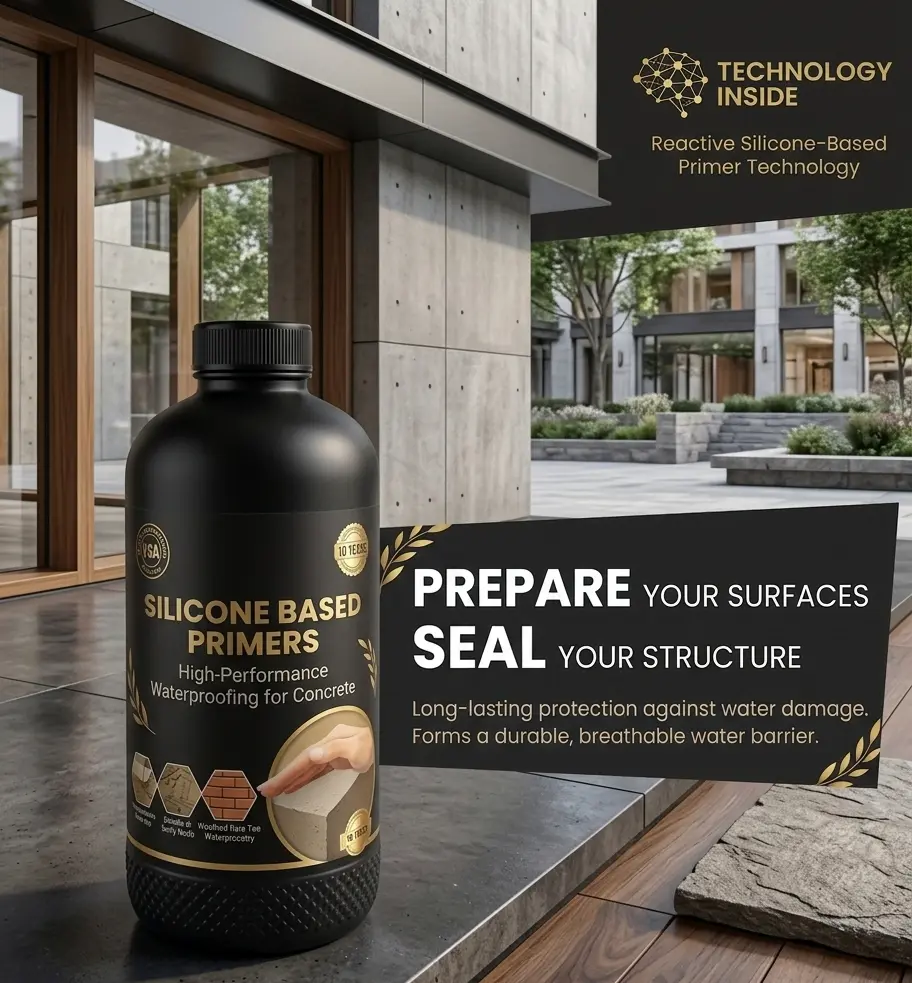
Why Are Silicone Based Primers Useful in Construction?
Buildings are regularly subjected to environmental conditions. Exposure to moisture, humidity, light, dust, temperature changes, and air pollution can have an impact on the exposed surfaces over time.
An appropriate silicone coating can provide additional protection from the environment for the substrate material. Silicone technology is thus especially useful in the construction industry when applied to exterior structures that require surface protection from moisture and other environmental factors. Applying silicone-based primers ensures a virtually unbreakable bond when applying elastomeric sealants to non-porous metals or glass.
Construction businesses should thus evaluate the benefits of coatings not only based on their aesthetic properties.
Key Benefits of Polysiloxane Primer
High-performance silicone-based primers protect porous masonry from absorbing moisture while facilitating seamless coating adhesion.
| Benefit | Value for the Construction Industry |
| Moisture Protection | Helps provide water-repellent properties to suitable exterior surfaces, making it useful for façades, walls, and other areas exposed to rain or humidity. |
| Weather Resistance | Helps protect building surfaces against changing weather conditions, including rain, sunlight, and temperature fluctuations, supporting longer-lasting exterior finishes. |
| Flexibility | Can accommodate a degree of movement caused by temperature changes and environmental conditions, making it suitable for certain exterior building applications. |
| UV Resistance | Silicone-based formulations can offer resistance to ultraviolet exposure, helping maintain the performance and appearance of coated surfaces exposed to prolonged sunlight. |
| Durable Surface Finish | Can provide a protective finish that supports the long-term condition of suitable construction surfaces while reducing the impact of environmental exposure. |
| Aesthetic Versatility | Available in different formulations and finishes, allowing architects, contractors, and property developers to combine surface protection with the desired visual appearance. |
Applications of Organofunctional Silane Solution in Construction
The versatility of silicone chemistry allows silicone-based coatings to be considered for several building applications. Formulators rely on silicone-based primers to prevent premature delamination in demanding automotive and aerospace environments.
| Construction Area | Potential Purpose |
| Exterior walls | Weather and moisture protection |
| Building façades | Surface protection and appearance |
| Concrete surfaces | Protective surface treatment |
| Masonry | Water-repellent treatment |
| Roof-related applications | Protection in suitable coating systems |
| Commercial buildings | Exterior maintenance and refurbishment |
| Residential structures | Decorative and protective finishing |
| Industrial buildings | Environmental surface protection |
Not every silicone coating is appropriate for every substrate. Product specifications should be reviewed before application.
Silicone Based Primers vs Conventional Primers
Different coating technologies have different strengths. Silicone-based systems may be particularly attractive when moisture resistance, flexibility, and exterior durability are priorities. Using specialized silicone-based primers simplifies substrate preparation and drastically improves long-term weatherproofing performance.
| Factor | Silicone-Based Primers | Conventional Primers |
| Water repellency | Often strong | Depends on formulation |
| Flexibility | Generally good | Varies |
| UV resistance | Often good | Formulation-dependent |
| Exterior applications | Commonly suitable | Depends on product |
| Appearance | Multiple finish options | Multiple finish options |
| Breathability | Depends on formulation | Depends on formulation |
This comparison is general. Product performance should always be assessed using technical specifications rather than coating category alone.
Factors Construction Businesses Should Consider
Prior to selecting the type of silicone coating, it is necessary to consider the following factors:
- Nature of substrate
- Condition of surface
- Climate
- Exposure to moisture
- UV exposure
- Temperature fluctuations
- Finish required
- Life span of coating
- Application technique
- Maintenance needs
- Compatibility with existing materials
Selection of a coating based on cost alone may lead to higher maintenance costs in the future.
Maintenance and Long-Term Performance
Even though durable coatings need maintenance too, surfaces of buildings must be regularly checked for any accumulation of dirt, damage, cracks, or deterioration. In medical device manufacturing, silicone-based primers are vital for securely bonding soft silicone components to rigid plastic housings.
If any of those factors are present, then timely maintenance can possibly prevent further deterioration of the surfaces. Cleaning of surfaces must be carried out in accordance with the specifications of the coating systems, and maintenance must be done according to the manufacturer’s instructions.
Final Thoughts
Silicone-based primers offer construction firms an exceptional solution for protecting and finishing vulnerable building surfaces. The ability of silicone coatings to be waterproof, flexible, weather-resistant, and potentially UV-resistant makes it an important construction material.
Nevertheless, only proper substrate preparation, compatible materials, right conditions for application, right thickness of coating and maintenance will ensure good result from such a coating system. With careful consideration of all the above-mentioned parameters, construction firms will be able to choose coating systems for their projects.
Protect your building surfaces for many years to come. Contact our company, Biopol Chemicals, for more information about our high-quality silicone primers used in commercial and industrial construction.
FAQs
1. Where are silicone primers applied in construction projects?
These can be applied to compatible exterior walls, façades, concrete, masonry, and other construction materials as long as there is a need for protecting them from any exposure to the environment.
2. Will the silicone primer help in protecting buildings from rain?
The right types of coatings may offer waterproofing capabilities and prevent any absorption of water into compatible surfaces.
3. Are silicone primers appropriate for concrete?
There are certain silicone coatings that are formulated especially for concrete and masonry constructions.
4. Is there any need to prepare the surface before applying the silicone primer?
Yes. There should be some necessary surface preparations such as cleaning, defect repair, and removal of any loose particles.
Also Read