Silicone vs plastic safety is a topic of intense interest as consumers actively seek non-toxic, long-lasting alternatives for kitchenware, medical devices, and everyday consumer products. While silicone is widely marketed as a cleaner and greener substitute for conventional polymers, examining silicone vs plastic safety reveals a far more nuanced picture regarding toxicity, chemical leaching, and environmental impact. Both materials rely on synthetic processing and fossil-fuel-derived components, making it critical to understand how they compare in daily household environments.
Key Takeaways
- Material Origin & Structure: While traditional plastics rely heavily on carbon backbones derived entirely from petrochemicals, silicone uses a silicon-oxygen foundation derived from quartz sand, combined with hydrocarbons.
- Thermal & Chemical Stability: Silicone generally offers higher resistance to heat and physical breakdown than standard plastics, reducing the risk of structural warping and immediate plasticizer degradation. Understanding silicone vs plastic safety to choose healthier, BPA-free kitchen utensils.
- Leaching Risks Remain: Neither material is entirely inert; both silicone and plastic can leach additives or low-molecular-weight compounds (such as siloxanes or phthalates) under high heat, wear, or exposure to fatty substances.
Comparative Safety & Functional Overview
To evaluate silicone vs plastic safety, one must first look at how these synthetic polymers are manufactured. Plastics are primarily carbon-based chains derived directly from petroleum refining and processing.
In contrast, silicone is created by extracting silicon from quartz sand or rock using high-heat reduction, which is then bound with carbon-hydrogen organic groups (such as methyl groups).
While silicone relies on fossil fuels during its synthesis, its elemental backbone gives it fundamentally different chemical properties compared to petroleum-based plastics.
| Feature / Metric | Conventional Plastics | Food-Grade / Medical Silicone |
| Primary Chemical Backbone | Carbon-Carbon Chains (C-C) | Silicon-Oxygen Chains (Si-O) |
| Common Additives of Concern | BPA, Phthalates, Microplastics, PFAS | Low-molecular-weight Siloxanes (D4, D5, D6) |
| Heat Tolerance | Low to Moderate (Prone to leaching & melting) | High Thermal Stability (Typically $-40^\circ\text{C}$ to $230^\circ\text{C}$) |
| Microplastic Generation | High (Degrades into persistent microparticles) | Very Low (Does not fragment into standard microplastics) |
| End-of-Life & Recyclability | Low municipal recycling rates; degrades into microplastics | Non-recyclable via standard curb programs; persistent in landfills |
Chemical Leaching and Toxicological Risk
When discussing silicone vs plastic safety, chemical migration into food and beverages is the primary concern for consumers. Conventional plastics frequently contain plasticizers, bisphenols (like BPA and BPS), and flame retardants that can migrate when exposed to heat, UV light, or acidic foods. These compounds are known endocrine disruptors associated with various metabolic and developmental issues.
Silicone is often considered safer because it does not require phthalates or bisphenols to maintain flexibility.
However, evaluating silicone vs plastic safety requires acknowledging that low-quality silicones can contain residual volatile organic compounds and cyclic siloxanes (such as D4, D5, and D6). While high-grade, 100% platinum-cured silicone minimizes this risk, low-quality silicone fillers can degrade and compromise material safety.
Durability and Thermal Stability
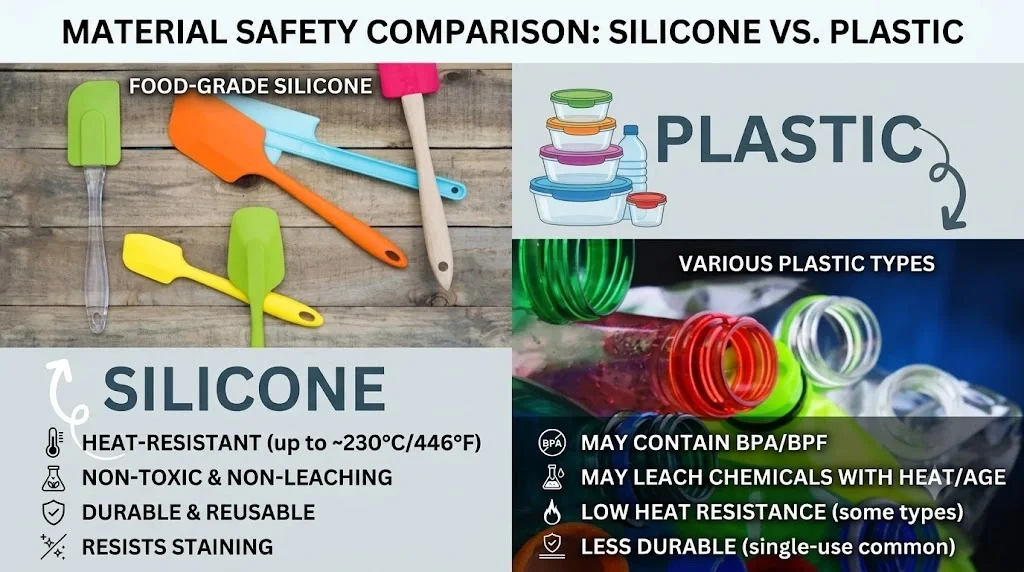
A key factor in silicone vs plastic safety is how each material behaves under extreme physical conditions. Standard plastics warp, melt, or release harmful fumes at elevated temperatures, making them unsuitable for baking or microwave heating. Over time, plastic items become brittle, scratch easily, and shed microscopic particles known as microplastics into water systems and food supplies.
Conversely, high-quality silicone maintains its physical integrity across a broad temperature spectrum without melting or shattering. Because it resists oxidation and UV degradation, silicone does not break down into microplastic fragments as readily as conventional plastic. However, once a silicone utensil or container shows visible signs of cracking, pitting, or surface damage, its overall safety diminishes, and replacement becomes necessary.
Environmental Impact and End-of-Life Realities
Analyzing silicone vs plastic safety extends beyond individual health to long-term ecological outcomes. Neither traditional plastic nor silicone breaks down naturally in municipal landfills. While plastic breaks apart into persistent microplastics that pollute marine ecosystems, silicone remains intact for decades without undergoing rapid biological degradation.
Furthermore, neither material is easily recycled through standard municipal facilities. Silicone recycling requires specialized industrial plants that accept post-consumer silicone rubbers, meaning most discarded silicone ends up in landfills or incinerators alongside conventional plastic waste.
Ending Notes
When weighing silicone vs plastic safety, silicone emerges as a more durable, heat-stable alternative that eliminates exposure to bisphenols and microplastic shedding. However, it is not completely inert or environmentally friendly, making high-quality materials like glass and stainless steel the safest choices when possible.
Looking for reliable, high-grade specialty chemicals and eco-conscious silicone solutions? Discover our product range or contact our expert team today at biopolchemicals.com to upgrade your industrial chemical standards.
Frequently Asked Questions (FAQs)
1. Is Silicone a safer material for use in hot food preparation compared to plastic?
Food-safe silicone resists higher heat levels compared to regular plastics without bending or leaking harmful siloxanes but when in contact with high-fat-content foods and heated at very high temperatures, there could be some migration of siloxanes.
2. Does silicone have BPA or Phthalate chemicals?
It does not. The silicone material has a different chemical composition compared to carbon-based plastics and does not need any BPA, BPS, or Phthalates to keep it flexible.
3. Are there safer materials apart from silicone and plastic?
For storage and high-heat purposes, other safer natural options include stainless steel, glass and ceramic.
Also Read