
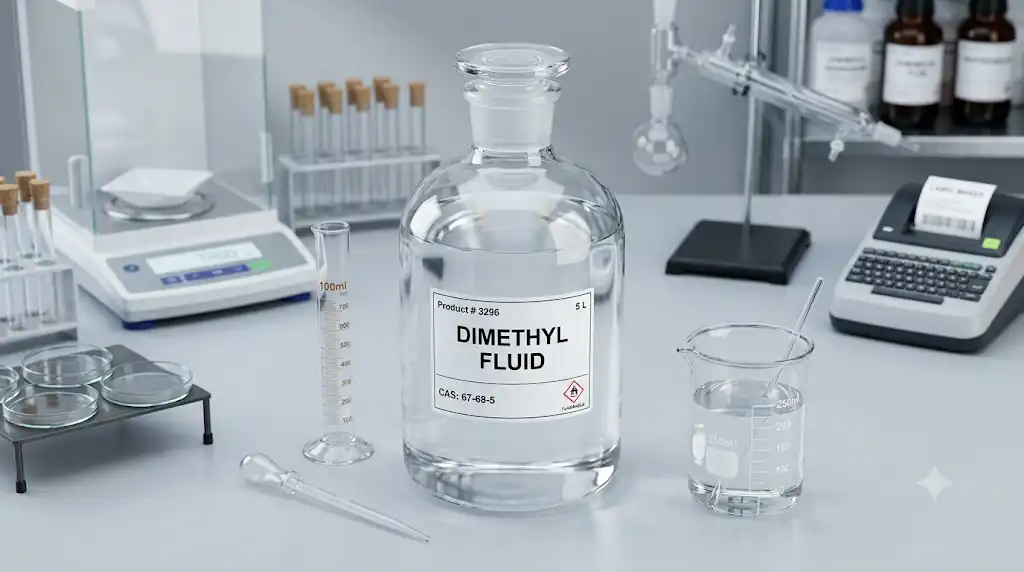
Dimethyl fluid is a clear, essentially odorless silicone liquid made of polydimethylsiloxane (PDMS), a polymer built on a backbone of alternating silicon and oxygen atoms with methyl groups attached. It is also sold under the cosmetic name dimethicone, and its viscosity runs from 0.65 cSt, which flows like water, to a million cSt and beyond. Suppliers point to its thermal stability, low surface tension, chemical inertness and low toxicity.
Those traits explain why it appears in skin and hair care, mold release, lubricants, defoamers, damping devices and electrical equipment. This guide covers what it is, how the grades differ, where it is used, how to handle it safely and how to pick the right one for your job.
Key Takeaways
- It is polydimethylsiloxane, a silicone liquid with a silicon-oxygen backbone and methyl groups.
- Viscosity is the main specification, and it ranges from 0.65 cSt to a million cSt and beyond.
- Supplier data cites open-system use from about -40°C to 200°C, with some heat-resistant grades rated to 250°C in closed systems.
- Typical jobs include personal care, mold release, lubrication, defoaming, damping and electrical insulation.
- It has low toxicity, but the thinnest 0.65 cSt grade is a flammable liquid, so read the safety data sheet.
- Confirm the grade, CAS number and viscosity tolerance before you buy.
What Is Dimethyl Fluid?
It is the common name for polydimethylsiloxane. Pharmaceutical references describe it as a fluid mixture of fully methylated linear siloxane polymers, with the chain ends blocked by trimethylsiloxy units so the polymer cannot react further.
The silicon-oxygen backbone is the key. It is more robust than the carbon-carbon chains found in organic polymers, which supports its resistance to heat, oxidation and shear stress.
Chain length decides viscosity. One manufacturer lists a 100 cP fluid at a calculated molecular weight of about 6,000, while its 10,000 cP fluid comes in at about 62,500.
Suppliers quote more than one CAS number for this material, including 63148-62-9 and 9006-65-9, so confirm which one appears on your data sheet.
Dimethyl Silicone Fluid, Dimethicone and Silicone Oil: What Is the Difference?
The names overlap. Suppliers use dimethyl silicone fluid, PDMS, silicone oil and the cosmetic term for the same polydimethylsiloxane liquid. That cosmetic term is the one you will see on ingredient labels.
Functional versions are a different product. Amine-functional silicones, for example, carry a cationic group that changes how they behave, so they should not be swapped for the plain fluid.
How It Is Made
Pharmaceutical references describe production by hydrolysis and polycondensation of dichlorodimethylsilane and chlorotrimethylsilane. The ratio of those two building blocks sets the molecular weight and, with it, the viscosity.
Another route reacts a cyclic siloxane with hexamethyldisiloxane using an acid or base catalyst.
Key Properties of Dimethyl Fluid
Thermal stability. Supplier figures differ slightly. One manufacturer cites about -40°C to 200°C in open systems, another says -50°C to 200°C, and a third catalog lists -30°C to 250°C for general-purpose grades, with a high-temperature grade rated to 250°C in closed heating systems. That catalog also notes that its standard fluid hardly changes in air below 150°C. For more on how silicone behaves as heat rises, see our note on the silicone melting point.
Flat viscosity-temperature behavior. Technical literature highlights flat viscosity-temperature curves and outstanding oxidation resistance, which is why the fluid keeps flowing predictably as conditions change.
Low surface tension. Surface tension is unusually low, so the fluid spreads and wets surfaces easily. In cosmetics, that gives a silky, non-greasy feel.
Chemical inertness. It is non-corrosive, does not stain, and resists most common chemicals.
Water repellency and solubility. The fluid is nonpolar and insoluble in water and the lower alcohols. It forms a hydrophobic film, which is why it is used in water-repellent products.
Electrical insulation. Suppliers describe it as non-conductive with high dielectric strength.
Flash point, volatility and compressibility. Higher-viscosity grades combine low volatility with high flash points, and the fluid is also highly compressible. One supplier lists a flash point of 599°F (about 315°C) for a 350 cSt grade. At the other end, the 0.65 cSt grade has a flash point of roughly 1°C to 4°C in closed-cup tests and is classed as a flammable liquid.
Heat conduction. Its thermal conductivity is lower than that of regular organic compounds, which matters if you plan to use it as a heating or cooling medium.
Viscosity Grades Explained
Viscosity is usually quoted in centistokes (cSt), a kinematic unit. Some suppliers use centipoise (cP) instead, so check the units before comparing data sheets. Product names often carry the nominal viscosity, so a “350” grade is a 350 cSt fluid.
| Grade | Viscosity (cSt) | Typical use |
| Ultra-low | 0.65 to 1 | Water-like flow for high-penetration uses and fast-evaporating carriers |
| Low | 5 to 100 | Spray cosmetics, skin and hair care, gloss, fabric care, lubricants for plastics, foams and rubbers |
| Standard | 200 to 1,000 | Mold release agents and general-purpose industrial formulations |
| Medium-high | 3,000 to 5,000 | Lubrication, heat transfer, coatings, textiles and eye surgery |
| High | 10,000 to 100,000 | Viscosity modification, sealants, potting compounds, O-ring greasing, damping |
| Ultra-high | 300,000 and above | Non-flowing fluids for high-performance sealants, damping and vibration control |
These ranges follow one manufacturer’s grading, and other suppliers name their grades differently. Volatile types, including a cyclic version, evaporate without leaving residue and are used where a smooth texture matters.
Common Uses of Dimethyl Fluid
The same chemistry covers many jobs. For a wider look at silicones beyond fluids, our guide to silicone uses covers the bigger picture.
Personal Care and Cosmetics
In creams, lotions, sunscreens and hair care, the fluid adds slip, improves spreadability and can reduce the greasy feel of some formulas. In larger amounts it helps protect skin against moisture loss. If you want to understand more about silicones in hair products, we cover that separately.
In the U.S., this ingredient at 1% to 30% is recognized as an over-the-counter skin protectant. It also appears in some head lice products.
It has limits, though. It protects poorly against solvents, oils and dust.
Mold Release, Lubrication and Polishes
Manufacturers describe it as a cost-effective choice for release agents, lubricants and polishes. It stops rubber and plastic parts from sticking to molds, lubricates plastics, foams and rubbers, and greases O-rings in higher viscosities. It is also used in automobile and furniture polishes. Our silicone lubricant guide goes into more detail on the lubrication side.
Defoaming and Food Processing
It is used as a defoamer in industries ranging from food processing to chemical manufacturing, and as an antifoaming agent in topical emulsions.
In the U.S., 21 CFR 173.340 permits dimethylpolysiloxane that meets set specifications as a defoaming agent in food processing, with a limit of 10 parts per million in the food.
Damping, Heat Transfer and Electrical Uses
Because of its low volatility and high compressibility, the fluid suits damping and hydraulic-type applications. High-viscosity grades are used for damping and as bath fluids, and mid-range grades serve as heat-transfer and dielectric media.
Other Specialty Uses
Manufacturers also list fluid drives, calibration baths and sonar transducers. It serves as the active fluid in some viscous limited-slip differentials and couplings, and it forms a water-repellent film on glass containers.
Textile, Water-Repellent and Coating Uses
In textiles, it works as a softener and lubricant. Suppliers also offer emulsified versions, such as 50% silicone nonionic emulsions, and list water repellents among the applications.
Medical and Healthcare Uses
Medical-grade PDMS is offered for medical devices, drug delivery and topical formulations. In eye surgery, 1,000 cSt and 5,000 cSt silicone oils are approved by the FDA for use in the eye and are used to repair complex retinal detachments. The oil stays in the eye until a second surgery removes it, typically within 3 to 6 months.
The material may also be combined with simethicone in oral products for gas.
Sterilization needs care. Thin films can be sterilized by dry heat for at least 2 hours at 160°C. Steam autoclaving of large quantities is not recommended because absorbed water makes the fluid hazy, and gamma irradiation can cross-link it and raise its viscosity.
Is It Safe? Safety and Handling
Pharmaceutical references describe the material as relatively nontoxic and nonirritant, though it can cause temporary eye irritation. Cosmetic safety reviews list it as safe as used in cosmetic formulations. If you want to read more about reactions, see our article on silicone allergy.
A few habits keep handling safe:
- Treat the 0.65 cSt grade as a flammable liquid and keep it away from heat and ignition sources.
- Wear eye protection, because contact can cause temporary irritation.
- Read the safety data sheet for the exact grade before use.
- Follow the supplier’s storage and shelf-life guidance on the technical data sheet.
How to Choose the Right Dimethyl Fluid
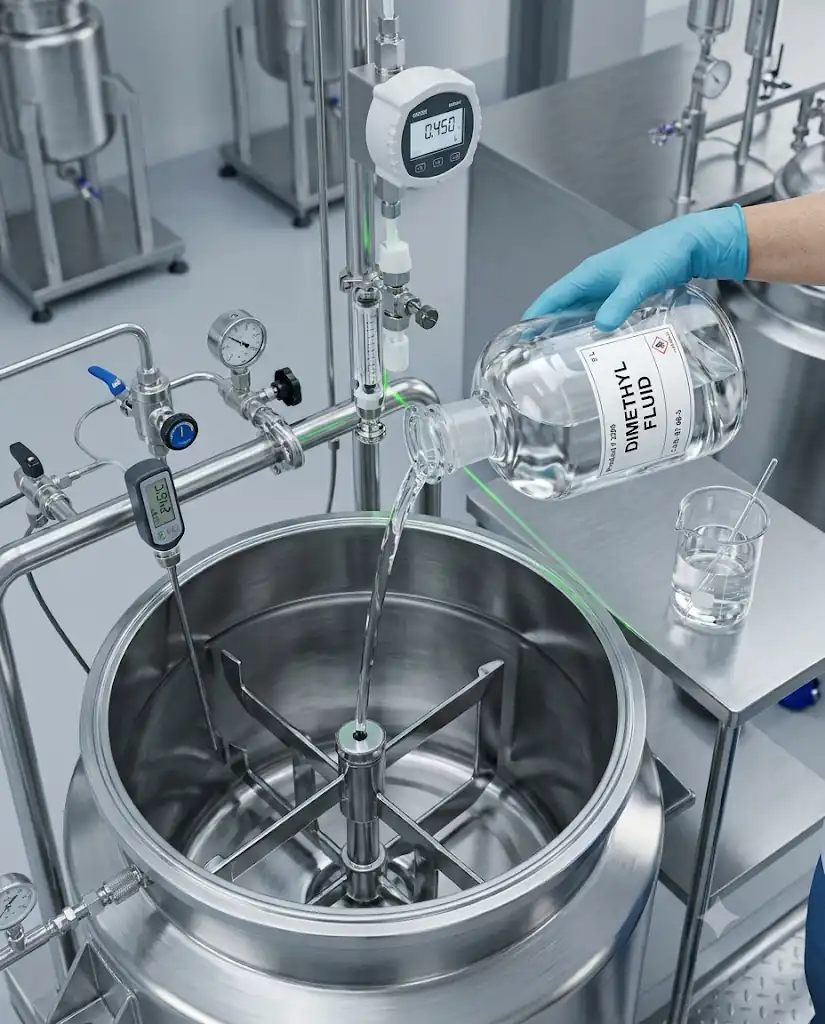
Picking by price alone is a risky way to buy. Work through these steps instead:
- Match the viscosity to the job, using the grade table above as a starting point.
- Confirm the grade you need. Suppliers offer food, medical, personal care and industrial versions.
- Check compatibility with your operating conditions. The fluid is nonpolar and does not dissolve in water or the lower alcohols.
- Ask for the technical data sheet and safety data sheet, including the CAS number and the viscosity tolerance. Some technical grades are held to within about 5% of the stated viscosity.
- Check the units (cSt or cP) before you compare suppliers.
If you only need a small bottle for a workshop trial or lab test, you can compare packaged dimethyl fluid online first, then move up to drums or totes once the grade is settled.
Common Mistakes to Avoid
- Ordering without checking whether the viscosity is quoted in cSt or cP.
- Using an industrial grade where a food, cosmetic or medical grade is required.
- Overlooking that the thinnest grades are flammable.
- Swapping a functional silicone fluid, such as an amine type, for the plain fluid.
Frequently Asked Questions
What is dimethyl fluid used for?
It is used in personal care products, mold release agents, lubricants, polishes, defoamers, damping devices, heat-transfer baths, electrical insulation and textile finishing. Medical-grade versions appear in eye surgery and other healthcare uses.
Is dimethyl fluid the same as dimethicone?
Yes. Suppliers commonly refer to the same polydimethylsiloxane liquid by either name. Only the naming differs: cosmetics and pharmaceuticals use one term, while dimethyl silicone fluid or silicone oil is more common in industry.
Is dimethyl fluid safe for skin and hair?
Pharmaceutical references call it relatively nontoxic and nonirritant, apart from possible temporary eye irritation. In the U.S., dimethicone at 1% to 30% is recognized as an over-the-counter skin protectant ingredient. Check the full formula of any product you use.
What viscosity of dimethyl fluid should I choose?
Thin grades (5 to 100 cSt) suit sprays, skin and hair care, gloss and fabric care. Grades from 200 to 1,000 cSt suit mold release and general industrial formulations. Grades of 10,000 cSt and above suit viscosity modification, sealants and damping.
Is dimethyl fluid flammable, and how hot can it get?
The thinnest 0.65 cSt grade is a flammable liquid with a flash point of roughly 1°C to 4°C. Thicker grades have much higher flash points, such as about 315°C for a 350 cSt grade. Supplier data cites open-system use up to about 200°C, and some heat-resistant grades are rated to 250°C in closed systems.
The Bottom Line
Dimethyl fluid earns its place because it stays predictable across a wide range of temperatures and uses. Choose the viscosity first, confirm the grade second and read the data sheet before anything else. Handle the thinnest grades with care, and you will get dependable results across most applications.