A silicone superspreader can flatten a beading spray droplet into a thin film that coats a waxy leaf. That is a real advantage when ordinary wetters fail, but it is also an additive that punishes careless mixing. Here is how it works, where it earns its place, which rates and pH limits matter, and what to check before it goes into your tank.
Key Takeaways
- A silicone superspreader is a trisiloxane-based adjuvant that pulls spray surface tension down to roughly 20 to 22 mN/m, while one manufacturer puts the limit for conventional adjuvants near 30.
- It helps most on waxy, hard-to-wet foliage and can speed up rainfastness, but only when the pesticide label allows it.
- Typical rates run from about 0.01% to 0.1% of spray volume. More does not mean better.
- Performance is best near pH 6 to 8, and labels ask for finished mixes to be sprayed within 24 to 36 hours.
- Plan for the downsides: heat injury, runoff, finer droplets, open questions on bees, and limits in organic systems.
- Read the label first, jar test next, and trial on a small area before spraying the whole field.
What Is a Silicone Superspreader?
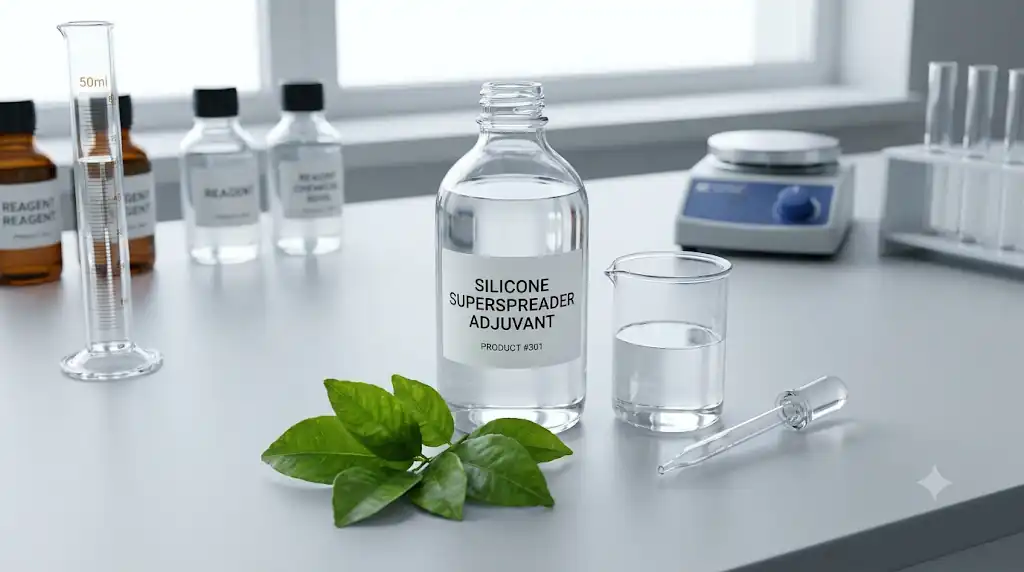
A silicone superspreader is a tank-mix additive built on a short silicon–oxygen backbone with water-loving polyether chains attached. Chemists call it a trisiloxane surfactant, and it sits inside the wider group of agrochemical adjuvants that change how a spray behaves on the plant.
That flexible silicon backbone is the secret. Plain water has a surface tension of about 72 dynes per cm (the same number as mN/m), An extension-backed organic farming guide estimates that organosilicones cut surface tension by roughly 10 dynes/cm more than other surfactants, on average. One manufacturer puts the lower limit for conventional non-silicone adjuvants at about 30 mN/m, while data sheets for trisiloxane products report roughly 20 to 22 mN/m at a 0.1% concentration. Suppliers often shorten the name to silicone spreader or super spreader, which can make product searches confusing.
How a Silicone Superspreader Works
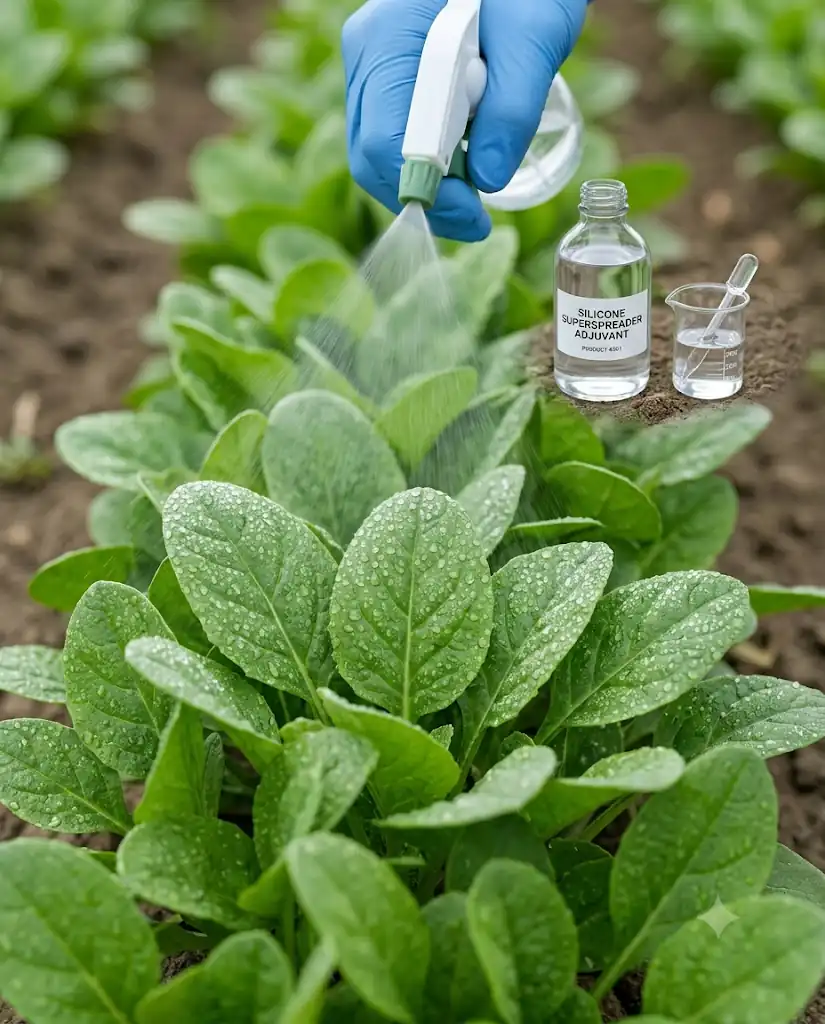
Lower surface tension means a smaller contact angle, so the droplet stops beading and runs outward. At the extreme end, called superspreading, the droplet disappears into a thin layer across the leaf. Push the rate too high and that layer can run right off the leaf, which defeats the purpose.
A wider film puts more of the active ingredient in contact with the plant. In Australian vineyard research, a modified organosilicone blend gave droplet spread up to ten times greater than the industry-standard adjuvant at recommended rates.
Under certain conditions, these products can also pull spray into the stomata, the tiny pores on a leaf. This is the usual explanation for faster rainfastness. In a greenhouse study on velvetleaf, organosilicone surfactants sharply improved the rainfastness of a herbicide even when simulated rain arrived 15 minutes after treatment.
Two details are easy to miss. Stomatal entry can depend on concentration, and one data sheet says it needs 0.2% or more, which is above that product’s normal range of 0.025% to 0.1%. Also, some trisiloxane surfactant grades are designed for low stomatal infiltration, for jobs where coverage matters but rapid uptake does not.
Types and Grades: Not Every Organosilicone Superspreads
Even among trisiloxane surfactant products, grades differ in what they are built to do. Some are built for the extreme spreading described above, and many commercial organosilicone products are blends of silicone with other surfactants. One major supplier lists low-drift, low-foam, film-forming and water-conditioning versions in its range.
- Superspreader grades: built for extreme spreading and, under certain conditions, entry into stomata.
- Low-infiltration grades: made for jobs where coverage matters but rapid uptake is unwanted.
- Film-forming grades: offer rainfast coverage when stomatal entry is not desired.
- Silicone blends: many commercial products combine silicone with other surfactants.
- Specialty versions: low-foam, low-drift or water-conditioning options for particular tank problems.
Silicone Superspreader vs NIS vs Oil Adjuvants
Most spray programs begin with a nonionic surfactant. According to Penn State Extension, nonionic surfactants are the most commonly used type and suit most registered pesticides, while organosilicone surfactants are the newer group that reduce surface tension, increase spreading and improve rainfastness.
| Adjuvant type | Best for | Watch out for |
| Nonionic surfactant (NIS) | General use; the most commonly used type | Less spreading than a superspreader |
| Silicone spreader | Hard-to-wet foliage, coverage, rain risk | Runoff and heat injury; check the label |
| Crop oil or methylated seed oil | Getting the active through a waxy cuticle | Leaf burn in hot weather |
Oils and silicones solve different problems. Oils help the active cross a waxy cuticle, while a silicone superspreader mainly improves spread. Using the wrong surfactant can cut effectiveness and raise the risk of plant injury, so match the type to the label.
Where It Helps Most
Manufacturers list uses with herbicides, insecticides, fungicides, plant growth regulators and foliar fertilizers or micronutrients. The common thread is a surface that repels water, such as a waxy leaf. Rain risk is another reason growers reach for an organosilicone adjuvant, because faster uptake can shorten the vulnerable window after spraying.
Be careful with the water-saving story. Suppliers say better spread lets you cut spray volume. Vineyard trials were mixed: some low-volume sprays matched high-volume results, but others lost deposit through over-wetting, and the researchers advised against organosilicones in high-volume fungicide sprays.
Spray drones are a newer use. They apply far less water than ground rigs, with 12 liters per hectare used in one maize trial, so how each droplet spreads matters even more. Trials of aerial-spray adjuvants have reported better droplet deposition and coverage, but the gain depends on the formulation: in that maize trial, adjuvants improved a water-dispersible granule mix and had no significant effect on an ultra-low-volume formulation. Those trials tested aerial adjuvants in general, so they say nothing specific about a silicone superspreader. Test any drone claim on your own mix, and keep the drift risk from finer droplets in mind.
Also remember that an adjuvant is not always needed. Some pesticide labels advise against adding one, so it should never be added by habit.
Rates, pH and Mixing Rules
Rates depend on the product, so the label wins. One supplier lists 0.01% to 0.05% for insecticide and fungicide sprays and 0.025% to 0.1% for herbicides, and another gives 0.025% to 0.1%. At 0.1%, a silicone spreader works out to just 1 mL per liter of spray.
Here is what those percentages mean in the tank. The amounts are product volume per spray volume, so check them against your own label.
| Spray volume | 0.025% | 0.05% | 0.1% |
| 15 L knapsack | 3.75 mL | 7.5 mL | 15 mL |
| 100 L | 25 mL | 50 mL | 100 mL |
| 200 L | 50 mL | 100 mL | 200 mL |
Water chemistry matters too. An organosilicone adjuvant breaks down in strongly acidic or alkaline water. A widely used grade is labeled for best results between pH 6 and 8, with weaker performance below pH 5 or above 9, and some labels ask you to spray within 24 to 36 hours of mixing.
Mixing order counts as well. Follow the pesticide and adjuvant labels, and jar test with your own water: shake the combined jar, let it stand for 15 minutes, then look for scum, gels or separation. Some labels call for lower-than-normal agitation after adding the spreader.
One more boundary: a spreader is not a compatibility fix. When a mix clumps or separates, Penn State points to compatibility agents and jar testing, while emulsifiers keep oily ingredients mixed with water. Each of the tank-mix adjuvants has its own job.
A Simple Mixing Checklist
- Read both the pesticide label and the adjuvant label for permission, rate and mixing order.
- Check the pH of your water; one widely used grade works best at pH 6 to 8, and other labels list pH 5 to 8.
- Run a jar test with the same water and the same order, shake it, and let it stand for 15 minutes.
- Part-fill the tank and add products in the order the labels give.
- Add the spreader with gentle agitation where the label says so, then keep agitation low while topping up.
- Spray within the time window on the label, such as 24 or 36 hours.
- Trial a small area first and note the temperature on the day.
Silicone Super Spreader vs Silicone Antifoam
Both are silicone-based, and that is where the similarity ends. A spreader is an activator adjuvant: it lowers surface tension to improve coverage and uptake. An antifoam is a utility adjuvant: it prevents or collapses foam in the tank. Most foam-control products used in organic production are silicone-based too.
Foam forms from agitation and from the surfactants in a mix, and some spreader labels call for lower-than-normal agitation. An antifoam does a different job from a spreader. Penn State also advises using only products made for agriculture, never industrial products or household detergents.
Risks to Weigh Before You Spray
- Heat and crop injury. Organosilicones are best applied below about 90°F (32°C), because hot weather raises the risk of leaf injury. Some varieties are more sensitive, so trial a small area first.
- Runoff. Too much super spreader leaves a film so thin and fluid that it drains off the leaf.
- Finer droplets and drift. Lower surface tension tends to produce finer droplets, and droplets of about 150 microns or smaller drift easily. Choose nozzles and weather windows with that in mind.
- Bees. The evidence is mixed. In German laboratory tests, 50% of 30 insecticide–adjuvant mixes raised caged-bee mortality, and one organosilicone did so with four of five insecticides. A later semi-field trial on flowering oilseed rape found no meaningful increase. Avoid spraying where bees are foraging.
- Organic production. Synthetic silicones are prohibited in organic crop production, and only some products qualify, so confirm with your certifier first.
- Local rules. Some labels carry aquatic-use restrictions, and a few US states require adjuvants to be registered.
Common Mistakes to Avoid
- Adding extra because the spread looks good. Too much product can flow right off the leaf.
- Spraying during a hot spell, above about 90°F.
- Ignoring water pH, or letting the mix stand past the label’s time window.
- Skipping the jar test on a new combination.
- Assuming it suits every product, when some labels advise against any adjuvant.
- Using an industrial product instead of an agricultural adjuvant.
- Spraying over blooms while bees are foraging.
- Expecting it to fix an incompatible mix.
How to Choose the Right Grade
- Confirm that the pesticide label permits organosilicone adjuvants at all.
- Ask for the technical data sheet: trisiloxane surfactant content, surface tension at 0.1% (around 22 mN/m or lower for a superspreader grade) and pH stability.
- Decide whether you want stomatal entry or only better coverage, and pick the grade to match.
- If your mix includes spray oils or emulsifiable concentrates, ask whether the grade is built for that. Some are.
- Ask for a certificate of analysis with each lot and compare its surface tension with the data sheet value.
- Check shelf life and storage advice; one data sheet lists 12 months.
- Be wary of miracle claims. No single adjuvant fixes every spray problem.
Frequently Asked Questions
What is a silicone superspreader used for?
It is added to the spray tank so droplets spread across hard-to-wet leaves instead of beading up. It is used with herbicides, insecticides, fungicides, growth regulators and foliar nutrients, and it often helps rainfastness when the label allows.
How much silicone superspreader should I add per liter of water?
Follow the product label. Many grades fall between 0.01% and 0.1% of the spray volume, which is about 0.1 to 1 mL per liter, or 1.5 to 15 mL for a 15-liter knapsack. Going higher risks runoff.
Is a silicone superspreader the same as a normal surfactant?
No. One manufacturer puts the lower limit for conventional adjuvants at about 30 mN/m, while trisiloxane grades report roughly 20 to 22 mN/m. That is why it needs closer attention to pH, heat and crop sensitivity.
Does a silicone superspreader make a spray rainfast?
It often helps, mainly by drawing spray into leaf pores. One greenhouse study showed better rainfastness even when rain came 15 minutes after spraying. Results still depend on the active ingredient, the grade and the concentration, so check the label.
Can a super spreader harm plants or bees?
It can if misused. Hot weather and sensitive varieties raise the chance of leaf injury, and too much product can run off. Bee data are mixed, with some lab tests showing higher mortality when an organosilicone is paired with certain insecticides and a field-style trial finding no meaningful effect. Keep sprays away from foraging bees and test a small area first.
Bottom Line
A silicone superspreader is a powerful tool for helping a spray cover difficult leaves, but that strength comes with risks. Use it when the label allows, mix it at the lowest effective rate, mind the pH and the weather, and keep bees and organic rules in view. Start with a jar test and a small trial, and let the results, not the hype, decide how far you take it.