
Silicone became the default swim cap material because it doesn’t trigger the allergic reactions some swimmers get from latex, and because it holds up to chlorine and repeated use far better. But “silicone” covers a real range of quality, and the manufacturing standards behind a genuinely good cap are more specific than most packaging lets on — exact hardness ranges, tear-strength minimums, and chemical-safety limits that most swimmers never see. This piece explains what’s actually inside a silicone cap, what trade-offs still exist compared with latex, and how to tell a well-made cap from a merely mar
Key Takeaways
Silicone swim caps eliminate latex allergy risk entirely.
They’re more durable than latex, though “5x longer” claims aren’t verified.
Snugger fit and better drag reduction, but less flexible and pricier than latex.
Fit and sizing matter more than most buyers expect.
Best for regular or competitive swimmers; occasional swimmers may prefer latex.
What “Silicone” Actually Means Here
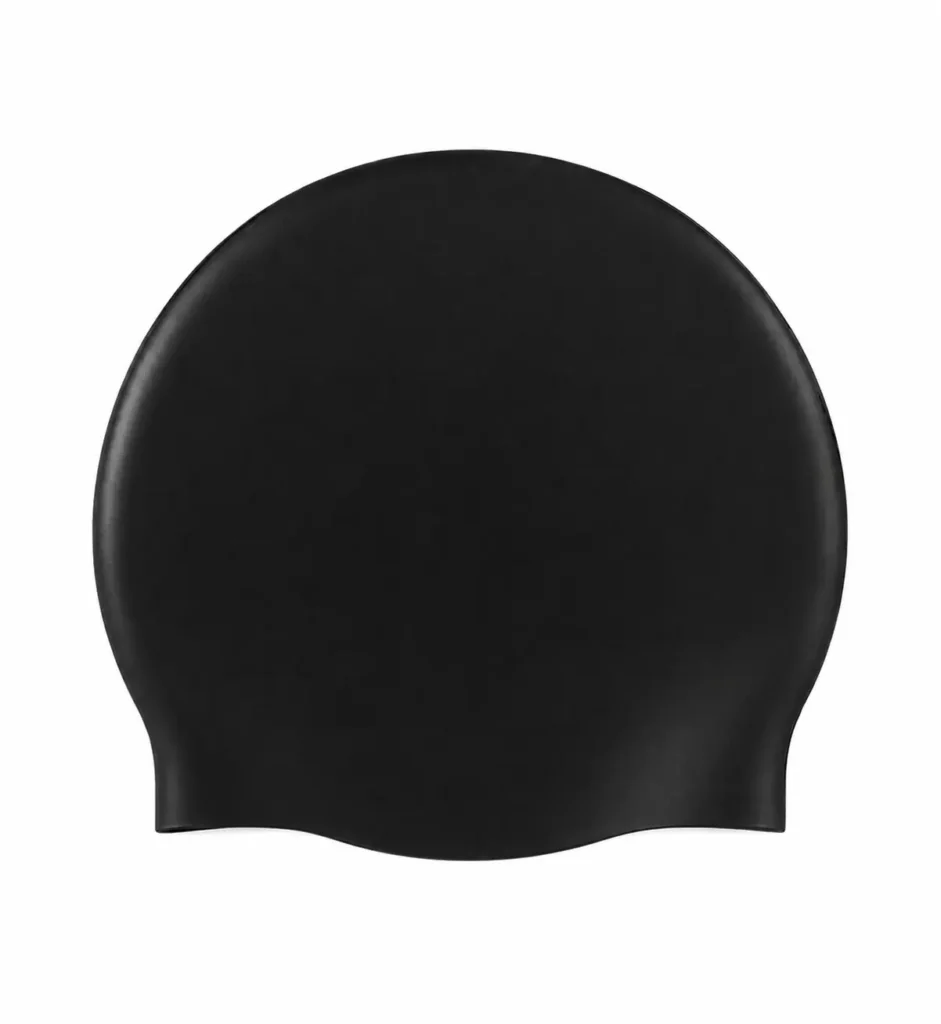
Silicone Swim cap is a rubber compound, not a single fixed material. Manufacturers work with two main types: high-temperature vulcanized (HTV) silicone and liquid silicone rubber (LSR), the latter suited to fully automated injection molding. Most cap-grade formulations target a Shore A hardness of roughly 20–30 — a specific softness range, not a coincidence. Go softer than that and the cap loses its snap and tends to sag or loosen; go firmer and it feels tight and uncomfortable on the head. On top of the base rubber, a typical formulation blends in reinforcing fillers like nano-silica (which also contributes some antibacterial and heat-dissipating properties), plus small amounts of stabilizers and, in higher-end caps, UV absorbers to slow long-term aging.
The curing step matters too. Better manufacturers use a platinum-catalyzed addition-cure system rather than older peroxide-based curing, mainly because it avoids leaving reactive by-products in the finished rubber — relevant if a product is going to sit against your skin for an hour several times a week. A secondary “post-cure” bake (extended heating after the initial molding) further stabilizes the cap’s dimensions and clears out residual odor and any surface exudation, which is one reason a cheap cap sometimes smells strongly of rubber right out of the packet while a properly finished one barely smells at all.
Why Silicone Took Over From Latex
The material’s rise has a fairly simple origin story: latex caps, while cheap and comfortable, cause real allergic reactions in some swimmers, and manufacturers turned to silicone specifically because it doesn’t carry that same risk. Once that switch happened, a few side benefits followed naturally. Silicone tolerates chlorine exposure much better than latex, which chemically degrades and perishes with repeated exposure. It’s also thicker and more structurally stable, so it can be molded into more elaborate shapes — the dome-style racing caps, chin-strap styles, and novelty shapes you see today are silicone specifically because the material holds complex geometry in a way latex doesn’t.
That extra thickness has a secondary, often-overlooked benefit: it keeps the head warmer in cold water, simply because there’s more insulating material between your scalp and the water. It’s a real physical effect, not a marketing add-on — though it’s worth noting plainly that no cap, silicone included, keeps hair genuinely dry. Water still gets in around the ears and the neckline; a cap reduces exposure rather than eliminating it entirely.
The Trade-Offs Nobody Puts on the Packaging
Because most of what you read about silicone caps comes from people selling them, the downsides tend to get quietly skipped. There are a few worth knowing before you buy:
- Cost. Silicone caps generally cost more than latex, for the simple reason that they use more material and a more involved curing process.
- Comfort trade-off. Precisely because it’s thicker and less flexible than latex, silicone can feel more constricting around the head — some swimmers genuinely find latex more comfortable for shorter sessions, even while preferring silicone’s durability and hair-friendliness for regular training.
- Grip is a middle ground, not a guarantee. Silicone tends to slip slightly more than latex during vigorous swimming, but noticeably less than looser lycra/fabric caps — so a snug, correctly sized fit still matters more than the material label alone.
None of these make silicone a worse choice for most swimmers — they just mean “silicone is always strictly better” isn’t quite accurate. It’s a different set of trade-offs, weighted in most swimmers’ favor for regular use, but not a free upgrade in every respect.
What Quality Standards Actually Require
This is the part almost no consumer-facing page covers, and it’s genuinely useful for judging whether a cap is well made. Industry manufacturing and testing guidance for silicone swim caps sets specific, checkable numbers — not just a general promise of “quality silicone”:
| Property | Typical Requirement |
| Tensile strength | At least 10 MPa |
| Elongation at break | At least 500% |
| Resilience (shape recovery) | At least 85% |
| Tear strength | At least 30 kN/m |
| Chlorine resistance | No more than 5% mass loss after 72 hours’ immersion |
| Accelerated aging test | Conditioned at roughly 40°C / 95% humidity for 168 hours |
| Skin-contact pH | 5.5–7.5, close to skin’s natural range |
| Microbial safety | No detectable Salmonella or Staphylococcus aureus |
There are chemical-safety limits behind the scenes too — caps are expected to stay under set thresholds for migratable heavy metals, volatile organic compounds, and phthalates, the kind of testing that matters because a cap sits directly against skin for extended periods, repeatedly, often in a heated and humid environment that can accelerate chemical migration. None of this is usually printed on the packaging, but it’s a reasonable set of questions to ask a manufacturer or retailer if you’re buying in bulk for a team or a swim school: does this product meet a defined tensile, tear, and chemical-safety standard, or is “silicone” the only claim being made?
Separating Real Evidence From Marketing Claims
Worth flagging directly: some marketing content about silicone caps cites vague, unlinked “studies” — for instance, claims that silicone caps last “up to 5 times longer” than latex, attributed to unnamed outlets without a traceable source. That specific figure isn’t something this article can verify, and a claim like that should be read as a marketing estimate, not an established fact, until a real source is named and checked. That doesn’t mean silicone isn’t more durable than latex — the chlorine-resistance testing above genuinely supports that it holds up better — just that the precise multiplier some pages quote isn’t something to take at face value.
| Claim | What’s Actually Supported |
| Silicone doesn’t cause the allergic reactions some swimmers get from latex | Well-established reason the material became standard |
| Silicone caps outlast latex against chlorine exposure | Supported — chlorine-resistance testing is a defined part of quality standards |
| Silicone caps last “5 times longer” than latex | Unverifiable as stated — no traceable, named source |
| Silicone caps are always more comfortable than latex | Overstated — thickness can make silicone feel more constricting for some wearers |
| A silicone cap keeps your hair fully dry | Not accurate — no cap is fully waterproof, especially around the ears and neckline |
How to Choose and Care for Yours
- Check for a snug, not painful, fit — the cap should stretch on without pinching, sitting close to the hairline.
- For team or bulk purchases, ask whether the supplier can confirm tensile, tear, and chemical-safety figures rather than relying on “silicone” alone as a quality signal.
- Rinse in fresh water after every swim, especially after chlorinated or salt water, and let it air dry fully before storing.
- Keep it away from sharp objects, jewelry, and long nails while putting it on — silicone resists stretching well but is genuinely vulnerable to snags and small punctures.
- If you’re allergic to latex or have sensitive skin, silicone remains the more dependable default — but if a specific cap still irritates your skin, the issue is more likely a specific formulation or additive than “silicone” as a whole.
Faqs
Are silicone swim caps actually better than latex?
In most practical respects, yes — they resist chlorine better, don’t carry the same allergy risk, and hold complex shapes latex can’t. But latex is thinner, cheaper, and can feel more comfortable for some wearers during shorter sessions, so “better” depends on what you’re optimizing for.
Do silicone swim caps keep your hair dry?
No swim cap does this fully. Water still gets in at the edges, especially around the ears and the nape of the neck. A silicone cap meaningfully reduces water and chlorine exposure compared with swimming bare-headed, but it isn’t a waterproof seal.
How long do silicone swim caps actually last?
There’s no single verified figure for this — be cautious of specific multipliers (like “5 times longer than latex”) quoted without a named, checkable source. What is supported is that silicone resists chlorine degradation better than latex, so it reasonably lasts longer with normal care; exactly how much longer varies by formulation and use.
Is silicone actually hypoallergenic?
Silicone doesn’t carry the natural rubber latex proteins responsible for most latex allergies, which is the main reason it became the standard alternative. That said, any specific formulation’s dyes or additives could still cause irritation in a small number of people, so “hypoallergenic” is a strong general pattern, not an absolute guarantee for every individual and every product.
Why do some silicone caps feel tighter or more uncomfortable than others?
Hardness varies by formulation — cap-grade silicone generally targets a Shore A hardness of about 20–30. A cap made with silicone outside or at the stiffer end of that range will feel noticeably tighter and less forgiving than one formulated softer, even though both are “100% silicone.”
Do silicone caps slip off more than other materials?
Silicone tends to slip slightly more than latex during vigorous swimming, but considerably less than loose-fitting lycra or fabric caps. A correctly sized, snug fit matters more for staying in place than the base material alone.
What should I look for if I’m buying silicone caps in bulk for a team?
Ask whether the supplier can confirm the cap meets defined tensile strength, tear strength, and chemical-safety figures, rather than relying on “silicone” as the only quality claim. Industry testing standards for swim caps specify concrete minimums for exactly these properties.
Can a silicone swim cap cause a skin reaction?
It’s uncommon, since silicone itself lacks the proteins that trigger most latex allergies, but a reaction to a specific formulation’s dyes, fragrance, or other additives is still possible. If irritation happens with one cap, it doesn’t necessarily rule out silicone caps generally — a different formulation may not cause the same issue.
Conclusion
Silicone earned its place as the standard swim cap material for solid, checkable reasons: it avoids the allergy risk tied to latex, resists chlorine better over time, and can be molded into shapes latex simply can’t hold. But it isn’t a strictly superior material in every respect — it costs more, can feel more constricting than latex for some wearers, and still isn’t fully waterproof. The most useful thing a buyer can do is treat vague durability claims with a bit of skepticism and, where it matters (team orders, sensitive skin, heavy daily use), ask whether a cap actually meets defined tensile-strength, tear-resistance, and chemical-safety numbers rather than taking “silicone” as a quality guarantee on its own.