Water is one of the most common causes of damage in concrete structures. When moisture enters concrete through pores, cracks, joints, or other weak points, it can gradually affect durability and lead to problems such as dampness, corrosion, staining, and surface deterioration.
Key Takeaways
- Reduces water penetration in concrete.
- Improves resistance to moisture exposure.
- Suitable for tanks, basements, foundations, and wet areas.
- Proper mixing, dosage, curing, and compaction are essential.
An integral waterproofing compound is added to concrete or cement mortar during mixing to reduce water penetration. Instead of creating a waterproof layer only on the surface, it becomes part of the concrete mix. This makes it a useful option for construction projects where concrete is regularly exposed to moisture.
What Is an Integral Waterproofing Compound?
An integral waterproofing compound is a specially formulated additive used with cement, mortar, or concrete to improve resistance to water ingress.
Concrete contains small pores and capillary channels that can allow water to move through the material. Depending on the formulation, an integral waterproofing compound can help reduce this movement by modifying the pore structure or reducing water absorption.
It is commonly used in:
- Foundations and basements
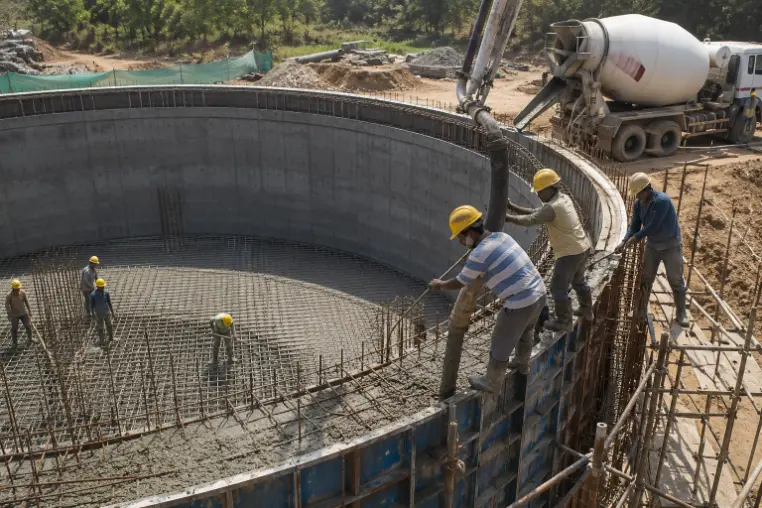
- Water tanks and reservoirs
- Bathrooms and wet areas
- Retaining walls
- Swimming pools
- Roof and terrace slabs
- Underground structures
- Concrete drains and water-related structures
The exact performance depends on the product, concrete mix, application method, and site conditions.
How Does It Work?
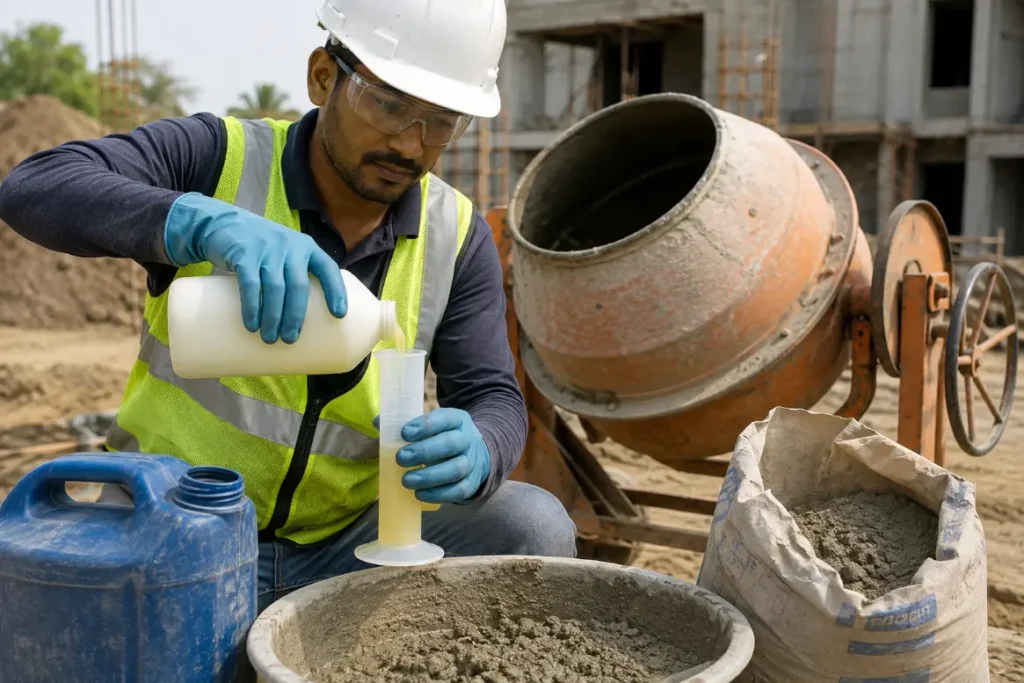
The compound is incorporated into the concrete or mortar while it is being prepared. Once mixed properly, it becomes distributed throughout the cementitious material.
A simplified process is:
Add compound → Mix with concrete → Place and compact → Cure properly → Reduced water penetration
The compound does not mean that concrete becomes completely immune to water. Poor compaction, excessive water in the mix, cracks, and badly treated joints can still allow leakage. For this reason, waterproofing should always be considered together with proper concrete construction.
Benefits of Integral Waterproofing Compound
Using an integral waterproofing compound can provide several practical advantages:
- Reduces water absorption: It helps limit the movement of moisture through concrete.
- Protection within the concrete: Since it is mixed into the material, protection is not limited to a thin surface coating.
- Useful for damp environments: It can be suitable for structures exposed to groundwater, rain, or continuous moisture.
- Supports concrete durability: Lower water penetration can help reduce some moisture-related deterioration.
- Easy to include during mixing: It can be incorporated as part of the concrete or mortar preparation process.
- Suitable for different applications: The same type of waterproofing approach can be considered for several concrete structures, depending on product specifications.
Also Read: construction chemicals
Integral Waterproofing vs. Surface Waterproofing
Both methods have a role in construction, but they work differently.
| Factor | Integral Waterproofing | Surface Waterproofing |
|---|---|---|
| Application | Added to concrete or mortar | Applied over the finished surface |
| Protection | Incorporated within the material | Mainly protects the surface |
| Timing | During concrete mixing | Before or after construction |
| Common forms | Waterproofing admixture | Coating, membrane, cementitious treatment |
| Repair | Requires attention to the concrete itself | Surface treatment can often be repaired |
| Best use | Part of concrete mix protection | External or surface-level protection |
For many projects, using both approaches may provide better overall protection, especially where water exposure is high.
How to Use an Integral Waterproofing Compound
The application process depends on the manufacturer’s instructions. In general, construction teams should:
- Check the product’s technical data sheet.
- Measure the recommended quantity accurately.
- Add it according to the specified mixing procedure.
- Ensure that it is distributed evenly throughout the mix.
- Avoid adding unnecessary water to improve workability.
- Compact the concrete properly after placement.
- Follow the recommended curing procedure.
- Pay special attention to joints, cracks, pipe penetrations, and other vulnerable areas.
Dosage should always be based on the manufacturer’s recommendations, because different formulations have different requirements.
Important Factors When Choosing a Product
Before selecting an integral waterproofing compound, consider:
- Concrete and cement compatibility
- Recommended dosage
- Required water resistance
- Setting and workability characteristics
- Compatibility with other admixtures
- Type of structure
- Exposure to water or groundwater
- Applicable project specifications
- Manufacturer’s technical support
For important construction work, conducting a trial mix before large-scale use is a sensible step.
Frequently Asked Questions
1. What is the main purpose of an integral waterproofing compound?
Its main purpose is to reduce water penetration and moisture absorption in concrete or cement mortar.
2. Can it make concrete completely waterproof?
Not by itself. Concrete quality, curing, compaction, crack control, joints, and structural detailing also have a major effect on waterproofing performance.
3. Where can integral waterproofing compounds be used?
They can be used in applications such as basements, foundations, water tanks, retaining walls, swimming pools, bathrooms, roofs, and underground concrete structures.
4. Is it better than surface waterproofing?
Neither method is universally better. Integral waterproofing protects the concrete mix, while surface systems protect exposed surfaces. The right choice depends on the structure and water exposure.
5. How much waterproofing compound should be added?
The correct dosage depends on the specific product and concrete mix. Always follow the manufacturer’s technical data sheet rather than using a general dosage.
Conclusion
An integral waterproofing compound can be a useful part of a concrete waterproofing system. By incorporating the compound into the mix, construction teams can improve resistance to moisture penetration while maintaining the normal concrete construction process.
However, the compound should not be treated as a replacement for good workmanship. Proper mix design, accurate dosing, compaction, curing, crack control, and joint detailing are equally important for achieving reliable and long-lasting waterproofing.