
Buildings and infrastructure do not last forever without maintenance. Over time, concrete can crack, steel reinforcement can corrode, water can seep into structures, and surfaces can begin to deteriorate. This is where the construction repair and rehabilitation chemical market comes in.
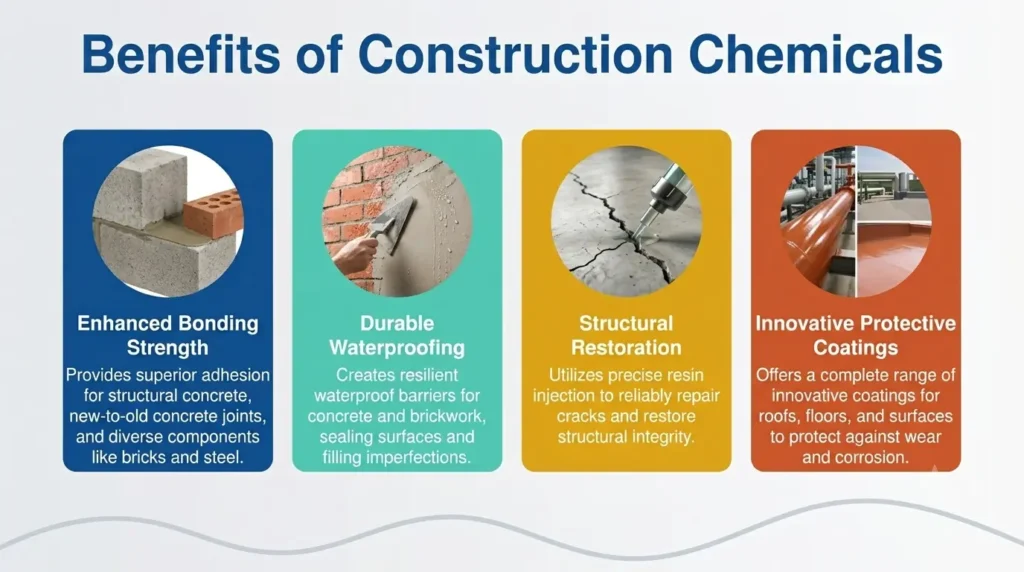
Repair and rehabilitation chemicals are used to restore damaged structures, prevent further deterioration, improve waterproofing, and extend the useful life of buildings and infrastructure. The market includes products such as repair mortars, epoxy systems, injection grouts, protective coatings, sealants, bonding agents, corrosion inhibitors, and waterproofing chemicals.
What Are Construction Repair and Rehabilitation Chemical Market?
Construction repair and rehabilitation chemicals are specialty products designed to fix or protect existing structures.
They are used for different problems depending on the condition of the building or infrastructure. For example, a contractor may use an epoxy system to repair a particular type of structural crack, while polyurethane injection material may be selected to control water leakage.
Common products include:
- Concrete repair mortars
- Polymer-modified repair mortars
- Epoxy repair compounds
- Injection grouts
- Polyurethane injection systems
- Crack fillers and sealants
- Bonding agents
- Corrosion inhibitors
- Protective coatings
- Waterproofing chemicals
- Chemical anchoring systems
- Cementitious repair materials
The right product depends on the cause of the damage, the condition of the structure, exposure to moisture or chemicals, and the required performance of the repair.

Why Is the Market Growing of Construction Repair and Rehabilitation Chemical Market?
Several factors are contributing to the growth of the construction repair and rehabilitation chemical market.
Aging Infrastructure
One of the biggest factors is the age of existing infrastructure.
Bridges, roads, tunnels, commercial buildings, water-treatment facilities, industrial plants, and other structures require regular inspection and maintenance. As these assets age, the need for concrete repair, corrosion protection, waterproofing, and structural rehabilitation increases.
Repairing an existing structure can also reduce the cost and disruption associated with complete reconstruction when the underlying structure remains suitable for continued use.
Also Read:Construction Chemicals for Flooring
Growing Infrastructure Investment
Governments and private companies continue to invest in highways, metro systems, airports, bridges, ports, water infrastructure, and urban development.
These projects create demand for construction chemicals during both the construction and maintenance stages.
According to Mordor Intelligence, infrastructure accounted for around 38.45% of global construction repair and rehabilitation chemical demand in 2025.
Urbanization
Cities are expanding rapidly, particularly in developing economies. Existing buildings also need to be maintained as urban areas become more crowded.
In many locations, demolition and reconstruction are not practical because of cost, limited space, or disruption to residents and businesses. Rehabilitation provides a way to improve the condition and service life of existing structures.
Also Read:Mortar in Construction
Major Products in Construction Repair and Rehabilitation Chemical Market
The market covers a wide range of products, each designed for a particular repair requirement.
| Product | Typical Use |
| Repair mortars | Repairing damaged concrete |
| Epoxy systems | Crack repair, bonding and structural repairs |
| Injection grouts | Filling cracks and voids |
| PU injection systems | Sealing water-bearing cracks |
| Protective coatings | Protecting concrete and steel |
| Corrosion inhibitors | Reducing reinforcement corrosion |
| Bonding agents | Improving adhesion between old and new materials |
| Sealants | Joints and movement cracks |
| Waterproofing chemicals | Preventing water penetration |
| Chemical anchors | Fixing reinforcement and structural components |
Repair Mortars
Repair mortars are widely used when sections of damaged concrete need to be restored.
Modern repair mortars can be formulated to provide good adhesion, strength, workability, durability, and controlled shrinkage. Polymer-modified products are often selected for repairs where ordinary cement-based materials may not provide the required performance.
Injection Grouting
Injection materials are used when cracks, voids, or gaps need to be filled without removing large sections of the structure.
Depending on the application, contractors may use epoxy, polyurethane, acrylic, or cement-based injection materials.
Mordor Intelligence estimates that injection grouting materials accounted for about 33.72% of the global construction repair and rehabilitation chemicals market in 2025.
Where Are These Chemicals Used?
Repair and rehabilitation chemicals are used across several parts of the construction industry.
Concrete Repair
Concrete can deteriorate because of moisture, corrosion, chemical exposure, poor construction, repeated loading, or environmental conditions.
Repair systems can be used for damaged:
- Columns
- Beams
- Slabs
- Walls
- Foundations
- Parking structures
- Bridges
- Tunnels
The visible crack or damaged area is not always the actual cause of the problem. A proper assessment is important before selecting a repair material.
Waterproofing
Water penetration is another common problem in buildings and infrastructure.
Waterproofing and injection systems are used in:
- Basements
- Roofs
- Underground structures
- Water tanks
- Bathrooms
- Tunnels
- Parking areas
- Bridges
A suitable waterproofing solution can help prevent moisture from causing more serious deterioration over time.
Corrosion Protection
Steel reinforcement inside concrete can corrode when moisture, chlorides, or other aggressive substances reach it.
A rehabilitation project may therefore involve removing damaged concrete, treating the reinforcement, applying a suitable repair material, and adding a protective coating.
India Construction Repair and Rehabilitation Chemical Market
India is an important market for Construction Repair and Rehabilitation Chemical Market because of its growing infrastructure, expanding cities, and large stock of existing buildings and public assets.
The broader Indian construction chemicals market includes products such as concrete repair materials, waterproofing systems, coatings, admixtures, flooring materials, sealants, and other specialty products.
Market estimates differ depending on which products are included. Mordor Intelligence estimates India’s overall construction chemicals market at approximately USD 2.25 billion in 2025 and forecasts it could reach around USD 4.47 billion by 2031.
This broader market figure should not be confused with the repair and rehabilitation segment alone. Different research companies use different definitions and market boundaries, so figures should be compared carefully.
Key Opportunities in the Market Construction Repair and Rehabilitation Chemical Market
There are several areas where manufacturers, distributors, contractors, and service providers can find opportunities.
Infrastructure Rehabilitation
Old bridges, roads, tunnels, water systems, and public buildings require regular maintenance.
This creates recurring demand for repair mortars, grouts, waterproofing materials, protective coatings, and corrosion-control products.
Industrial Buildings
Factories, warehouses, power facilities, chemical plants, and other industrial structures can face harsh operating conditions.
These environments may require repair and protection systems that can withstand moisture, chemicals, abrasion, heavy traffic, and temperature changes.
Commercial Buildings
Hotels, offices, hospitals, shopping centers, and other commercial properties often need repairs while remaining operational.
This creates demand for materials that can cure quickly and cause minimal disruption during application.
Sustainable Rehabilitation
There is also growing interest in extending the life of existing structures rather than automatically replacing them.
When technically appropriate, rehabilitation can reduce demolition, material consumption, construction waste, and disruption.
This makes durable repair and protection systems increasingly relevant to sustainability discussions in construction.
Important Trends For Construction Repair and Rehabilitation Chemical Market
Better-Performing Repair Materials
Customers are becoming more interested in durability and long-term performance instead of choosing products based only on their initial price.
Faster Repair Solutions
Roads, industrial facilities, commercial buildings, and other assets often cannot remain out of service for long.
This is increasing interest in rapid-setting and fast-strengthening repair materials.
Environmentally Considerate Products
Environmental requirements are influencing product development. Manufacturers are working on formulations with lower emissions and improved environmental characteristics.
Complete Repair Systems
Contractors increasingly need more than a single chemical product. A successful repair may involve several stages:
Inspection → Surface Preparation → Repair → Waterproofing → Protection → Maintenance
Companies that can provide suitable products along with technical guidance and application support can have an advantage.
Challenges Facing for The Construction Repair and Rehabilitation Chemical Market
The market also has its share of challenges.
Some of the major ones include:
- Fluctuating raw material prices
- Competition from low-cost products
- Shortage of trained applicators
- Incorrect product selection
- Poor surface preparation
- Improper mixing or application
- Quality differences between products
- Delayed project payments
- Limited technical awareness among smaller contractors
It is important to remember that a good repair chemical does not automatically guarantee a good repair. Surface preparation, application technique, curing conditions, and proper diagnosis all have a major impact on the final result.

Future Outlook
The need to maintain aging infrastructure will continue, while urbanization and infrastructure investment will create additional demand. India and other developing markets could offer particularly strong opportunities as their infrastructure networks expand and existing structures require more maintenance.
Areas such as concrete repair, injection grouting, waterproofing, corrosion protection, protective coatings, and rapid repair materials are likely to remain important.
For manufacturers and suppliers, the opportunity is not simply to sell another construction chemical. The bigger opportunity is to understand the actual problem a structure is facing and provide a repair solution that is technically appropriate, durable, and practical to apply.
Frequently Asked Questions
What are construction repair and rehabilitation chemicals?
They are specialty construction materials used to repair, restore, waterproof, strengthen, and protect existing structures.
What are the most common repair chemicals?
Common products include repair mortars, epoxy systems, injection grouts, polyurethane systems, bonding agents, sealants, corrosion inhibitors, waterproofing materials, and protective coatings.
Why is the repair and rehabilitation market growing?
Aging infrastructure, urbanization, infrastructure investment, increasing maintenance requirements, and the need to extend the service life of buildings are major factors.
Is the Indian market growing?
Yes. India’s broader construction chemicals market is expected to grow over the coming years, supported by construction activity, infrastructure development, urbanization, and maintenance of existing assets.
What is the difference between repair and rehabilitation?
Repair generally focuses on fixing specific damage or defects. Rehabilitation is broader and may involve repairing, strengthening, protecting, and upgrading an existing structure so that it can continue to perform effectively.
What factors should be considered when choosing a repair chemical?
The cause of damage, substrate condition, crack characteristics, moisture exposure, structural requirements, environmental conditions, application method, curing time, and expected service life should all be considered.