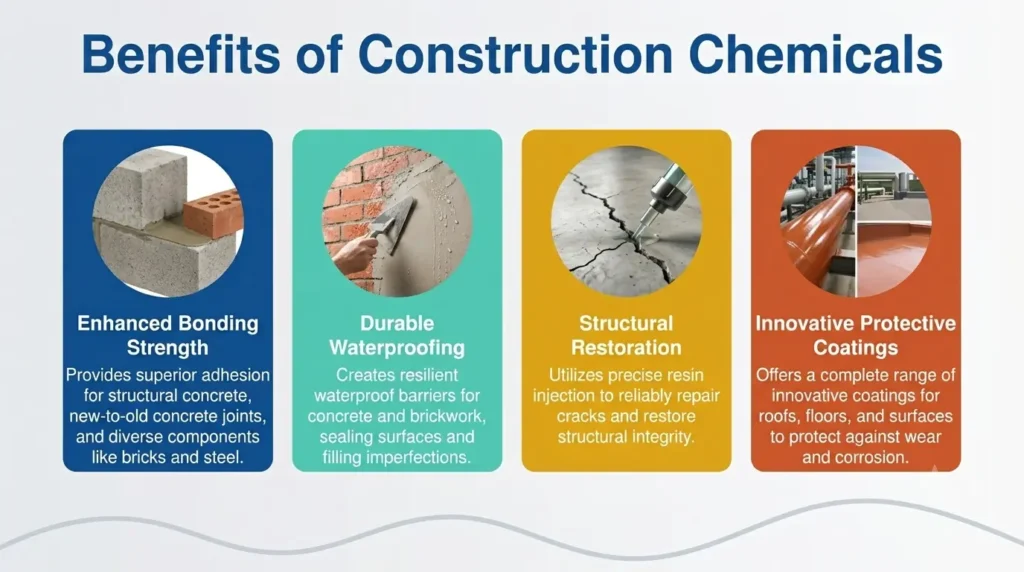
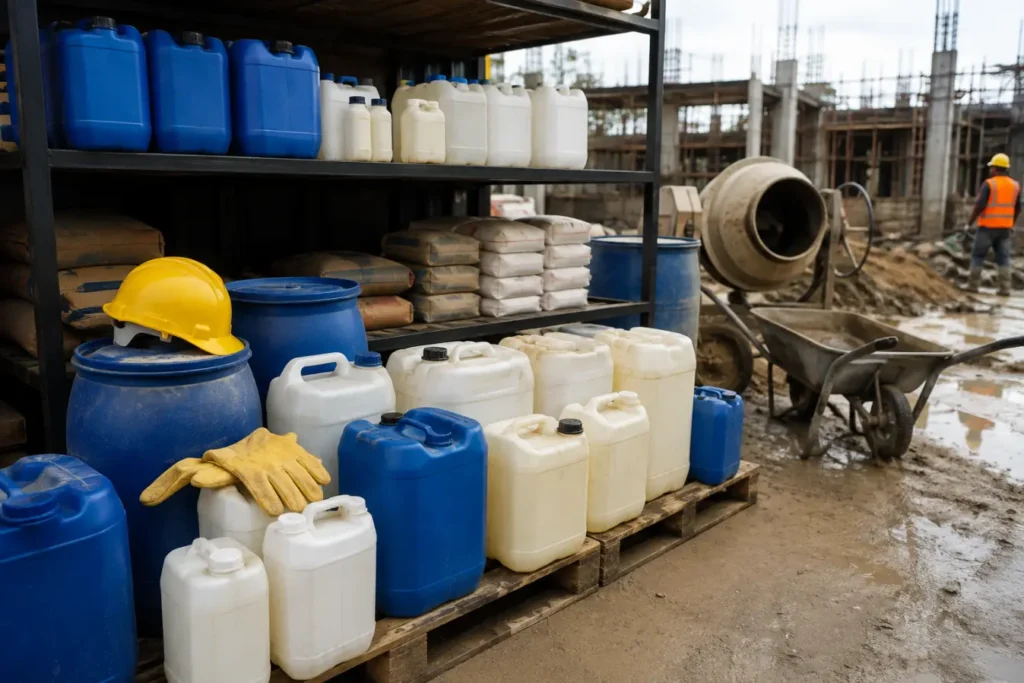
Water is one of the common causes of concrete deterioration. When moisture enters concrete through pores, cracks, joints, or weak areas, it can gradually affect the structure. Over time, water penetration may lead to dampness, corrosion of reinforcement, surface damage, and costly maintenance.
Key Takeaways
- Reduces water penetration in concrete.
- Improves concrete durability and moisture resistance.
- Useful for basements, foundations, tanks, and walls.
- Works best with proper mixing, compaction, and curing.
A waterproofing admixture can help reduce this problem. It is added to concrete or mortar during mixing to lower water permeability and improve resistance to moisture. These admixtures are commonly used in foundations, basements, water tanks, retaining walls, roofs, tunnels, and other structures that are regularly exposed to water.
Also Read:Admixture:Uses and Applications
What Is a Waterproofing Admixture?
A waterproofing admixture is a chemical additive mixed with concrete or mortar to reduce its ability to absorb and transmit water. Depending on the formulation, it may work by reducing capillary pores, making pore surfaces water-repellent, or forming materials that block small water pathways inside the concrete.
However, an admixture should not be treated as a complete replacement for a waterproofing system. Concrete quality, mix design, curing, joint treatment, drainage, and crack control also have a major effect on waterproofing performance.
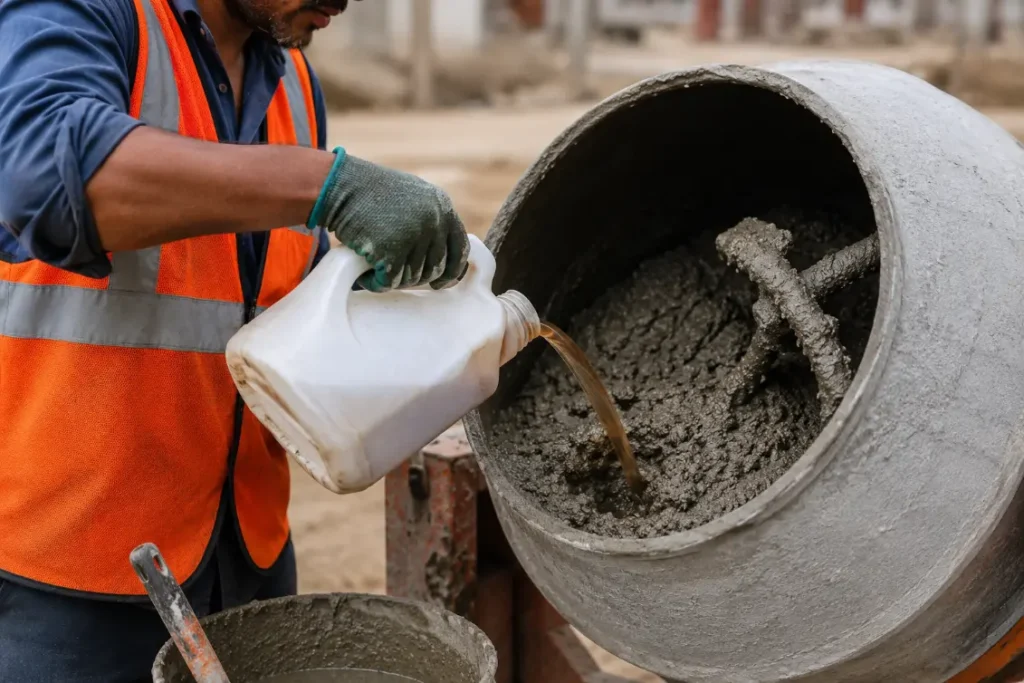
How Does Waterproofing Admixture Work?
Concrete contains small pores and capillaries that can allow water to move through it. A suitable admixture helps reduce these pathways or limits water movement through them.
Common mechanisms include:
- Reducing permeability: Helps make the concrete matrix less open to water movement.
- Water-repellent action: Some products reduce the ability of concrete pores to absorb water.
- Pore blocking: Certain admixtures help block capillary channels within the cement matrix.
- Crystalline action: Some formulations create insoluble crystalline structures that help seal fine pathways.
The actual performance depends on the product, concrete mix, dosage, curing, and site conditions.
Types of Waterproofing Admixtures
Different products are designed for different applications. Common types include:
| Type | Main Function | Typical Uses |
|---|---|---|
| Integral waterproofing admixture | Reduces water permeability | Foundations, slabs, walls |
| Crystalline admixture | Helps block capillary pathways | Basements, tanks |
| Hydrophobic admixture | Reduces water absorption | Concrete and masonry |
| Pore-blocking admixture | Limits moisture movement | Underground structures |
| Water-reducing admixture | Reduces water demand while improving workability | Structural concrete |
The right choice depends on the concrete specification and the conditions in which the structure will be used.
Benefits of Waterproofing Admixture
Using a suitable waterproofing admixture can provide several practical benefits:
- Helps reduce water penetration through concrete
- Can improve resistance to moisture-related deterioration
- Helps protect embedded reinforcement from moisture exposure
- Suitable for new concrete construction
- Can be used in underground and water-retaining structures
- Works within the concrete rather than only on the surface
- Can complement membranes, coatings, sealants, and other waterproofing methods
Where Is Waterproofing Admixture Used?
Waterproofing admixtures are used in many types of construction, including:
- Building foundations
- Basement walls and floors
- Retaining walls
- Water storage tanks
- Swimming pools
- Concrete roofs and terraces
- Tunnels and underground structures
- Parking areas
- Drainage and sewage structures
- Concrete pipes
They are especially useful where concrete is expected to remain in contact with groundwater, rainwater, or stored water.
How to Use Waterproofing Admixture
Correct dosage and mixing are important. Always follow the product manufacturer’s technical instructions.
- Choose the right product: Check whether it is suitable for the concrete grade and application.
- Use the recommended dosage: More admixture does not necessarily mean better waterproofing.
- Control the water-cement ratio: Excess water can increase concrete permeability.
- Mix properly: The admixture should be distributed evenly throughout the concrete.
- Compact the concrete: Proper vibration helps reduce unwanted voids and weak spots.
- Cure adequately: Good curing supports proper cement hydration and concrete development.
Waterproofing Admixture vs Surface Waterproofing
| Factor | Waterproofing Admixture | Surface Waterproofing |
|---|---|---|
| Application | Added to fresh concrete or mortar | Applied to the finished surface |
| Protection | Works within the concrete | Mainly protects the surface |
| Best suited for | New construction | New or existing structures |
| Crack repair | Not normally intended for repairs | Some systems can treat surface cracks |
| Use with other systems | Can complement membranes and coatings | Can be used as part of a wider system |
In many projects, both approaches are used together. For example, a basement may use an admixture in the concrete along with joint sealing, external membranes, drainage, and protective coatings.
Things to Check Before Selection
Before buying or specifying a waterproofing admixture, consider:
- Concrete grade and mix design
- Groundwater exposure
- Hydrostatic pressure
- Required durability
- Compatibility with other admixtures
- Setting and workability requirements
- Recommended dosage
- Site temperature and conditions
- Relevant project specifications
- Manufacturer’s technical data
A trial mix can be useful for larger projects to check workability, setting, strength, and water-resistance performance before full-scale use.
Also Read:Concrete Admixture: Selection Guide
Conclusion
A waterproofing admixture can be a useful part of concrete waterproofing, particularly in structures exposed to moisture or groundwater. It helps reduce permeability and can support better long-term durability when used correctly.
Still, good waterproofing depends on more than a chemical additive. Proper mix design, controlled water content, compaction, curing, joint treatment, crack control, and suitable drainage all need attention. Using these measures together provides a more reliable approach to protecting concrete from water damage.

Frequently Asked Questions
1. What is the main purpose of a waterproofing admixture?
Its main purpose is to reduce water permeability and moisture penetration in concrete or mortar.
2. Can waterproofing admixture stop leakage completely?
Not always. Leakage caused by major cracks, joints, construction defects, or structural movement may require additional waterproofing or repair systems.
3. Where is waterproofing admixture commonly used?
It is commonly used in basements, foundations, water tanks, retaining walls, tunnels, swimming pools, roofs, and other moisture-exposed structures.
4. Can it be added to existing concrete?
Integral waterproofing admixtures are normally added during concrete or mortar mixing. Existing concrete usually requires surface treatments, injection systems, or other repair methods.
5. Does waterproofing admixture replace curing?
No. Proper curing is still necessary. The admixture works as part of the concrete mix, while curing helps the concrete develop its intended properties.
6. How should the dosage be decided?
The dosage should be based on the manufacturer’s technical recommendations and the project’s concrete requirements. Avoid changing the dosage without proper testing.